Troisi Lopez Emahnuel, Liparoti Marianna, Minino Roberta, Romano Antonella, Polverino Arianna, Carotenuto Anna, Tafuri Domenico, Sorrentino Giuseppe, Sorrentino Pierpaolo
Institute of Applied Sciences and Intelligent Systems, National Research Council, Pozzuoli, Italy.
Department of Philosophical, Pedagogical and Quantitative-Economics Sciences, University of Studies G. D'Annunzio, Chieti-Pescara, Italy.
Heliyon. 2024 Aug 3;10(15):e35751. doi: 10.1016/j.heliyon.2024.e35751. eCollection 2024 Aug 15.
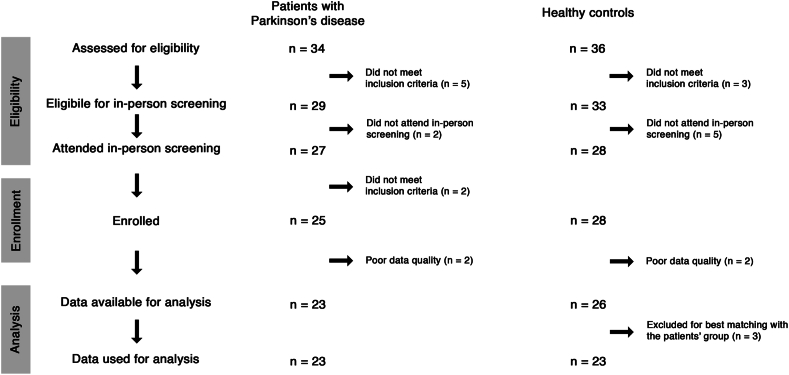
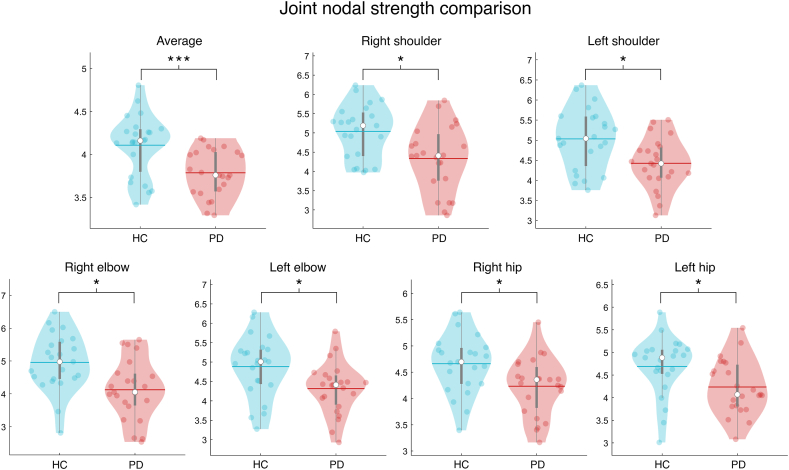
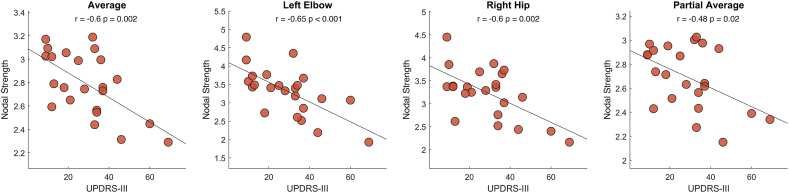
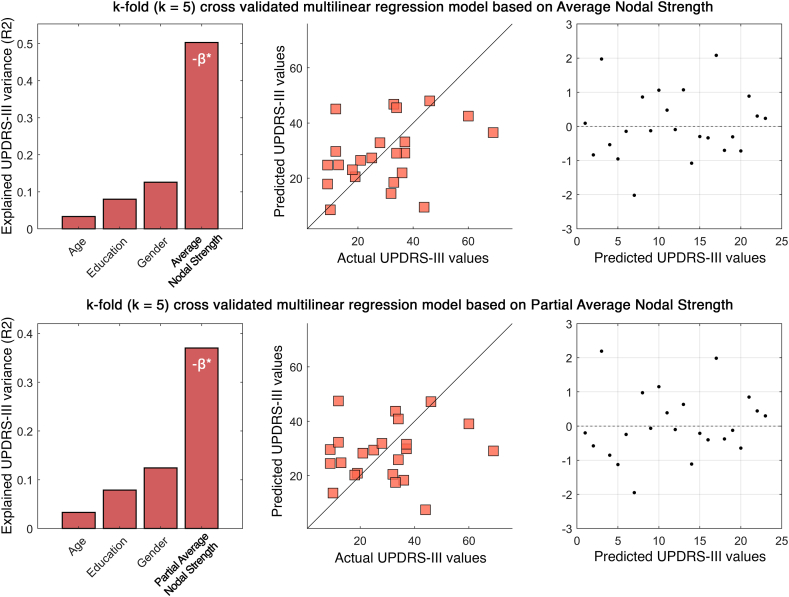
The analysis of gait kinematics requires to encode and collapse multidimensional information from multiple anatomical elements. In this study, we address this issue by analyzing the joints' coordination during gait, borrowing from the framework of network theory. We recruited twenty-three patients with Parkinson's disease and twenty-three matched controls that were recorded during linear gait using a stereophotogrammetric motion analysis system. The three-dimensional angular velocity of the joints was used to build a kinematic network for each participant, and both global (average whole-body synchronization) and nodal (individual joint synchronization, i.e., nodal strength) were extracted. By comparing the two groups, the results showed lower coordination in patients, both at global and nodal levels (neck, shoulders, elbows, and hips). Furthermore, the nodal strength of the left elbow and right hip in the patients, as well as the average joints' nodal strength were significantly correlated with the clinical motor condition and were predictive of it. Our study highlights the importance of integrating whole-body information in kinematic analyses and the advantages of using network theory. Finally, the identification of altered network properties of specific joints, and their relationship with the motor impairment in the patients, suggests a potential clinical relevance for our approach.
步态运动学分析需要对来自多个解剖学元素的多维信息进行编码和整合。在本研究中,我们借鉴网络理论框架,通过分析步态期间关节的协调性来解决这个问题。我们招募了23名帕金森病患者和23名匹配的对照者,使用立体摄影测量运动分析系统在直线步态期间对他们进行记录。关节的三维角速度用于为每个参与者构建一个运动学网络,并提取全局(全身平均同步性)和节点(单个关节同步性,即节点强度)指标。通过比较两组,结果显示患者在全局和节点水平(颈部、肩部、肘部和髋部)的协调性较低。此外,患者左肘部和右髋部的节点强度以及平均关节节点强度与临床运动状况显著相关,并可对其进行预测。我们的研究强调了在运动学分析中整合全身信息的重要性以及使用网络理论的优势。最后,特定关节网络特性改变的识别及其与患者运动障碍的关系,表明我们的方法具有潜在的临床相关性。