Boadu Vida Gyimah, Teye Ernest, Lamptey Francis Padi, Amuah Charles Lloyd Yeboah, Sam-Amoah L K
University of Cape Coast, College of Agriculture and Natural Sciences, School of Agriculture, Department of Agricultural Engineering, Cape Coast, Ghana.
Akenten Appiah-Menka University of Skills Training and Entrepreneurial Development, Department of Hospitality and Tourism Education, Kumasi, Ghana.
Heliyon. 2024 Jul 31;10(15):e35512. doi: 10.1016/j.heliyon.2024.e35512. eCollection 2024 Aug 15.
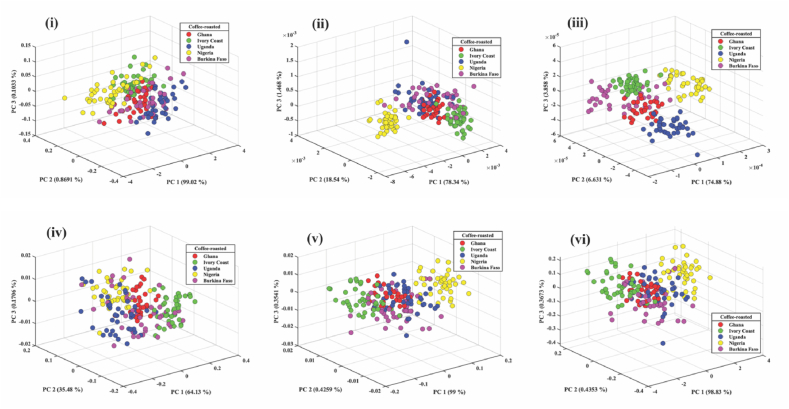
African coffee is among the best traded coffee types worldwide, and rapid identification of its geographical origin is very important when trading the commodity. The study was important because it used NIR techniques to geographically differentiate between various types of coffee and provide a supply chain traceability method to avoid fraud. In this study, geographic differentiation of African coffee types (bean, roasted, and powder) was achieved using handheld near-infrared spectroscopy and multivariant data processing. Five African countries were used as the origins for the collection of Robusta coffee. The samples were individually scanned at a wavelength of 740-1070 nm, and their spectra profiles were preprocessed with mean centering (MC), multiplicative scatter correction (MSC), and standard normal variate (SNV). Support vector machines (SVM), linear discriminant analysis (LDA), neural networks (NN), random forests (RF), and partial least square discriminate analysis (PLS-DA) were then used to develop a prediction model for African coffee types. The performance of the model was assessed using accuracy and F1-score. Proximate chemical composition was also conducted on the raw and roasted coffee types. The best classification algorithms were developed for the following coffee types: raw bean coffee, SD-PLSDA, and MC + SD-PLSDA. These models had an accuracy of 0.87 and an F1-score of 0.88. SNV + SD-SVM and MSC + SD-NN both had accuracy and F1 scores of 0.97 for roasted coffee beans and 0.96 for roasted coffee powder, respectively. The results revealed that efficient quality assurance may be achieved by using handheld NIR spectroscopy combined with chemometrics to differentiate between different African coffee types according to their geographical origins.
非洲咖啡是全球交易最活跃的咖啡品种之一,在交易这种商品时,快速识别其地理来源非常重要。这项研究很重要,因为它使用近红外技术对不同类型的咖啡进行地理区分,并提供一种供应链可追溯方法以避免欺诈行为。在本研究中,利用手持式近红外光谱和多变量数据处理实现了对非洲咖啡类型(生豆、烘焙豆和咖啡粉)的地理区分。选取了五个非洲国家作为罗布斯塔咖啡的采集地。样品在740 - 1070纳米波长下进行单独扫描,其光谱图采用均值中心化(MC)、多元散射校正(MSC)和标准正态变量变换(SNV)进行预处理。然后使用支持向量机(SVM)、线性判别分析(LDA)、神经网络(NN)、随机森林(RF)和偏最小二乘判别分析(PLS - DA)来建立非洲咖啡类型的预测模型。使用准确率和F1分数评估模型性能。还对生咖啡和烘焙咖啡类型进行了近似化学成分分析。针对以下咖啡类型开发了最佳分类算法:生咖啡豆、SD - PLSDA以及MC + SD - PLSDA。这些模型的准确率为0.87,F1分数为0.88。对于烘焙咖啡豆,SNV + SD - SVM的准确率和F1分数均为0.97;对于烘焙咖啡粉,MSC + SD - NN的准确率和F1分数分别为0.96。结果表明,结合化学计量学使用手持式近红外光谱,根据地理来源区分不同的非洲咖啡类型,可实现有效的质量保证。