Hung Yu Fan, Liu Po-Chen, Lin Ching-Hung, Lin Chao-Nan, Wu Hung-Yi, Chiou Ming-Tang, Liu Hung-Jen, Yang Cheng-Yao
Graduate Institute of Veterinary Pathobiology, National Chung Hsing University, Taichung City, 402202, Taiwan.
Animal Disease Diagnostic Center, National Chung Hsing University, Taichung City, 402202, Taiwan.
Heliyon. 2024 Aug 6;10(15):e35579. doi: 10.1016/j.heliyon.2024.e35579. eCollection 2024 Aug 15.
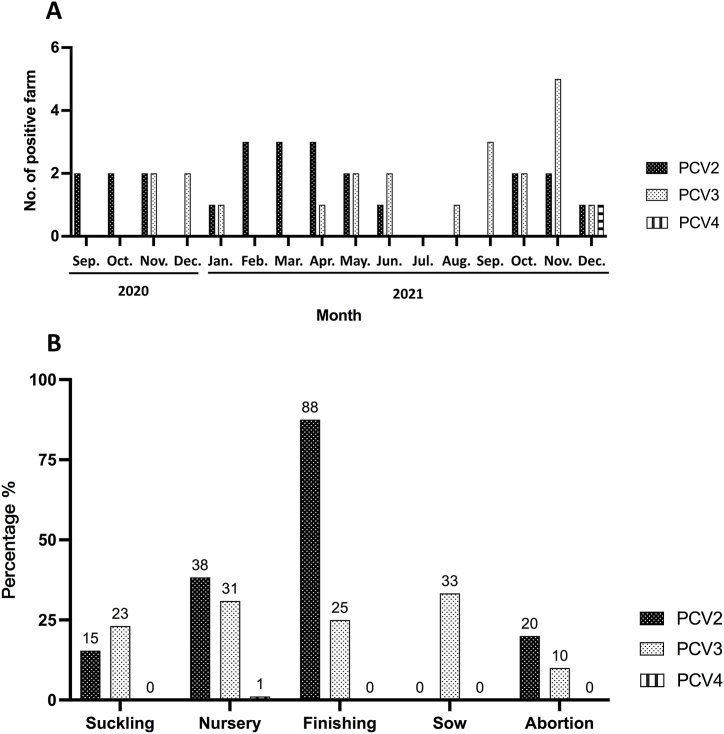
type (PCV) 2 is an important pathogen that has been circulating worldwide and has cuased serious economic loss in pig industry. However, both PCV3 and PCV4 are newly emerging viruses. In Taiwan, PCV2 has been one of the critical pathogens in pig frams and PCV3 has been detected since 2016; however, the epidemiolog of PCV3 in Taiwan remains unclear and PCV4 has yet to be identified. Therefore, in order to detect the positive rate of PCV2, to investigate the epidemiolog of PCV3 in the pig farms, and to examine whether pigs were infected with PCV4 in Taiwan, a total of 128 samples from 46 clinical cases of pigs were collected from September 2020 to December 2021. The case detection rates were 54.3 % for PCV2, 43.5 % for PCV3, and 2.2 % for PCV4. The results suggested that the positivity rates for both PCV2 and PCV3 were still high in Taiwan. In addition, PCV3 was detected among cases from all 7 sampled counties and in 11 of the 16 sampling months, suggesting that PCV3 may lead to endemic pig disease in Taiwan. Surprisingly, the PCV4 was also detected, suggesting the first PCV4 case in Taiwan. The complete genomes derived from the identified PCV3 and PCV4 strains were subsequently sequenced followed by phylogenetic analysis. The results suggested that the 17 identified PCV3 strains could be divided into Taiwanese-like and Japanese-like strains. In addition, the amino acid residues at positions 27, 80, and 212 in the identified PCV4 cap protein were asparagine, isoleucine, and methionine, respectively, and thus the identified PCV4 was catalorized into clade PCV4b. Consequently, it is concluded that (i) the prevalence of PCV2 and PCV3 is still high in Taiwanese pigs, (ii) PCV3 has may be an endemic infection in Taiwan and can be classified into Japanese-like and Taiwanese-like strains, (iii) PCV4 was detected for the first time in Taiwanese pigs and can be classified into PCV4b. It remains unclear how PCV2, PCV3, and PCV4 were introduced to Taiwan, and thus continuous investigation of emerging pathogens in pigs is needed.
猪圆环病毒2型(PCV)是一种在全球传播的重要病原体,给养猪业造成了严重的经济损失。然而,PCV3和PCV4都是新出现的病毒。在台湾地区,PCV2一直是猪场中的关键病原体之一,自2016年以来已检测到PCV3;然而,台湾地区PCV3的流行病学情况仍不清楚,PCV4尚未被发现。因此,为了检测台湾地区PCV2的阳性率,调查猪场中PCV3的流行病学情况,并检测猪是否感染了PCV4,于2020年9月至2021年12月共采集了来自46例临床病例猪的128份样本。PCV2的病例检出率为54.3%,PCV3为43.5%,PCV4为2.2%。结果表明,台湾地区PCV2和PCV3的阳性率仍然很高。此外,在所有7个采样县的病例中以及16个采样月中的11个月都检测到了PCV3,这表明PCV3可能导致台湾地区猪的地方病。令人惊讶的是,还检测到了PCV4,这表明台湾地区出现了首例PCV4病例。随后对鉴定出的PCV3和PCV4毒株的完整基因组进行测序,并进行系统发育分析。结果表明,鉴定出的17株PCV3毒株可分为台湾型和日本型毒株。此外,鉴定出的PCV4衣壳蛋白第27、80和212位的氨基酸残基分别为天冬酰胺、异亮氨酸和甲硫氨酸,因此鉴定出的PCV4被归类为PCV4b分支。因此,可以得出结论:(i)台湾地区猪中PCV2和PCV3的流行率仍然很高;(ii)PCV3在台湾地区可能是一种地方感染,可分为日本型和台湾型毒株;(iii)在台湾地区猪中首次检测到PCV4,可归类为PCV4b。目前尚不清楚PCV2、PCV3和PCV4是如何传入台湾的,因此需要持续调查猪中新出现的病原体。