Department of Neurology, Alzheimer Center Amsterdam, Amsterdam University Medical Center, location Vrije Universiteit Medical Center, Amsterdam, the Netherlands.
Amsterdam Neuroscience, Neurodegeneration, Amsterdam, the Netherlands.
Eur J Neurol. 2024 Dec;31(12):e16426. doi: 10.1111/ene.16426. Epub 2024 Aug 22.
Behavioral variant frontotemporal dementia (bvFTD) and primary psychiatric disorders (PPD), such as mood, psychotic, and autism spectrum disorders, share similar clinical characteristics of behavior and social cognition. Better understanding of clinical progression in bvFTD and PPD is essential for adequate disease monitoring and trial design.
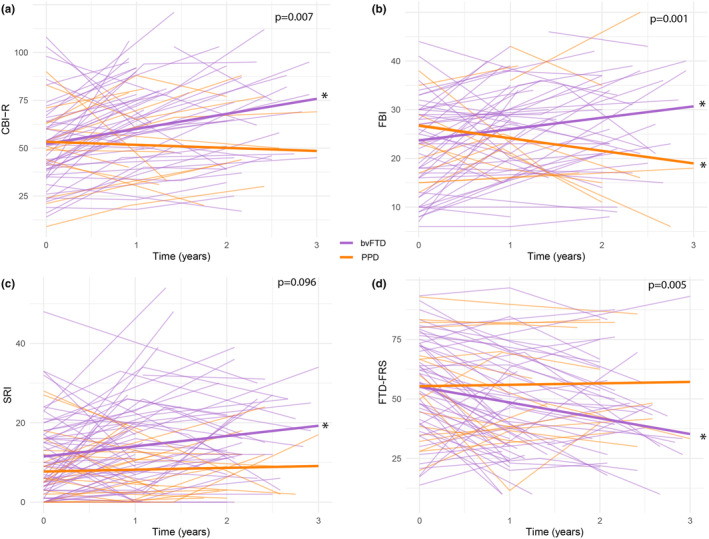
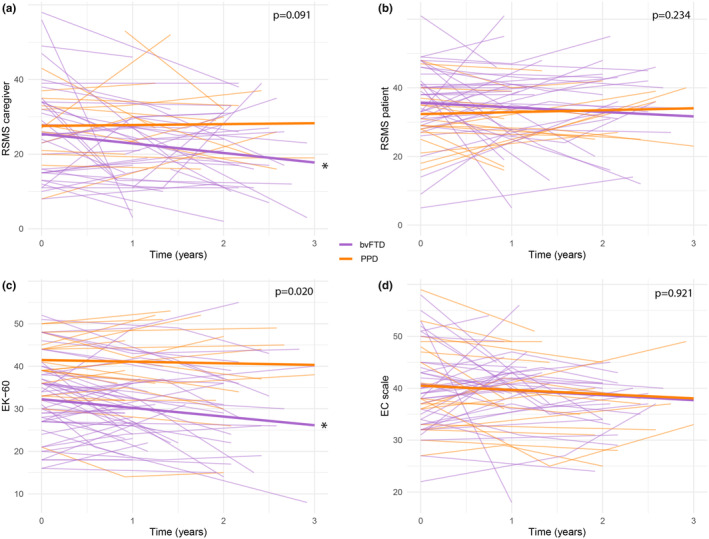
In this longitudinal study (N = 89), patients with bvFTD and PPD with at least one follow-up assessment were included from the Social Brain Project of the Alzheimer Center Amsterdam. Behavioral change and social cognitive decline were assessed via informant-rated questionnaires (Cambridge Behavioral Inventory-Revised, Frontal Behavioral Inventory [FBI], Stereotypy Rating Inventory, Frontotemporal Dementia Rating Scale, Revised Self-Monitoring Scale [RSMS]-caregiver) and patient assessment (Ekman 60-Faces Test, RSMS-patient, Emotional Contagion Scale). Clinical trajectories (median = 1.4 years, interquartile range = 1.0-2.2) were examined using linear mixed models. In a subsample, associations with baseline serum neurofilament light (sNfL) were examined.
At baseline, behavioral and social cognitive symptoms were similar between diagnosis groups, except for poorer emotion recognition in bvFTD. Over time, behavioral symptoms worsened in bvFTD, whereas most measures remained stable and the FBI improved in PPD. Regarding social cognition, emotion recognition and caregiver-reported socioemotional sensitivity worsened in bvFTD and remained stable in PPD. Patient-reported social cognitive measures did not change over time. Higher sNfL was associated with faster behavioral change.
Trajectories of behavior and social cognition differentiate bvFTD from PPD, provided that social cognition is not patient-reported. Therefore, we stress the need to optimize longitudinal social cognitive assessment in bvFTD. sNfL may be a useful prognostic marker of behavioral progression in neuropsychiatric populations.
行为变异额颞叶痴呆(bvFTD)和原发性精神障碍(PPD),如情绪、精神病和自闭症谱系障碍,具有相似的行为和社会认知临床特征。更好地了解 bvFTD 和 PPD 的临床进展对于充分的疾病监测和试验设计至关重要。
在这项纵向研究(N=89)中,从阿姆斯特丹阿尔茨海默病中心的社会大脑项目中纳入了至少有一次随访评估的 bvFTD 和 PPD 患者。通过知情者评定问卷(剑桥行为量表修订版、额叶行为量表[FBI]、刻板行为评定量表、额颞叶痴呆评定量表修订版、自我监测量表修订版[RSMS]-照顾者)和患者评估(埃克曼 60 张面孔测试、RSMS-患者、情绪传染量表)评估行为变化和社会认知下降。使用线性混合模型检查临床轨迹(中位数=1.4 年,四分位距=1.0-2.2)。在一个子样本中,还检查了与基线血清神经丝轻链(sNfL)的相关性。
在基线时,行为和社会认知症状在诊断组之间相似,除了 bvFTD 的情绪识别能力较差。随着时间的推移,bvFTD 的行为症状恶化,而大多数指标保持稳定,PPD 的 FBI 则有所改善。关于社会认知,情绪识别和照顾者报告的社会情感敏感性在 bvFTD 中恶化,在 PPD 中保持稳定。患者报告的社会认知测量在整个过程中没有变化。较高的 sNfL 与行为变化的加快相关。
行为和社会认知的轨迹将 bvFTD 与 PPD 区分开来,前提是社会认知不是患者报告的。因此,我们强调需要优化 bvFTD 的纵向社会认知评估。sNfL 可能是神经精神障碍人群行为进展的有用预后标志物。