Instituto Tecnológico Vale, Belém, Pará, Brazil.
Programa de Pós-Graduação em Genética e Biologia Molecular, Universidade Federal do Pará, Belém, Pará, Brazil.
PLoS One. 2024 Aug 22;19(8):e0308741. doi: 10.1371/journal.pone.0308741. eCollection 2024.
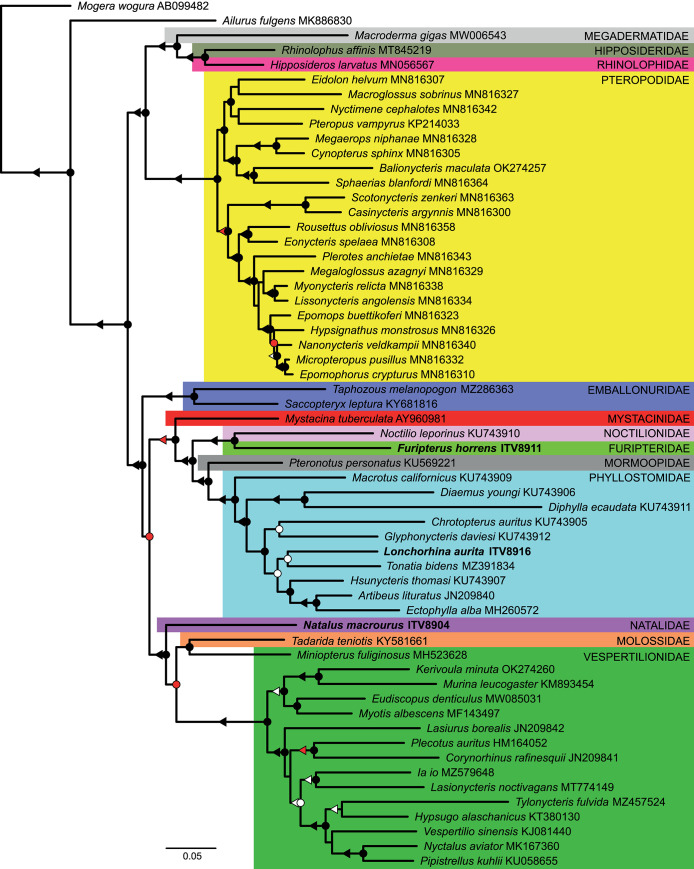
The IUCN Red List of Threatened Species contains 175 Brazilian bat species that are threatened by extinction in some degree. From this perspective, it is essential to expand the knowledge about the genetic diversity of vulnerable bats. Genomic sequencing can be useful to generate robust and informative genetic references, increasing resolution when analyzing relationships among populations, species, or higher taxonomic levels. In this study, we sequenced and characterized in detail the first complete mitochondrial genomes of Furipterus horrens, Lonchorhina aurita, and Natalus macrourus, and investigated their phylogenetic position based on amino acid sequences of protein-coding genes (PCGs). The mitogenomes of these species are 16,516, 16,697, and 16,668 bp in length, respectively, and each comprises 13 PCGs, 22 tRNA genes, two rRNA genes, and a putative control region (CR). In the three species, genes were arranged similarly to all other previously described bat mitogenomes, and nucleotide composition was also consistent with the reported range. The length and arrangement of rrnS and rrnL were also consistent with those of other bat species, showing a positive AT-skew and a negative GC-skew. Except for trnS1, for which we did not observe the DHU arm, all other tRNAs showed the cloverleaf secondary structure in the three species. In addition, the mitogenomes showed minor differences in start and stop codons, and in all PCGs, codons ending in adenine were more common compared to those ending in guanine. We found that PCGs of the three species use multiple codons to encode each amino acid, following the previously documented pattern. Furthermore, all PCGs are under purifying selection, with atp8 experiencing the most relaxed purifying selection. Considering the phylogenetic reconstruction, F. horrens was recovered as sister to Noctilio leporinus, L. aurita and Tonatia bidens shared a node within Phyllostomidae, and N. macrourus appeared as sister to Molossidae and Vespertilionidae.
世界自然保护联盟濒危物种红色名录收录了 175 种巴西受威胁蝙蝠物种,这些物种在某种程度上都面临灭绝的威胁。从这个角度来看,扩大对脆弱蝙蝠遗传多样性的认识是至关重要的。基因组测序可以用来生成强大而有信息量的遗传参考资料,提高分析种群、物种或更高分类水平之间关系的分辨率。在这项研究中,我们详细测序并描述了 Furipterus horrens、Lonchorhina aurita 和 Natalus macrourus 的第一个完整线粒体基因组,并基于蛋白质编码基因 (PCG) 的氨基酸序列研究了它们的系统发育位置。这三个物种的线粒体基因组长度分别为 16516、16697 和 16668bp,分别包含 13 个 PCG、22 个 tRNA 基因、两个 rRNA 基因和一个假定的控制区 (CR)。在这三个物种中,基因的排列与所有其他已描述的蝙蝠线粒体基因组相似,核苷酸组成也与报告的范围一致。rrnS 和 rrnL 的长度和排列也与其他蝙蝠物种一致,表现出正的 AT 倾斜和负的 GC 倾斜。除了 trnS1,我们没有观察到 DHU 臂,所有其他 tRNA 在这三个物种中都表现出三叶形二级结构。此外,线粒体基因组在起始和终止密码子方面存在微小差异,并且在所有 PCG 中,以腺嘌呤结尾的密码子比以鸟嘌呤结尾的密码子更为常见。我们发现,这三个物种的 PCG 使用多个密码子来编码每个氨基酸,遵循先前记录的模式。此外,所有 PCG 都受到纯化选择的影响,atp8 经历了最松弛的纯化选择。考虑到系统发育重建,F. horrens 被归为 Noctilio leporinus 的姐妹种,L. aurita 和 Tonatia bidens 在 Phyllostomidae 内共享一个节点,而 N. macrourus 则与 Molossidae 和 Vespertilionidae 姐妹关系。