Department of Cardiovascular Medicine, The Second Affiliated Hospital of Xi'an Jiaotong University, 157 West Five Road, Xi'an, Shaanxi, 710004, China.
Department of Cardiovascular Medicine, Zichang People's Hospital, Zichang, Shaanxi, 717300, China.
BMC Cardiovasc Disord. 2024 Aug 22;24(1):437. doi: 10.1186/s12872-024-04098-1.
Atrial Fibrillation (AF) is known to be associated with a negative emotional state. Patient-reported outcomes (PROs) are important tools for evaluating the endpoints of AF management. This study aims to examine the correlation between personality types and PROs in patients with AF.
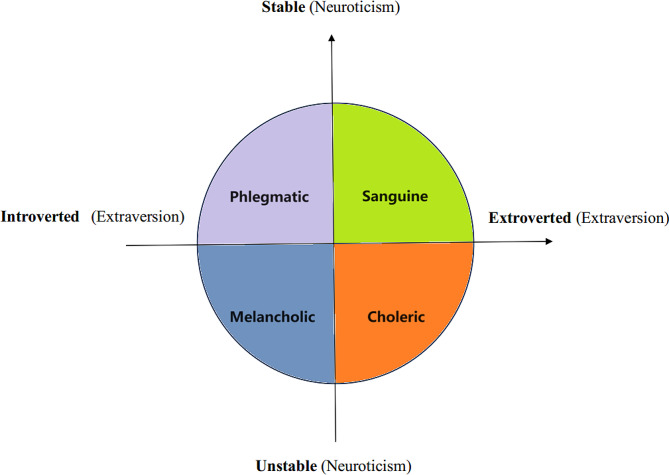
All included subjects were newly diagnosed with AF fewer than one month, and their personality types were assessed using the Eysenck Personality Questionnaire (EPQ). Quality of life (QoL) was measured using the Atrial Fibrillation Effect on Quality of Life (AFEQT) questionnaire. Anxiety and depression were assessed using the General Anxiety Scale (GAD-7) and the 9-item Patient Health Questionnaire (PHQ-9), respectively. We constructed stepwise linear regression analyses for factors related to the QoL and emotional state in patients with AF.
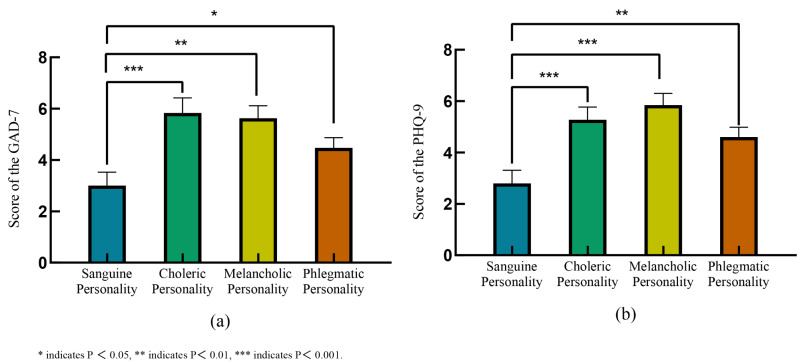
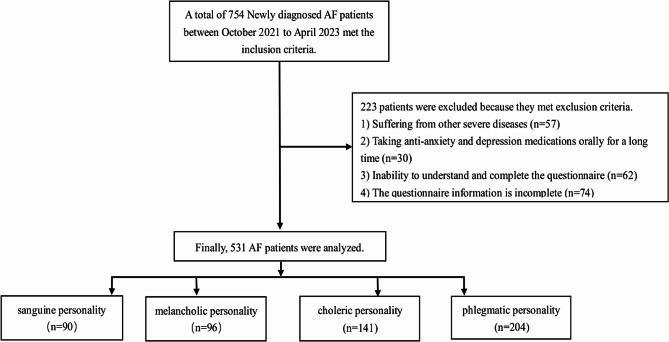
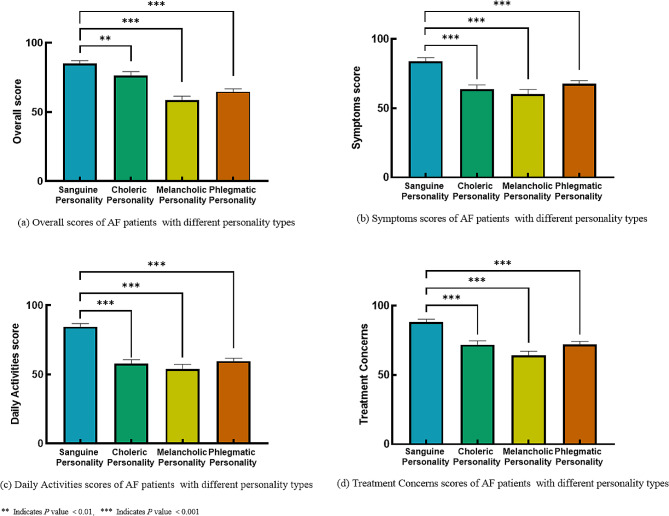
A total of 531 AF patients completed the survey and were categorized into four groups based on their personality types. Of these patients (mean age: 67.12 ± 10.93 years, 50.28% male), 357 (67.23%) had paroxysmal AF, and 16.95% (n = 90) had a sanguine personality. Compared to patients with other personality types, those with a sanguine personality had the highest average AFEQT scores (P < 0.001) and the lowest scores of GAD-7 and PHQ-9 scales (P < 0.05). Furthermore, multiple linear regression analyses suggested that sanguine personality was also independently associated with better QoL and emotional states (P < 0.05).
There is a significant association between the personality types and PROs in AF patients.
心房颤动(AF)与负面情绪状态有关。患者报告的结局(PRO)是评估 AF 管理终点的重要工具。本研究旨在探讨 AF 患者的人格类型与 PRO 之间的相关性。
所有纳入的受试者均为诊断为 AF 不足一个月的新患者,使用艾森克人格问卷(EPQ)评估其人格类型。使用房颤对生活质量的影响问卷(AFEQT)评估生活质量(QoL)。使用广泛性焦虑量表(GAD-7)和 9 项患者健康问卷(PHQ-9)分别评估焦虑和抑郁。我们构建了逐步线性回归分析,以确定与 AF 患者 QoL 和情绪状态相关的因素。
共有 531 名 AF 患者完成了调查,并根据其人格类型分为四组。这些患者(平均年龄:67.12±10.93 岁,50.28%为男性)中,357 例(67.23%)为阵发性 AF,16.95%(n=90)为乐天型人格。与其他人格类型的患者相比,乐天型人格的 AFEQT 评分平均值最高(P<0.001),GAD-7 和 PHQ-9 评分最低(P<0.05)。此外,多元线性回归分析表明,乐天型人格与更好的 QoL 和情绪状态也呈独立相关(P<0.05)。
AF 患者的人格类型与 PRO 之间存在显著关联。