Borel Liliane, Alescio-Lautier Béatrice, Léonard Jacques, Régner Isabelle
Aix Marseille Univ, CNRS, CRPN, Marseille, France.
Front Syst Neurosci. 2024 Aug 7;18:1309158. doi: 10.3389/fnsys.2024.1309158. eCollection 2024.
Stereotype threat can lead older adults to perceive their experiences in a biased manner, giving rise to interfering thoughts and negative emotions that generate stress and anxiety. Negative beliefs about aging may serve as an additional factor that increases the need for attentional demand, potentially resulting in a performance level below their actual capabilities. In the present study, we asked whether negative aging stereotypes influence a dynamic balance task and explored the means to counteract them in healthy elderly participants.
The performance of balance was compared in two groups of participants aged 65 to 75 years ( = 22) under stereotype threat or reduced-threat situation. Balance abilities were tested under dynamic conditions, requiring participants to maintain balance on a moving platform and using a gradient of difficulty (with eyes open or closed, without or with foam). Postural performance was evaluated by means of posturographic evaluation of the center of pressure displacement and motion analysis. Additionally, we investigated the effects of stereotype threat on a preferred walking speed task and on the Timed Up and Go (TUG) test.
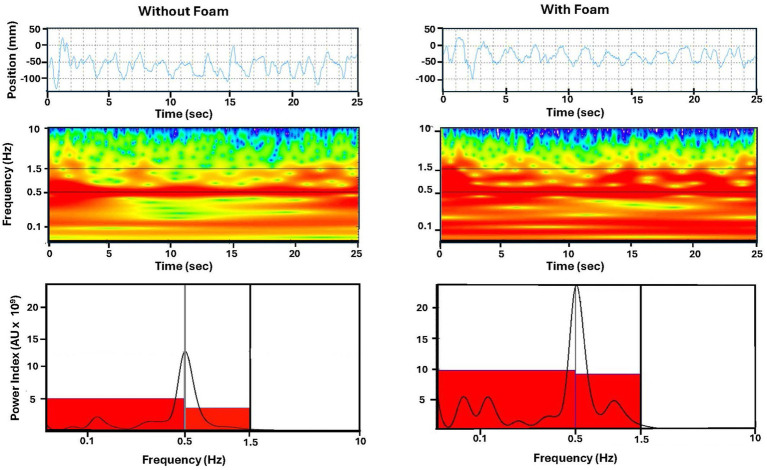
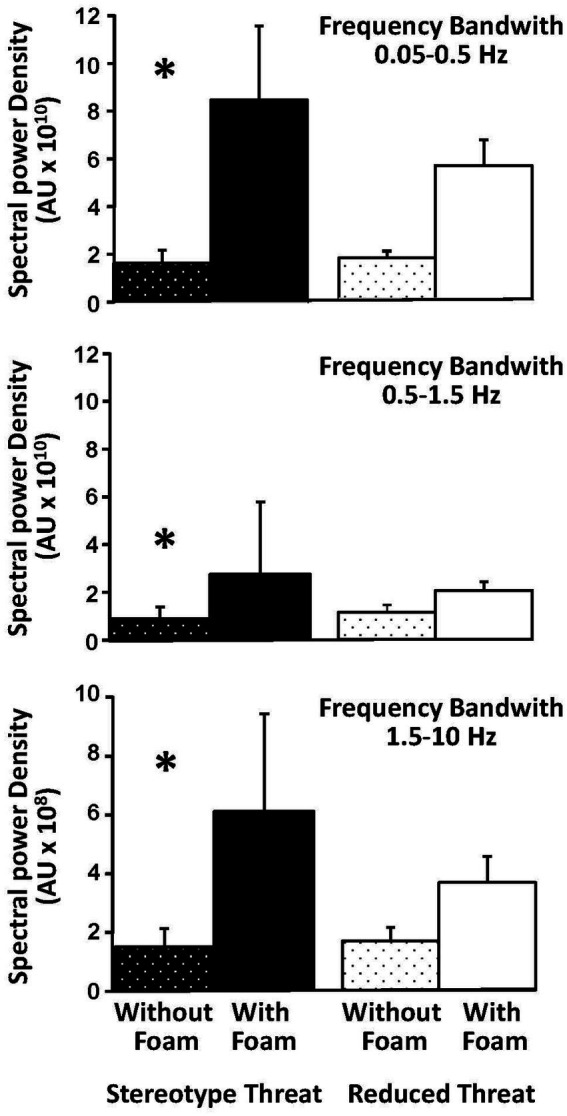
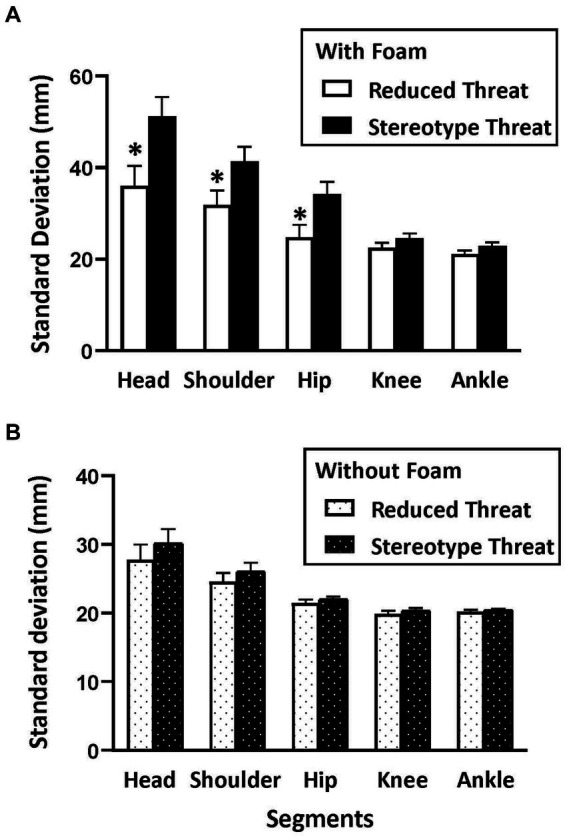
Participants under stereotype threat showed poorer balance, particularly in challenging conditions (eyes closed, on foam), with less effective body segments stabilization. Their postural stabilization on foam was worse compared to a solid surface. Conversely, those in the reduced threat condition maintained better body segment stabilization across all conditions, indicating consistent postural control regardless of the presence of foam. Stereotype threat did not affect preferred walking speed or the time to complete the "Time Up and Go" test.
DISCUSSION-CONCLUSION: This study provides the first description of age-based stereotype threat effects on a dynamic balance task and how to counteract them in healthy older adults. We suggest that the decrease in postural performance observed in participants exposed to stereotype threat can be attributed to a split in attentional focus between negative intrusive thoughts and the attention needed for maintaining balance. These findings open new perspectives on how to overcome negative expectations when evaluating and training physical abilities, thereby contributing to fall prevention among older adults.
刻板印象威胁会导致老年人以有偏差的方式看待自己的经历,引发干扰性思维和负面情绪,进而产生压力和焦虑。对衰老的负面信念可能是另一个增加注意力需求的因素,这可能导致他们的表现低于其实际能力水平。在本研究中,我们探讨了负面衰老刻板印象是否会影响动态平衡任务,并探索了在健康老年参与者中抵消这些影响的方法。
比较了两组年龄在65至75岁(每组n = 22)的参与者在刻板印象威胁或威胁降低情境下的平衡表现。在动态条件下测试平衡能力,要求参与者在移动平台上保持平衡,并使用不同难度梯度(睁眼或闭眼,无泡沫或有泡沫)。通过对压力中心位移的姿势描记评估和运动分析来评估姿势表现。此外,我们研究了刻板印象威胁对首选步行速度任务和定时起立行走(TUG)测试的影响。
处于刻板印象威胁下的参与者表现出较差的平衡能力,尤其是在具有挑战性的条件下(闭眼,在泡沫上),身体各部位的稳定效果较差。与在坚实表面上相比,他们在泡沫上的姿势稳定性更差。相反,处于威胁降低条件下的参与者在所有条件下都能更好地稳定身体各部位,表明无论是否有泡沫,姿势控制都较为一致。刻板印象威胁并未影响首选步行速度或完成“定时起立行走”测试的时间。
讨论 - 结论:本研究首次描述了基于年龄的刻板印象威胁对动态平衡任务的影响以及如何在健康老年人中抵消这些影响。我们认为,在受到刻板印象威胁的参与者中观察到的姿势表现下降可归因于负面侵入性思维与维持平衡所需注意力之间的注意力焦点分裂。这些发现为评估和训练身体能力时如何克服负面期望开辟了新的视角,从而有助于预防老年人跌倒。