Zhang Ziyang, Lv Deliang, You Yueyue, Zhao Zhiguang, Hu Wei, Xie Fengzhu, Lin Yali, Xie Wei, Wu Xiaobing
Department of Cardio-Cerebrovascular and Diabetes Prevention and Control, Shenzhen Center for Chronic Disease Control, Shenzhen, Guangdong, China.
J Family Community Med. 2024 Jul-Sep;31(3):197-205. doi: 10.4103/jfcm.jfcm_354_23. Epub 2024 Jul 17.
Diabetic retinopathy (DR) is one of the serious complications of diabetes mellitus (DM). Many studies have identified the risk factors associated with DR, but there is not much evidence on the importance of these factors for DR. This study aimed to investigate the associated factors for patients with type 2 DM (T2DM) and calculate the importance of the identified factors.
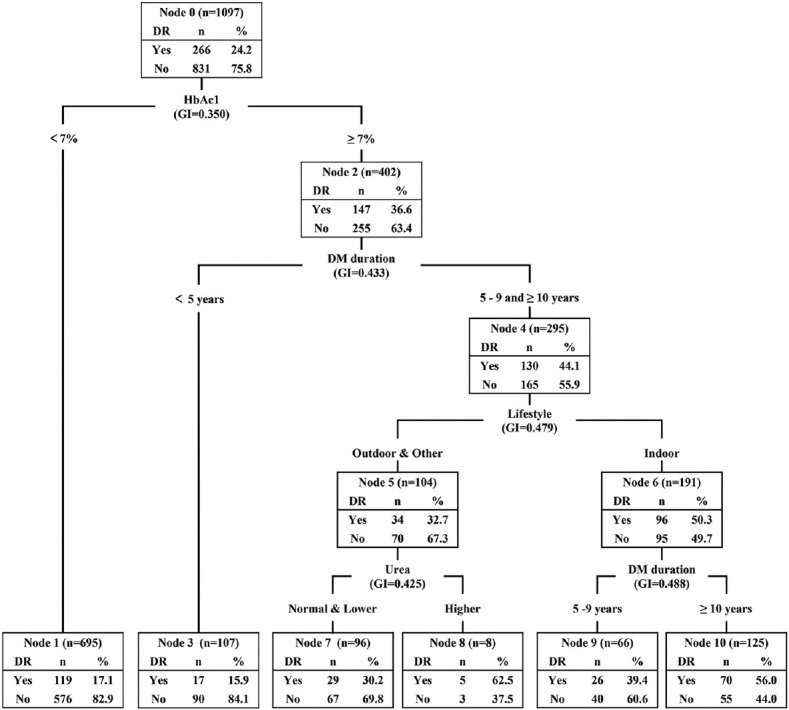
Using probability proportionate to size sampling method in this community-based cross-sectional study, 22 community health service centers were selected from 10 administrative districts in Shenzhen, China. Approximately 60 T2DM patients were recruited from each center. The participants completed a structural questionnaire, had their venous blood collected, and underwent medical examinations and fundus photography. Logistic regression models were used to identify the risk factors of DR. The classification and regression tree (CART) model was used to calculate the importance of the identified risk factors.
This study recruited 1097 T2DM patients, 266 of whom were identified as having DR, yielding a prevalence rate of 24.3% (95% confidence interval [CI]: 21.7%-26.9%). Results showed that a longer duration of DM, indoor-type lifestyle, and higher levels of hemoglobin A1c (HbA1c) or urea increased the risk of DR. Patients with HbA1c values ≥7% were about 2.45 times (odds ratio: 2.45; 95% CI: 1.83-3.29) more likely to have DR than their counterparts. The CART model found that the values of variable importance for HbA1c, DM duration, lifestyle (i.e., indoor type), and urea were 48%, 37%, 10%, and 4%, respectively.
The prevalence of DR is high for T2DM patients who receive DM health management services from the primary healthcare system. HbA1c is the most important risk factor for DR. Integration of DR screening and HbA1c testing into the healthcare services for T2DM to reduce vision impairment and blindness is urgently warranted.
糖尿病视网膜病变(DR)是糖尿病(DM)的严重并发症之一。许多研究已确定了与DR相关的危险因素,但关于这些因素对DR的重要性的证据并不多。本研究旨在调查2型糖尿病(T2DM)患者的相关因素,并计算所确定因素的重要性。
在这项基于社区的横断面研究中,采用按规模大小概率抽样方法,从中国深圳10个行政区中选取了22个社区卫生服务中心。每个中心招募约60名T2DM患者。参与者完成一份结构化问卷,采集静脉血,并接受医学检查和眼底摄影。采用逻辑回归模型确定DR的危险因素。使用分类与回归树(CART)模型计算所确定危险因素的重要性。
本研究共招募了1097名T2DM患者,其中266名被确定患有DR,患病率为24.3%(95%置信区间[CI]:21.7%-26.9%)。结果显示,糖尿病病程较长、室内型生活方式以及较高的糖化血红蛋白(HbA1c)或尿素水平会增加DR的风险。HbA1c值≥7%的患者患DR的可能性比其同龄人高约2.45倍(优势比:2.45;95%CI:1.83-3.29)。CART模型发现,HbA1c、糖尿病病程、生活方式(即室内型)和尿素的变量重要性值分别为48%、37%、10%和4%。
对于从基层医疗系统接受糖尿病健康管理服务的T2DM患者,DR的患病率较高。HbA1c是DR最重要的危险因素。迫切需要将DR筛查和HbA1c检测纳入T2DM的医疗服务中,以减少视力损害和失明。