Ayris Kirsten, Jackman Anna, Mauchline Alice, Rose David Christian
School of Agriculture, Policy, and Development, University of Reading, Reading, RG6 6UR UK.
Department of Geography and Environmental Science, University of Reading, Reading, RG6 6UR UK.
Agric Human Values. 2024;41(3):1257-1275. doi: 10.1007/s10460-024-10555-6. Epub 2024 Feb 29.
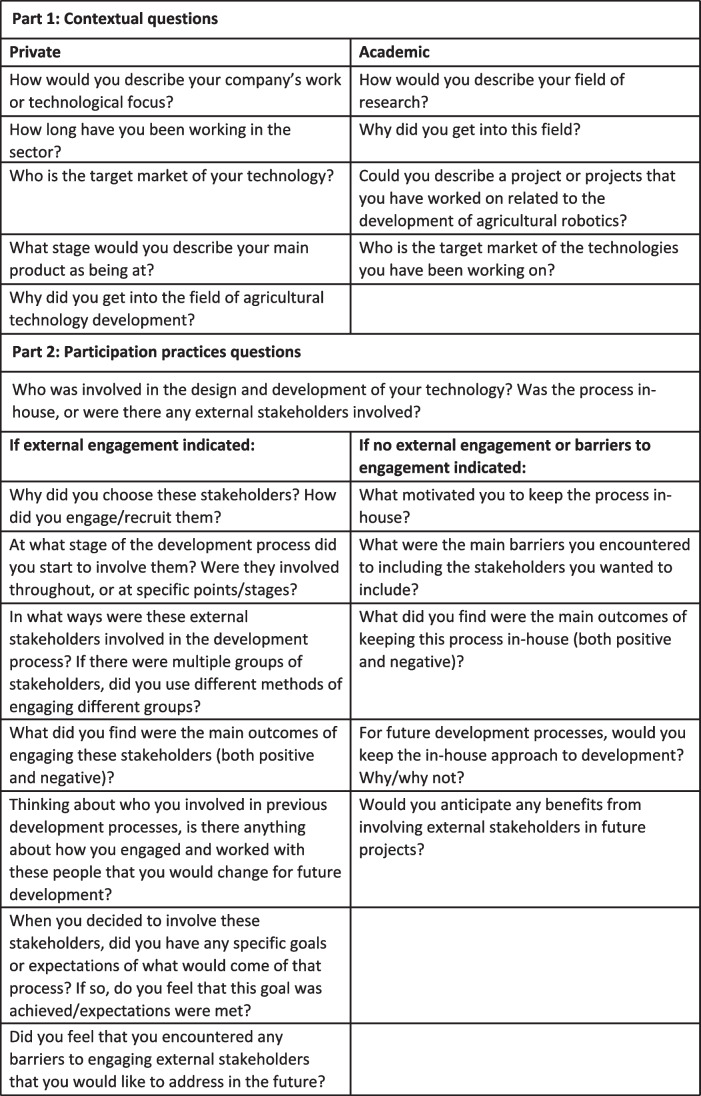
The global agricultural sector faces a significant number of challenges for a sustainable future, and one of the tools proposed to address these challenges is the use of automation in agriculture. In particular, robotic systems for agricultural tasks are being designed, tested, and increasingly commercialised in many countries. Much touted as an environmentally beneficial technology with the ability to improve data management and reduce the use of chemical inputs while improving yields and addressing labour shortages, agricultural robotics also presents a number of potential ethical challenges - including rural unemployment, the amplification of economic and digital inequalities, and entrenching unsustainable farming practices. As such, development is not uncontroversial, and there have been calls for a responsible approach to their innovation that integrates more substantive inclusion into development processes. This study investigates current approaches to participation and inclusion amongst United Kingdom (UK) agricultural robotics developers. Through semi-structured interviews with key members of the UK agricultural robotics sector, we analyse the stakeholder engagement currently integrated into development processes. We explore who is included, how inclusion is done, and what the inclusion is done for. We reflect on how these findings align with the current literature on stakeholder inclusion in agricultural technology development, and suggest what they could mean for the development of more substantive responsible innovation in agricultural robotics.
全球农业部门在迈向可持续未来的道路上面临着诸多重大挑战,而应对这些挑战所提出的工具之一便是在农业中运用自动化技术。特别是,用于农业任务的机器人系统正在许多国家进行设计、测试,并日益实现商业化。农业机器人技术常被吹捧为一种对环境有益的技术,它能够改善数据管理、减少化学投入物的使用,同时提高产量并解决劳动力短缺问题,但它也带来了一些潜在的伦理挑战,包括农村失业、经济和数字不平等的加剧,以及使不可持续的耕作方式根深蒂固。因此,其发展并非毫无争议,已经有人呼吁采取一种负责任的创新方式,将更实质性的包容性纳入发展进程。本研究调查了英国农业机器人开发者目前的参与和包容方式。通过对英国农业机器人领域关键成员进行半结构化访谈,我们分析了目前融入发展进程的利益相关者参与情况。我们探究哪些人被纳入、如何实现包容以及包容的目的何在。我们思考这些研究结果如何与农业技术发展中利益相关者包容的现有文献相契合,并探讨它们对于农业机器人更实质性的负责任创新发展可能意味着什么。