Zhou Zhen, Hughes Kgosi, Saif Nisha, Kim Hyoseon, Massett Michael P, Zheng Mingjie, Cecchi Alana C, Guo Dongchuan, Murdock David R, Pan Ping, Clinton Jelita S, Wang Jun, Greally John M, Milewicz Dianna M
Division of Medical Genetics, Department of Internal Medicine, The University of Texas Health Science Center at Houston McGovern Medical School, Houston, TX, USA.
Broad Institute of MIT and Harvard, Cambridge, MA, USA.
bioRxiv. 2024 Aug 16:2024.08.15.608063. doi: 10.1101/2024.08.15.608063.
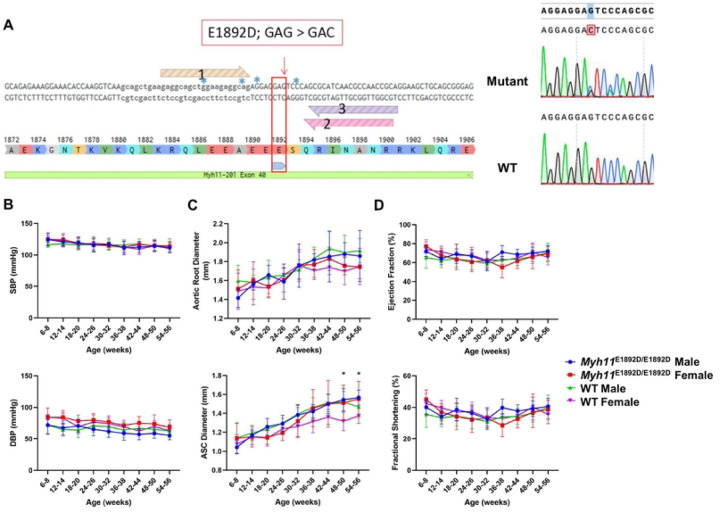
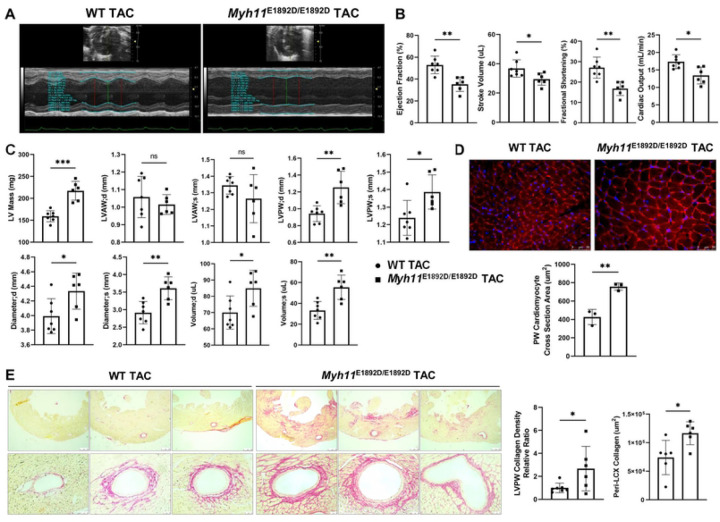
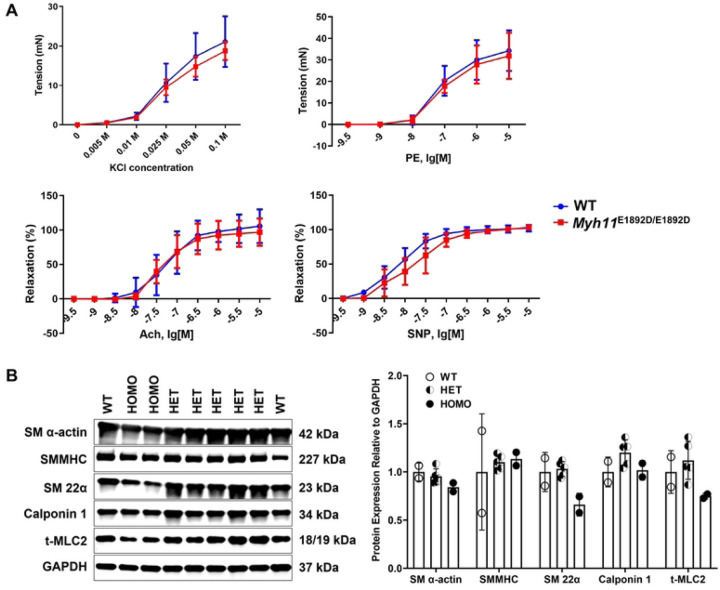
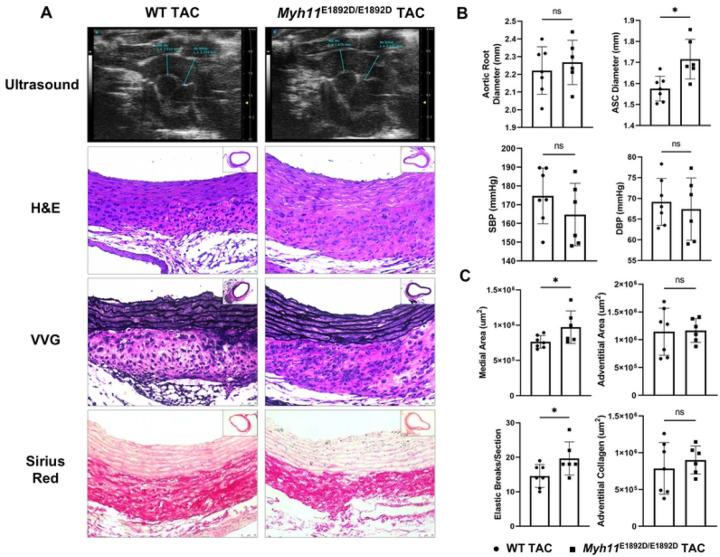
Smooth muscle cell-specific myosin heavy chain, encoded by , is selectively expressed in smooth muscle cells (s). Pathogenic variants in predispose to a number of disorders, including heritable thoracic aortic disease associated with patent ductus arteriosus, visceral myopathy, and megacystis-microcolon-intestinal hypoperistalsis syndrome. Rare variants of uncertain significance occur throughout the gene, including p.Glu1892Asp, and we sought to determine if this variant causes thoracic aortic disease in mice. Genomic editing was used to generate mice. Wild-type () and mutant mice underwent cardiovascular phenotyping and with transverse aortic constriction (). and WT mice displayed similar growth, blood pressure, root and ascending aortic diameters, and cardiac function up to 13 months of age, along with similar contraction and relaxation on myographic testing. TAC induced hypertension similarly in and WT mice, but mutant mice showed augmented ascending aortic enlargement and increased elastic fragmentation on histology. Unexpectedly, male mice two weeks post-TAC had decreased ejection fraction, stroke volume, fractional shortening, and cardiac output compared to similarly treated male WT mice. Importantly, left ventricular mass increased significantly due to primarily posterior wall thickening, and cardiac histology confirmed cardiomyocyte hypertrophy and increased collagen deposition in the myocardium and surrounding arteries. These results further highlight the clinical heterogeneity associated with rare variants. Given that is selectively expressed in SMCs, these results implicate a role of vascular SMCs in the heart contributing to cardiac hypertrophy and failure with pressure overload.
由[具体基因名称]编码的平滑肌细胞特异性肌球蛋白重链在平滑肌细胞(SMCs)中选择性表达。[具体基因名称]中的致病变异易引发多种疾病,包括与动脉导管未闭相关的遗传性胸主动脉疾病、内脏肌病以及巨膀胱-微结肠-肠道蠕动功能减退综合征。整个基因中存在意义不确定的罕见变异,包括p.Glu1892Asp,我们试图确定该变异是否会在小鼠中导致胸主动脉疾病。利用基因组编辑技术生成了[具体基因名称]敲入小鼠。野生型(WT)小鼠和突变小鼠接受了心血管表型分析,并进行了横向主动脉缩窄(TAC)。在13个月龄之前,[具体基因名称]敲入小鼠和WT小鼠在生长、血压、主动脉根部和升主动脉直径以及心脏功能方面表现相似,在肌电图测试中的收缩和舒张情况也相似。TAC在[具体基因名称]敲入小鼠和WT小鼠中同样诱发了高血压,但突变小鼠在组织学上显示升主动脉扩张加剧且弹性碎片增加。出乎意料的是,与同样接受TAC处理的雄性WT小鼠相比,TAC处理两周后的雄性[具体基因名称]敲入小鼠的射血分数、每搏输出量、缩短分数和心输出量均降低。重要的是,左心室质量显著增加,主要是由于后壁增厚,心脏组织学证实心肌细胞肥大以及心肌和周围动脉中的胶原蛋白沉积增加。这些结果进一步凸显了与[具体基因名称]罕见变异相关的临床异质性。鉴于[具体基因名称]在平滑肌细胞中选择性表达,这些结果表明血管平滑肌细胞在心脏中对压力超负荷导致的心肌肥大和心力衰竭发挥了作用。