Ahmed Physiotherapy & Research Center, Dhaka, Bangladesh.
Directorate of Students' Welfare, Bangladesh University of Engineering and Technology, Dhaka, Bangladesh.
PLoS One. 2024 Aug 26;19(8):e0308674. doi: 10.1371/journal.pone.0308674. eCollection 2024.
The purpose of this study was to ascertain whether there is a difference in musculoskeletal pain between those who are addicted to mobile games and those who are not, to ascertain the association between mobile game addiction and socio-demographic variables, and to ascertain the pain predictor for mobile game addiction on different musculoskeletal regions.
There were 840 students in all, both males and females, in this cross-sectional survey from three distinct Bangladeshi institutions. The Nordic Musculoskeletal Discomfort Questionnaire, the Gaming Addiction Scale, and the demographic data form were distributed to the participants. The data were analyzed using the Chi-square test and descriptive statistics. Binary logistic regression was used to find the predicted risk factor for mobile gaming addiction.
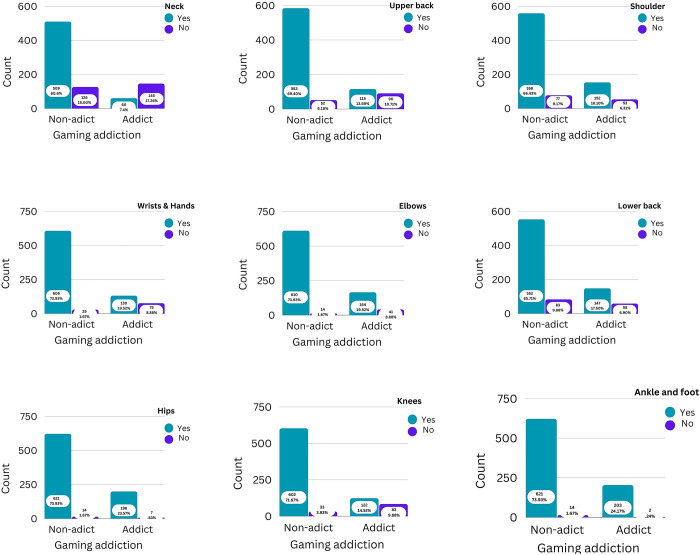
Musculoskeletal pain affects 52.1% of participants in some part of the body. Males have a 2.01-fold higher likelihood of developing gaming addiction compared to females. Those who are addicted to mobile games experience a higher occurrence of pain in the neck, upper back, elbows, and wrist and hands with a odds ratio of (OR 2.84, 95% CI: 1.49-5.36; p = 0.016), (OR 3.75, 95% CI 1.97-7.12; p = <0.001), (OR 3.38, 95% CI 1.34-8.50; p = 0.010), and (OR 2.14, 95% CI 1.00-4.57; p = 0.049) respectively.
These results demonstrate that mobile gaming addiction raises students' risk of musculoskeletal discomfort. Two-three times higher risk of developing pain in the neck, upper back, elbows, and wrist and hands among mobile game addicts.
本研究旨在确定沉迷于手机游戏的人和不沉迷于手机游戏的人之间是否存在肌肉骨骼疼痛的差异,确定手机游戏成瘾与社会人口学变量之间的关系,并确定不同肌肉骨骼区域手机游戏成瘾的疼痛预测因子。
本横断面研究共纳入来自孟加拉国三所不同机构的 840 名男女学生。向参与者发放北欧肌肉骨骼不适问卷、游戏成瘾量表和人口统计学数据表格。使用卡方检验和描述性统计分析来分析数据。使用二元逻辑回归来寻找手机游戏成瘾的预测风险因素。
身体某些部位的肌肉骨骼疼痛影响了 52.1%的参与者。与女性相比,男性患游戏成瘾的可能性高 2.01 倍。沉迷于手机游戏的人更容易出现颈部、上背部、肘部和手腕及手部疼痛,其比值比(OR)分别为 2.84(95%可信区间:1.49-5.36;p = 0.016)、3.75(95%可信区间:1.97-7.12;p < 0.001)、3.38(95%可信区间:1.34-8.50;p = 0.010)和 2.14(95%可信区间:1.00-4.57;p = 0.049)。
这些结果表明,手机游戏成瘾会增加学生肌肉骨骼不适的风险。手机游戏成瘾者出现颈部、上背部、肘部和手腕及手部疼痛的风险增加了两到三倍。