Wang Yuzhe, Xie Zhen, Huang Huishi, Liang Xinquan
Singapore Institute of Manufacturing Technology Agency for Science, Technology and Research (A*STAR) Singapore Singapore.
Advanced Remanufacturing and Technology Centre Agency for Science, Technology and Research (A*STAR) Singapore Singapore.
Smart Med. 2024 Feb 23;3(1):e20230045. doi: 10.1002/SMMD.20230045. eCollection 2024 Feb.
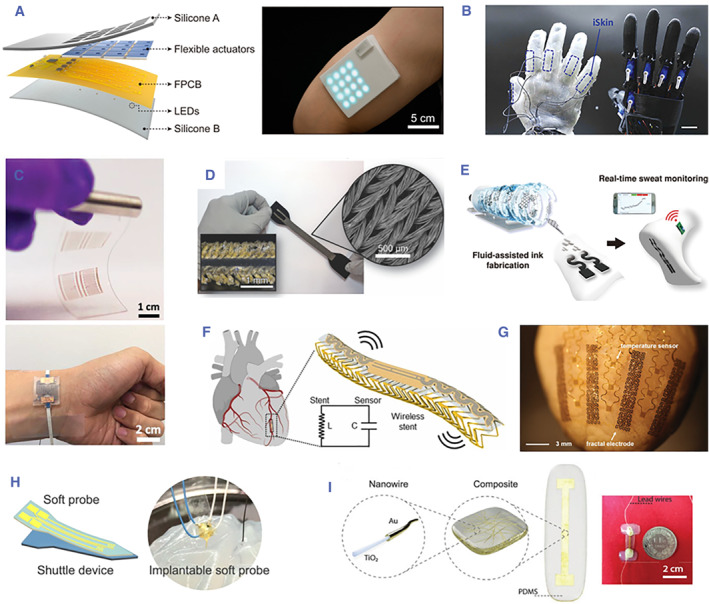
Recent advancements in soft robotics have been emerging as an exciting paradigm in engineering due to their inherent compliance, safe human interaction, and ease of adaptation with wearable electronics. Soft robotic devices have the potential to provide innovative solutions and expand the horizons of possibilities for biomedical applications by bringing robots closer to natural creatures. In this review, we survey several promising soft robot technologies, including flexible fluidic actuators, shape memory alloys, cable-driven mechanisms, magnetically driven mechanisms, and soft sensors. Selected applications of soft robotic devices as medical devices are discussed, such as surgical intervention, soft implants, rehabilitation and assistive devices, soft robotic exosuits, and prosthetics. We focus on how soft robotics can improve the effectiveness, safety and patient experience for each use case, and highlight current research and clinical challenges, such as biocompatibility, long-term stability, and durability. Finally, we discuss potential directions and approaches to address these challenges for soft robotic devices to move toward real clinical translations in the future.
由于其固有的柔顺性、与人类安全互动以及易于与可穿戴电子设备适配,软机器人技术的最新进展已成为工程领域中一个令人兴奋的范例。软机器人设备有可能通过使机器人更接近自然生物,提供创新解决方案并拓展生物医学应用的可能性。在本综述中,我们调研了几种有前景的软机器人技术,包括柔性流体致动器、形状记忆合金、缆线驱动机构、磁驱动机构和软传感器。讨论了软机器人设备作为医疗设备的选定应用,如手术干预、软植入物、康复与辅助设备、软机器人外骨骼和假肢。我们关注软机器人技术如何能提升每个用例的有效性、安全性和患者体验,并突出当前的研究和临床挑战,如生物相容性、长期稳定性和耐用性。最后,我们讨论应对这些挑战的潜在方向和方法,以使软机器人设备在未来迈向实际临床应用。