Department of Occupational and Environmental Medicine, Epidemiology and Hygiene, INAIL - Italian Workers' Compensation Authority, Via Fontana Candida 1, 00078 Monte Porzio Catone, Rome, Italy.
Department of Medicine and Surgery, University of Parma, Viale Gramsci 14, 43126 Parma, Italy; Center of Excellence for Toxicological Research (CERT) at University of Parma, Viale Gramsci 14, 43126 Parma, Italy.
Med Lav. 2024 Aug 27;115(4):e2024029. doi: 10.23749/mdl.v115i4.16100.
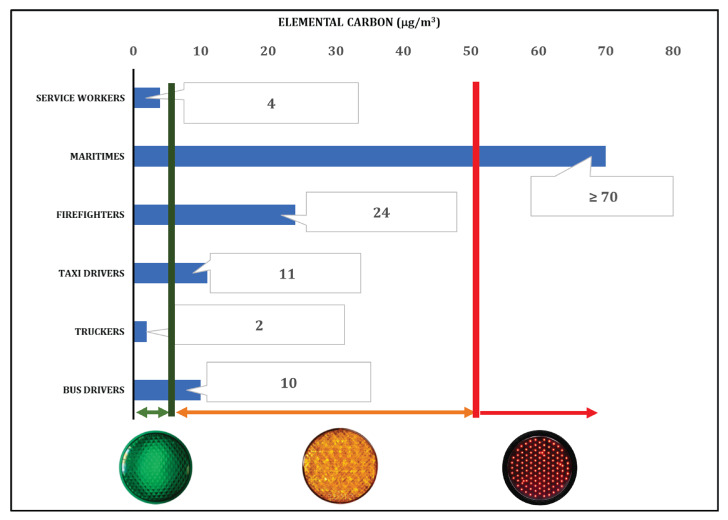
The Italian Interministerial Decree of February 11, 2021, introduces the diesel engine exhaust (DDE) among the carcinogenic occupational compounds, also establishing an occupational exposure limit. Elemental carbon (EC), improperly called black carbon, has been proposed as a tracer of DDE exposure; EC is the carbon that is quantified in the ambient matrixes after all the organic carbon has been removed; traditionally, EC is measured with a thermo-optical analytical technique. EC determination and relative interpretation are challenging for the following reasons: (i) the scarce availability of equipped laboratories hampers EC analysis, (ii) EC interpretation is not easy due to the lack of reference values. Finally, (iii) the limit value of 0.050 mg/m3 of EC in the workplace appears too high compared to recently published exposure data. All these aspects stimulate a reflection on the significance of EC data in the context of both occupational hygiene and occupational medicine.
2021 年 2 月 11 日,意大利部际法令将柴油机废气(DDE)列入致癌性职业化合物,同时也规定了职业接触限值。元素碳(EC),也被称为黑碳,被提议作为 DDE 暴露的示踪剂;EC 是在去除所有有机碳后量化环境基质中的碳;传统上,EC 是通过热光分析技术来测量。EC 的测定和相关解释具有挑战性,原因如下:(i)设备齐全的实验室稀缺,阻碍了 EC 分析;(ii)由于缺乏参考值,EC 的解释并不容易;最后,(iii)工作场所 EC 的限值 0.050mg/m3 与最近公布的暴露数据相比似乎过高。所有这些方面都促使人们对 EC 数据在职业卫生和职业医学背景下的意义进行反思。