Kwon Hyouk-Soo, Ryu Min Hyung, Carlsten Christopher
Department of Allergy and Clinical Immunology, Asan Medical Center, University of Ulsan College of Medicine, Seoul, Republic of Korea.
Air Pollution Exposure Laboratory, Division of Respiratory Medicine, Faculty of Medicine, The University of British Columbia, Vancouver, BC, Canada.
Exp Mol Med. 2020 Mar;52(3):318-328. doi: 10.1038/s12276-020-0405-1. Epub 2020 Mar 17.
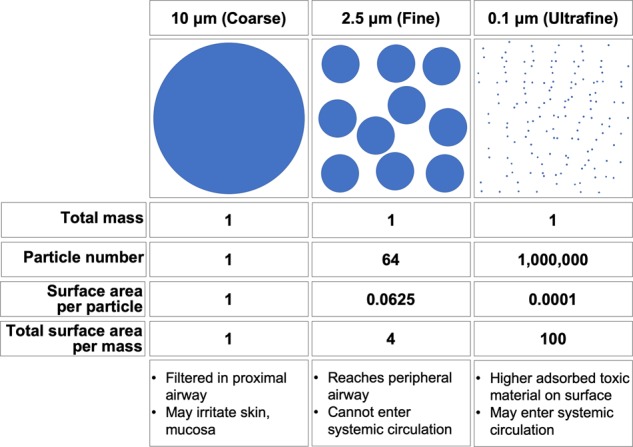
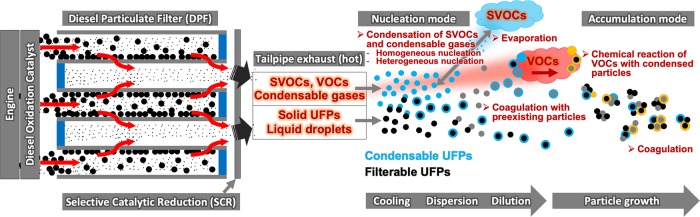
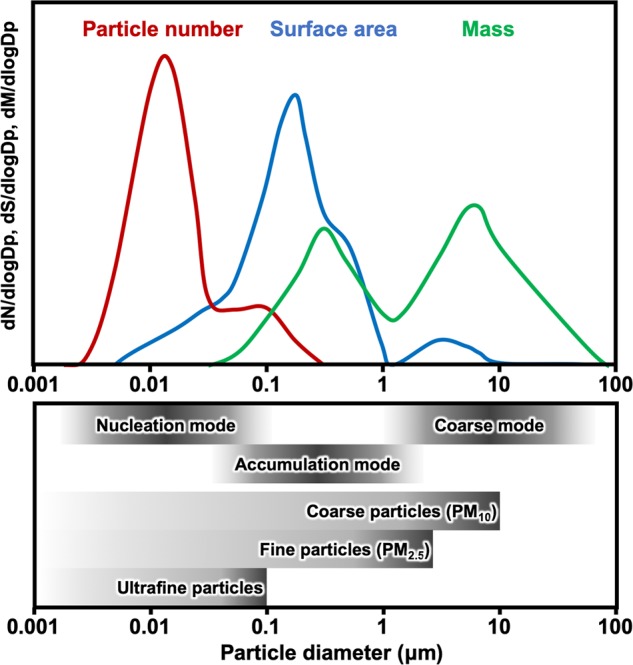
Ultrafine particles (UFPs) are aerosols with an aerodynamic diameter of 0.1 µm (100 nm) or less. There is a growing concern in the public health community about the contribution of UFPs to human health. Despite their modest mass and size, they dominate in terms of the number of particles in the ambient air. A particular concern about UFPs is their ability to reach the most distal lung regions (alveoli) and circumvent primary airway defenses. Moreover, UFPs have a high surface area and a capacity to adsorb a substantial amount of toxic organic compounds. Harmful systemic health effects of PM or PM are often attributable to the UFP fraction. In this review, we examine the physicochemical characteristics of UFPs to enable a better understanding of the effects of these particles on human health. The characteristics of UFPs from diesel combustion will be discussed in the greatest detail because road vehicles are the primary source of UFP emissions in urban pollution hotspots. Finally, we will elaborate on the role of UFPs on global climate change, since the adverse effects of UFPs on meteorological processes and the hydrological cycle may even be more harmful to human health than their direct toxic effects.
超细颗粒物(UFPs)是空气动力学直径为0.1微米(100纳米)或更小的气溶胶。公共卫生界越来越关注超细颗粒物对人类健康的影响。尽管它们的质量和尺寸较小,但在环境空气中的颗粒数量方面却占主导地位。对超细颗粒物的一个特别关注是它们能够到达肺部最远端区域(肺泡)并绕过主要气道防御。此外,超细颗粒物具有高表面积,能够吸附大量有毒有机化合物。PM或PM的有害全身健康影响通常归因于超细颗粒物部分。在本综述中,我们研究超细颗粒物的物理化学特性,以便更好地理解这些颗粒对人类健康的影响。由于道路车辆是城市污染热点中超细颗粒物排放的主要来源,因此将最详细地讨论柴油燃烧产生的超细颗粒物的特性。最后,我们将阐述超细颗粒物在全球气候变化中的作用,因为超细颗粒物对气象过程和水文循环的不利影响对人类健康的危害甚至可能比其直接毒性影响更大。