Gao Zhenyang, Zhang Xiaolin, Wu Yi, Pham Minh-Son, Lu Yang, Xia Cunjuan, Wang Haowei, Wang Hongze
State Key Labortory of Metal Matrix Composites, Shanghai Jiao Tong University, Shanghai, 200240, China.
School of Materials Science and Engineering, Shanghai Jiao Tong University, Shanghai, 200240, China.
Nat Commun. 2024 Aug 27;15(1):7373. doi: 10.1038/s41467-024-51757-0.
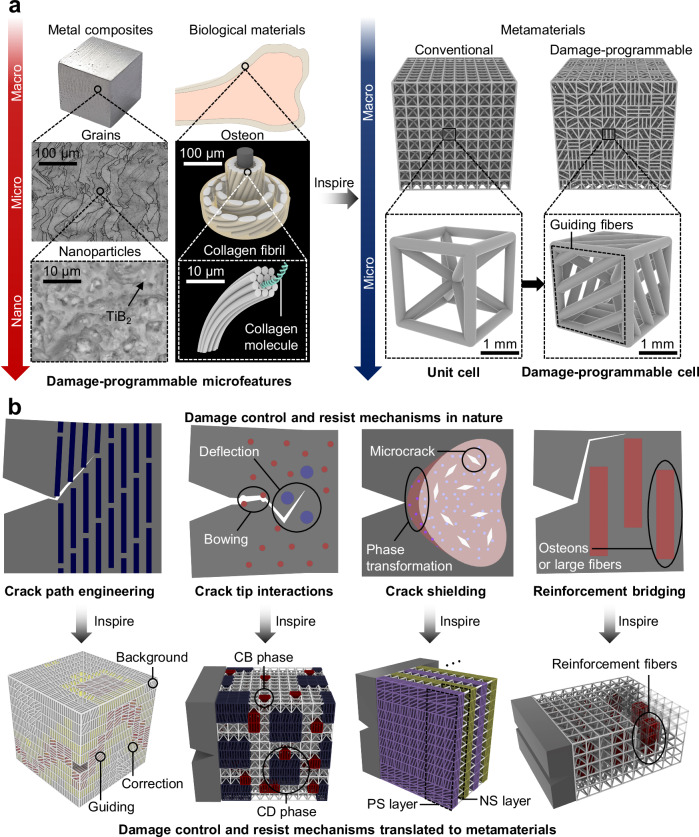
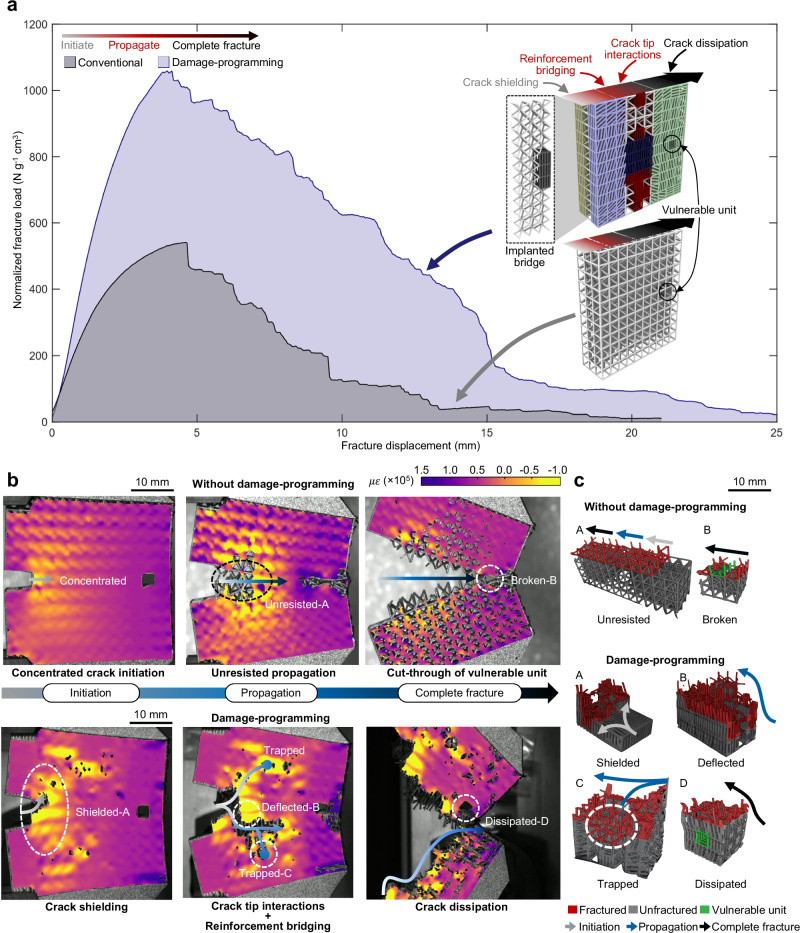
The fracture behaviour of artificial metamaterials often leads to catastrophic failures with limited resistance to crack propagation. In contrast, natural materials such as bones and ceramics possess microstructures that give rise to spatially controllable crack path and toughened material resistance to crack advances. This study presents an approach that is inspired by nature's strengthening mechanisms to develop a systematic design method enabling damage-programmable metamaterials with engineerable microfibers in the cells that can spatially program the micro-scale crack behaviour. Machine learning is applied to provide an effective design engine that accelerate the generation of damage-programmable cells that offer advanced toughening functionality such as crack bowing, crack deflection, and shielding seen in natural materials; and are optimised for a given programming of crack path. This paper shows that such toughening features effectively enable crack-resisting mechanisms on the basis of the crack tip interactions, crack shielding, crack bridging and synergistic combinations of these mechanisms, increasing up to 1,235% absorbed fracture energy in comparison to conventional metamaterials. The proposed approach can have broad implications in the design of damage-tolerant materials, and lightweight engineering systems where significant fracture resistances or highly programmable damages for high performances are sought after.
人工超材料的断裂行为往往会导致灾难性失效,对裂纹扩展的抵抗力有限。相比之下,诸如骨骼和陶瓷等天然材料具有微观结构,这些微观结构会产生空间可控的裂纹路径,并增强材料对裂纹扩展的抵抗力。本研究提出了一种受自然强化机制启发的方法,以开发一种系统设计方法,从而实现具有可工程化微纤维的损伤可编程超材料,这些微纤维可以在单元中对微观尺度的裂纹行为进行空间编程。应用机器学习来提供一个有效的设计引擎,加速生成具有先进增韧功能的损伤可编程单元,这些功能如在天然材料中所见的裂纹弯曲、裂纹偏转和屏蔽;并针对给定的裂纹路径编程进行优化。本文表明,这些增韧特性基于裂纹尖端相互作用、裂纹屏蔽、裂纹桥接以及这些机制的协同组合有效地实现了抗裂机制,与传统超材料相比,吸收的断裂能增加了高达1235%。所提出的方法在设计耐损伤材料和轻质工程系统方面可能具有广泛的意义,在这些系统中,人们追求显著的抗断裂能力或用于高性能的高度可编程损伤。