Martineau Carole-Anne, Rivard Nathalie, Bisaillon Martin
Département de Biochimie et de Génomique Fonctionnelle, Faculté de Médecine et des Sciences de la Santé, Université de Sherbrooke, 3201 Rue Jean-Mignault, Sherbrooke, QC, J1E 4K8, Canada.
Département d'Immunologie et Biologie Cellulaire, Faculté de Médecine et des Sciences de la Santé, Université de Sherbrooke, 3201 Rue Jean-Mignault, Sherbrooke, QC, J1E 4K8, Canada.
Infect Agent Cancer. 2024 Aug 27;19(1):40. doi: 10.1186/s13027-024-00606-2.
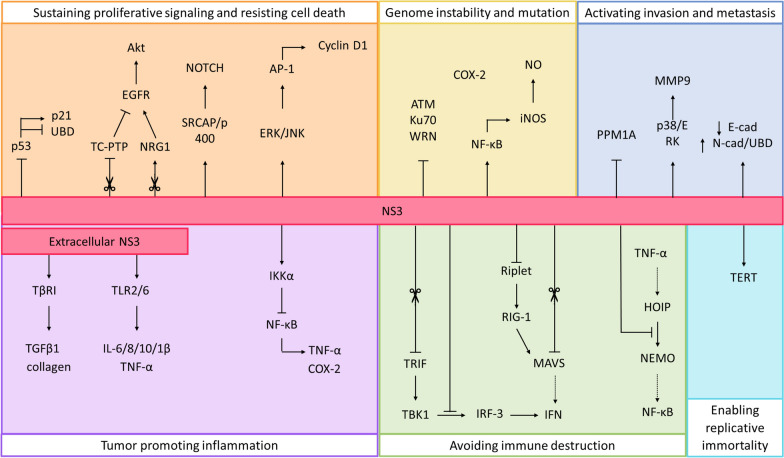
Hepatitis C virus (HCV) chronically infects approximately 170 million people worldwide and is a known etiological agent of hepatocellular carcinoma (HCC). The molecular mechanisms of HCV-mediated carcinogenesis are not fully understood. This review article focuses on the oncogenic potential of NS3, a viral protein with transformative effects on cells, although the precise mechanisms remain elusive. Unlike the more extensively studied Core and NS5A proteins, NS3's roles in cancer development are less defined but critical. Research indicates that NS3 is implicated in several carcinogenic processes such as proliferative signaling, cell death resistance, genomic instability and mutations, invasion and metastasis, tumor-related inflammation, immune evasion, and replicative immortality. Understanding the direct impact of viral proteins such as NS3 on cellular transformation is crucial for elucidating HCV's role in HCC development. Overall, this review sheds light on the molecular mechanisms used by NS3 to contribute to hepatocarcinogenesis, and highlights its significance in the context of HCV-associated HCC, underscoring the need for further investigation into its specific molecular and cellular actions.
丙型肝炎病毒(HCV)在全球约1.7亿人中长期感染,是已知的肝细胞癌(HCC)病原体。HCV介导致癌作用的分子机制尚未完全明确。这篇综述文章聚焦于NS3的致癌潜力,NS3是一种对细胞具有转化作用的病毒蛋白,尽管其确切机制仍不清楚。与研究更为广泛的核心蛋白和NS5A蛋白不同,NS3在癌症发展中的作用定义较少但至关重要。研究表明,NS3参与多个致癌过程,如增殖信号传导、细胞死亡抵抗、基因组不稳定和突变、侵袭和转移、肿瘤相关炎症、免疫逃逸以及复制永生。了解诸如NS3等病毒蛋白对细胞转化的直接影响对于阐明HCV在HCC发展中的作用至关重要。总体而言,本综述揭示了NS3促进肝癌发生的分子机制,并强调了其在HCV相关HCC背景下的重要性,突出了进一步研究其具体分子和细胞作用的必要性。