Debnath Suman, Laxmi Shoba, McCubbin Stepanic Olivia, Quek Sebastian Y, van Gastel Maurice, DeBeer Serena, Krämer Tobias, England Jason
Division of Chemistry and Biological Chemistry, School of Chemistry, Chemical Engineering and Biotechnology, Nanyang Technological University, 21 Nanyang Link, 637371 Singapore.
Max Planck Institute for Chemical Energy Conversion, Stiftstr. 34-36, Mülheim an der Ruhr D-45470, Germany.
J Am Chem Soc. 2024 Aug 28;146(34):23704-23716. doi: 10.1021/jacs.3c12268. Epub 2024 Aug 14.
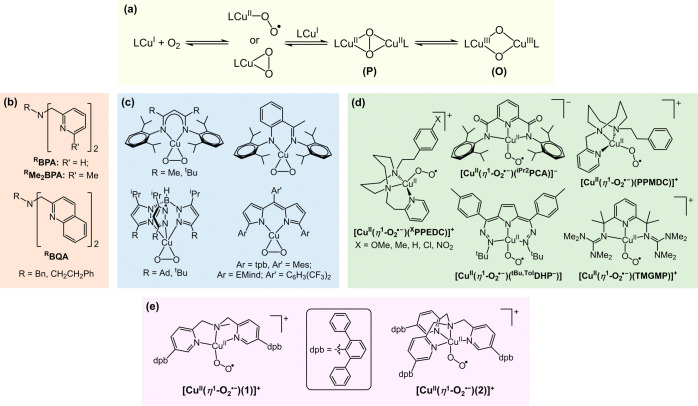
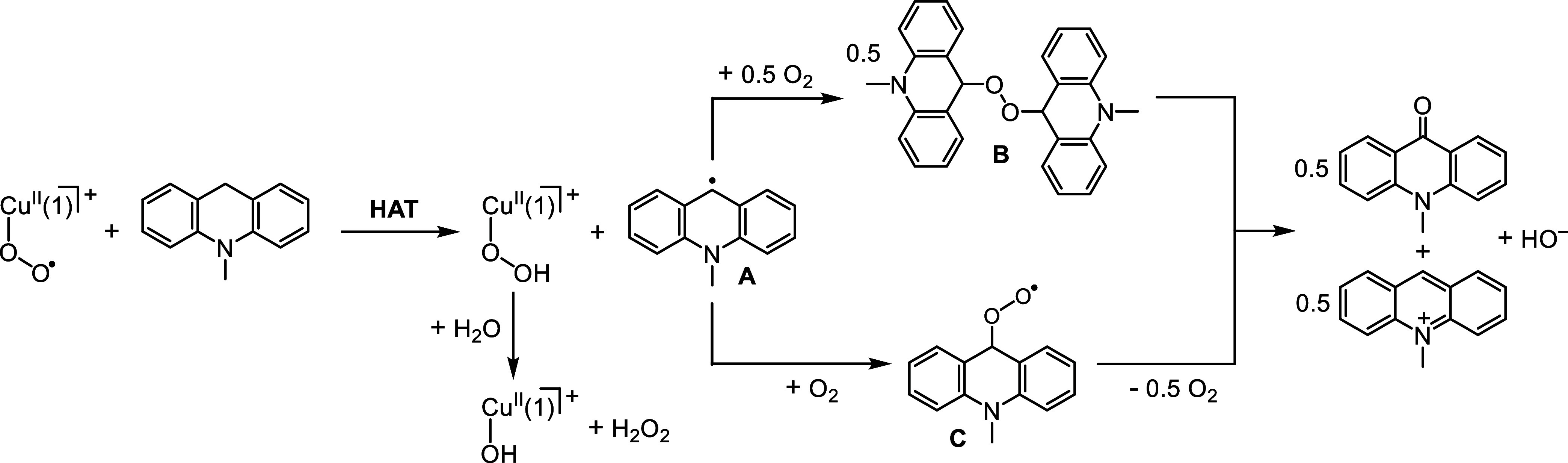
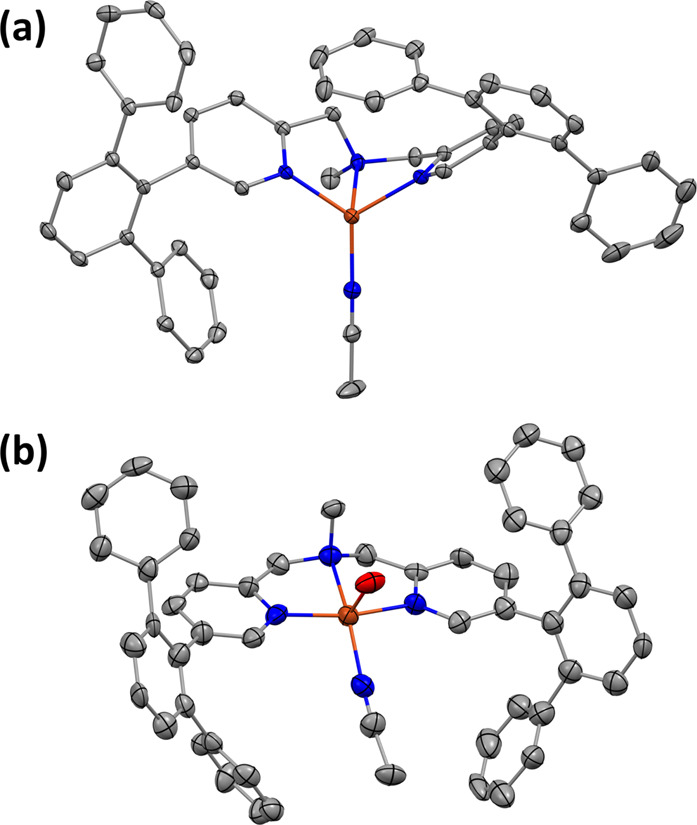
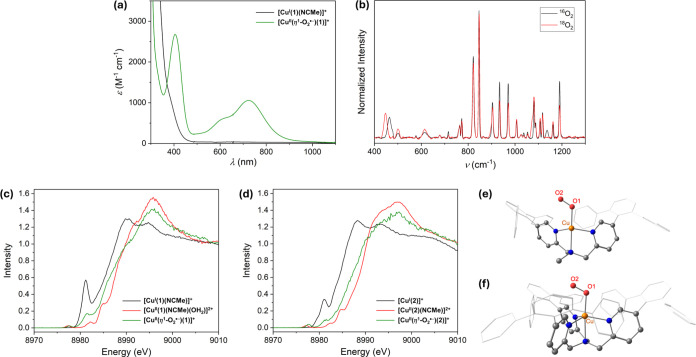
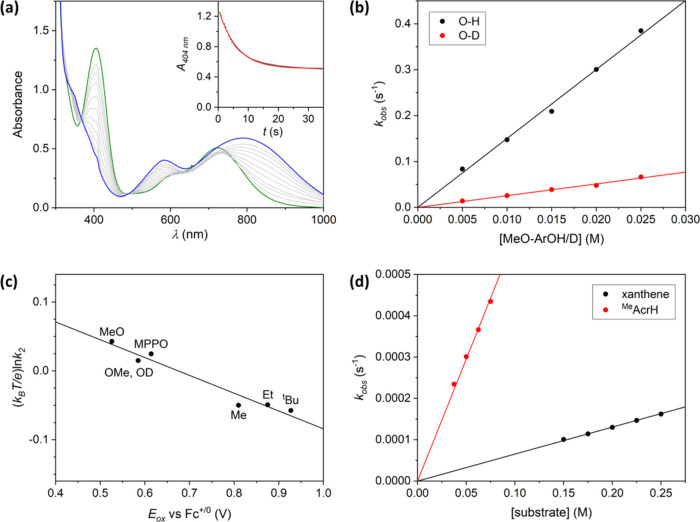
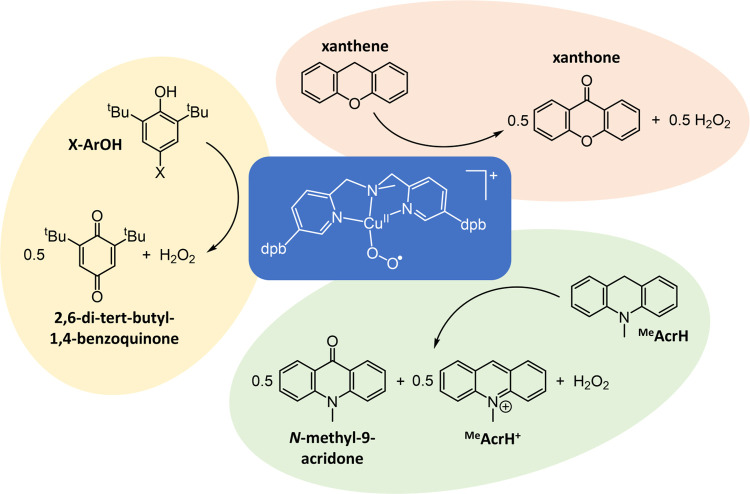
Although the reactivity of five-coordinate end-on superoxocopper(II) complexes, Cu(η-O), is dominated by hydrogen atom transfer, the majority of four-coordinate Cu(η-O) complexes published thus far display nucleophilic reactivity. To investigate the origin of this difference, we have developed a four-coordinate end-on superoxocopper(II) complex supported by a sterically encumbered bis(2-pyridylmethyl)amine ligand, dpb-BPA (), and compared its substrate reactivity with that of a five-coordinate end-on superoxocopper(II) complex ligated by a similarly substituted tris(2-pyridylmethyl)amine, dpb-TMPA (). Kinetic isotope effect (KIE) measurements and correlation of second-order rate constants ('s) versus oxidation potentials () for a range of phenols indicates that the complex [Cu(η-O)()] reacts with phenols via a similar hydrogen atom transfer (HAT) mechanism to [Cu(η-O)()]. However, [Cu(η-O)()] performs HAT much more quickly, with its for reaction with 2,6-di--butyl-4-methoxyphenol (MeO-ArOH) being >100 times greater. Furthermore, [Cu(η-O)()] can oxidize C-H bond substrates possessing stronger bonds than [Cu(η-O)()] is able to, and it reacts with -methyl-9,10-dihydroacridine (AcrH) approximately 200 times faster. The much greater facility for substrate oxidation displayed by [Cu(η-O)()] is attributed to it possessing higher inherent electrophilicity than [Cu(η-O)()], which is a direct consequence of its lower coordination number. These observations are of relevance to enzymes in which four-coordinate end-on superoxocopper(II) intermediates, rather than their five-coordinate congeners, are routinely invoked as the active oxidants responsible for substrate oxidation.
尽管五配位端基超氧铜(II)配合物Cu(η-O)的反应活性主要由氢原子转移主导,但迄今为止报道的大多数四配位Cu(η-O)配合物表现出亲核反应活性。为了研究这种差异的起源,我们合成了一种由空间位阻较大的双(2-吡啶甲基)胺配体dpb-BPA支撑的四配位端基超氧铜(II)配合物,并将其底物反应活性与由类似取代的三(2-吡啶甲基)胺dpb-TMPA连接的五配位端基超氧铜(II)配合物的底物反应活性进行了比较。动力学同位素效应(KIE)测量以及一系列酚类的二级速率常数()与氧化电位()的相关性表明,配合物[Cu(η-O)()]与酚类反应的机制与[Cu(η-O)()]类似,都是通过氢原子转移(HAT)。然而,[Cu(η-O)()]进行HAT的速度要快得多,其与2,6-二叔丁基-4-甲氧基酚(MeO-ArOH)反应的比[Cu(η-O)()]大于100倍。此外,[Cu(η-O)()]能够氧化比[Cu(η-O)()]更强的C-H键底物,并且它与N-甲基-9,10-二氢吖啶(AcrH)的反应速度大约快200倍。[Cu(η-O)()]表现出的更高的底物氧化能力归因于它比[Cu(η-O)()]具有更高的固有亲电性,这是其较低配位数的直接结果。这些观察结果与那些通常将四配位端基超氧铜(II)中间体而非其五配位同类物作为负责底物氧化的活性氧化剂的酶有关。