Department of Rheumatology and Immunology, Peking University People's Hospital, Beijing, 100044, China.
Beijing Key Laboratory for Rheumatism Mechanism and Immune Diagnosis (BZ0135), Beijing, 100044, China.
Clin Exp Med. 2024 Aug 28;24(1):201. doi: 10.1007/s10238-024-01462-5.
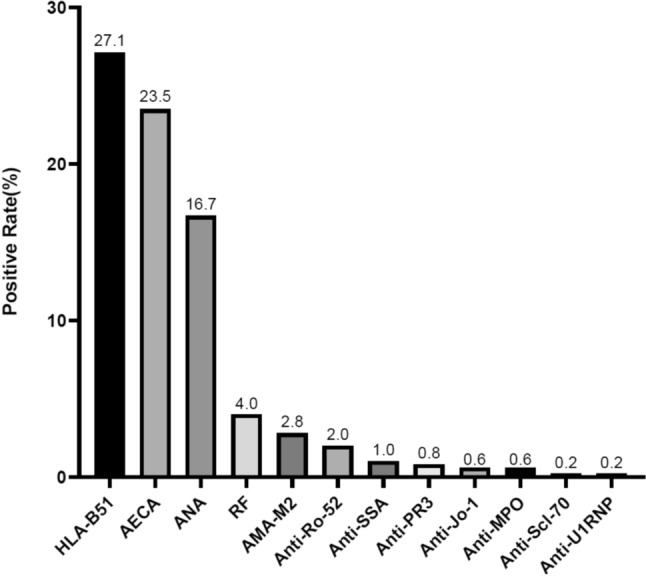
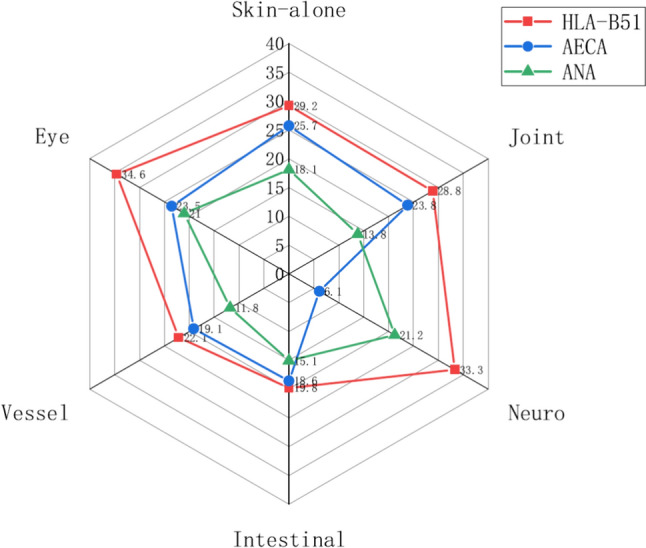
Behcet's syndrome (BS) is a vasculitis characterized by immune dysregulation. Biomarkers are valuable for assessing clinically atypical pathogenesis. We aimed to investigate the distribution of different biomarkers and their effects on the clinical features of patients with BS in a large-scale, real-world study. This is a retrospective, single-center study. In total, 502 patients diagnosed with BS were enrolled in this study. We analyzed the clinical features of this cohort and divided patients' symptoms into six categories, including mucocutaneous, articular, neurological, gastrointestinal, vascular, and ocular involvements. HLA-B51 cells, autoantibodies, and subsets of immune cells from the patients were tested. Pearson's correlation, Wilcoxon rank sum test and multivariate logistic regression were used for data analysis. Various autoantibodies were detected in the serum of 40.8% of patients with BS. The positivity rate of anti-endothelial cell antibodies (AECA) was the highest among autoantibodies and was found in 23.5% (118/502) of patients with BS. The positivity rate of HLA-B51 in patients with BS was 27.1%. Tumor necrosis factor (TNF)-α, IL-2, and IL-4 producing CD4 T cells were positively correlated with the gastrointestinal BS. Increased IL-4CD4 T cell was a risk factor for gastrointestinal BS (P = 0.006, Overall rate [OR] = 2.491, 95% Confidence interval [CI]: [1.317, 5.100]). Various autoantibodies can be detected in patients with BS. HLA-B51 and AECA are the most common biomarkers. Increased IL-4 CD4 T cell was a risk factor for gastrointestinal involvement in BS.
贝赫切特综合征(BS)是一种免疫失调为特征的血管炎。生物标志物对于评估非典型的临床发病机制具有重要价值。我们旨在通过一项大规模的真实世界研究,来调查不同生物标志物的分布及其对 BS 患者临床特征的影响。这是一项回顾性、单中心研究。共纳入 502 例 BS 患者。我们分析了该队列的临床特征,并将患者的症状分为六类,包括黏膜皮肤、关节、神经、胃肠道、血管和眼部受累。检测了患者的 HLA-B51 细胞、自身抗体和免疫细胞亚群。采用 Pearson 相关分析、Wilcoxon 秩和检验和多变量逻辑回归进行数据分析。BS 患者的血清中检测到各种自身抗体。自身抗体中抗内皮细胞抗体(AECA)的阳性率最高,在 23.5%(118/502)的 BS 患者中阳性。BS 患者的 HLA-B51 阳性率为 27.1%。TNF-α、IL-2 和 IL-4 产生的 CD4 T 细胞与胃肠道 BS 呈正相关。增加的 IL-4CD4 T 细胞是胃肠道 BS 的危险因素(P=0.006,总发生率 [OR]=2.491,95%置信区间 [CI]:[1.317, 5.100])。BS 患者可检测到各种自身抗体。HLA-B51 和 AECA 是最常见的生物标志物。增加的 IL-4 CD4 T 细胞是 BS 胃肠道受累的危险因素。