Apeagyei Angela E, Lidral-Porter Brendan, Patel Nishali, Solorio Juan, Tsakalos Golsum, Wang Yifeng, Warriner Wesley, Wolde Asrat, Zhao Yingxi, Dieleman Joseph L, Nonvignon Justice
Department of Health Metrics Sciences, University of Washington School of Medicine, Institute for Health Metrics and Evaluation, Seattle, Washington, United States of America.
Institute for Health Metrics and Evaluation, Seattle, Washington, United States of America.
PLOS Glob Public Health. 2024 Aug 28;4(8):e0003433. doi: 10.1371/journal.pgph.0003433. eCollection 2024.
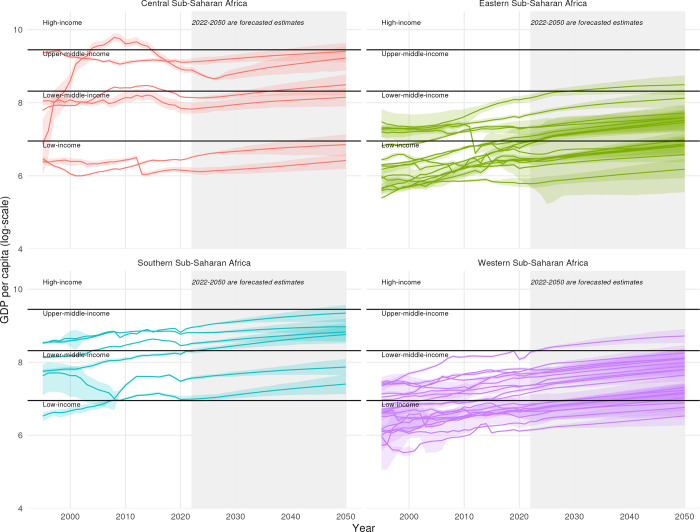
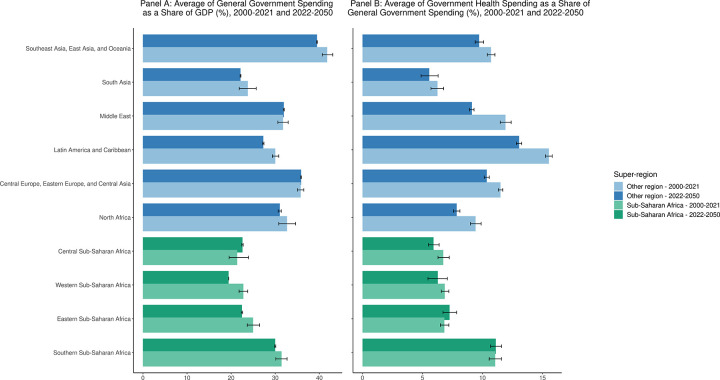
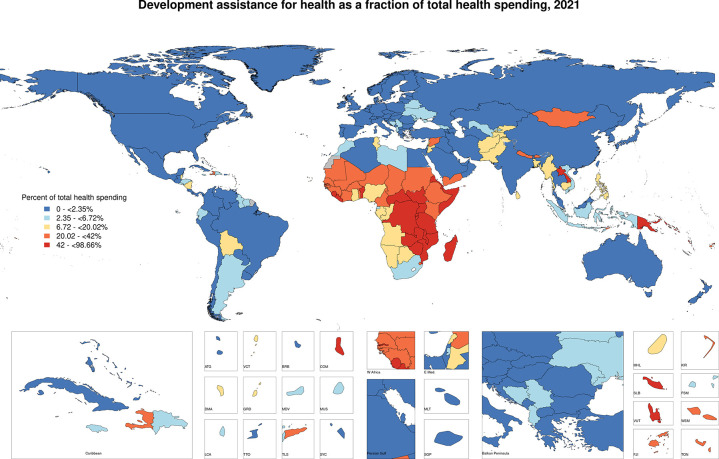
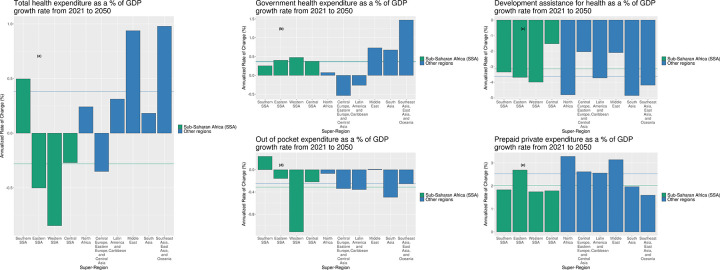
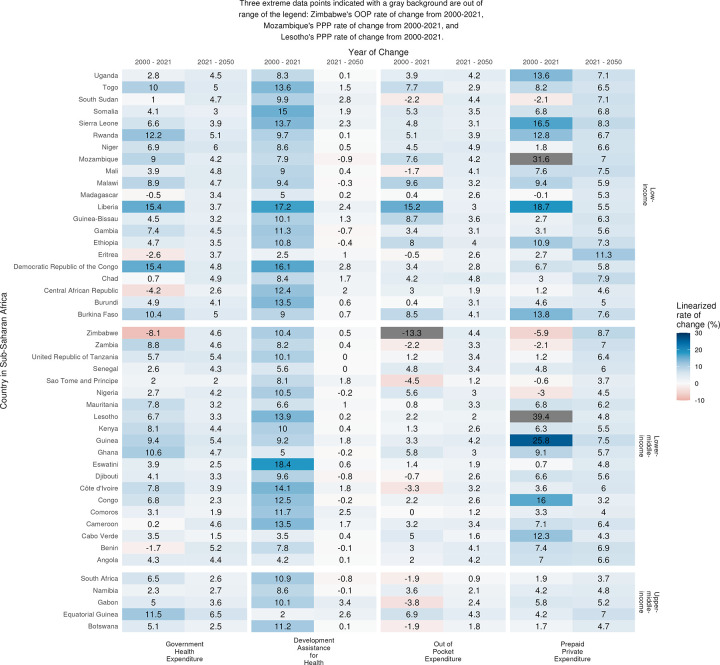
In 2021, global life expectancy at birth was 74 years whereas in sub-Saharan Africa it was 66 years. Yet in that same year, $92 per person was spent on health in sub- Saharan Africa, which is roughly one fifth of what the next lowest geographic region-North Africa and Middle East-spent ($379). The challenges to healthy lives in sub-Saharan Africa are many while health spending remains low. This study uses gross domestic product, government, and health spending data to give a more complete picture of the patterns of future health spending in sub-Saharan Africa. We analyzed trends in growth in gross domestic product, government health spending, development assistance for health and the prioritization of health in national spending to compare countries within sub-Saharan Africa and globally.We found that while gross domestic product was projected to increase through 2050 in sub-Saharan Africa, the share of gross domestic product that goes to health spending is only expected to increase moderately. Our exploration shows that this tepid growth is expected because the percent of overall government spending that is dedicated to health 7·2% (6·3-8·3) compared to average of 12·4% (11·7-13·2) in other regions) is expected to stay low. Even if the amount, of resources provided from donors climbs some, it is not expected to keep pace with growing economies in sub-Saharan Africa and may transition towards other global public health goods. Critically, development assistance for health provided to sub-Saharan Africa is expected to decrease in some countries, and the expected growth in government health spending might not be enough to cover this expected decline. Increases in spending with a concordant prioritization of health and the appropriate health system governance and structural reforms are critical to ensure that people who live in sub-Saharan Africa are not left behind.
2021年,全球出生时预期寿命为74岁,而撒哈拉以南非洲地区为66岁。然而,同年撒哈拉以南非洲地区人均卫生支出为92美元,约为第二低地理区域——北非和中东地区(379美元)支出的五分之一。撒哈拉以南非洲地区健康生活面临诸多挑战,而卫生支出仍然很低。本研究使用国内生产总值、政府和卫生支出数据,以更全面地了解撒哈拉以南非洲地区未来卫生支出模式。我们分析了国内生产总值增长、政府卫生支出、卫生发展援助以及国家支出中卫生优先事项的趋势,以比较撒哈拉以南非洲地区内部和全球范围内的国家。我们发现,虽然预计到2050年撒哈拉以南非洲地区的国内生产总值会增加,但用于卫生支出的国内生产总值份额预计只会适度增加。我们的研究表明,这种温和增长是预期的,因为用于卫生的政府总支出百分比为7·2%(6·3 - 8·3),而其他地区的平均水平为12·4%(11·7 - 13·2),预计将保持在较低水平。即使捐助者提供的资源有所增加,预计也无法跟上撒哈拉以南非洲地区不断增长的经济步伐,并且可能会转向其他全球公共卫生产品。至关重要的是,预计向撒哈拉以南非洲地区提供的卫生发展援助在一些国家将会减少,而政府卫生支出的预期增长可能不足以弥补这一预期下降。增加支出并相应地优先考虑卫生以及进行适当的卫生系统治理和结构改革,对于确保撒哈拉以南非洲地区的人们不被落下至关重要。