Department of Electrical Engineering, National Chung Hsing University, Taichung City, Taiwan.
Department of Oral Hygiene, Tzu-Hui Institute of Technology, Nanzhou Township, Pingtung County, Taiwan.
PLoS One. 2024 Aug 28;19(8):e0300911. doi: 10.1371/journal.pone.0300911. eCollection 2024.
The lean soft tissue mass (LSTM) of the limbs is approximately 63% of total skeletal muscle mass. For athletes, measurement of limb LSTM is the basis for rapid estimation of skeletal muscle mass. This study aimed to establish the estimation equation of LSTM in Asian athletes using bioelectrical impedance analysis (BIA).
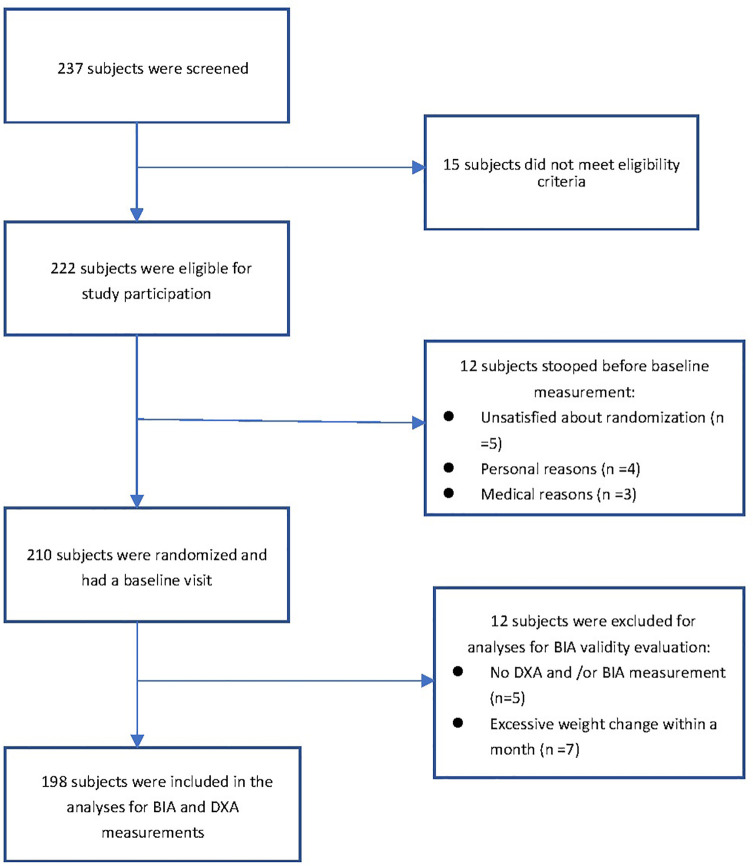
A total of 198 athletes (121 males, 77 females; mean age 22.04 ± 5.57 years) from different sports in Taiwan were enrolled. A modeling group (MG) of 2/3 (n = 132) of subjects and a validation group (VG) of 1/3 (n = 68) were randomly assigned. Using the InBody S-10, resistance and reactance were measured at 50 kHz from the right palm to the right sole while the participant was in the supine position. Predictor variables were height (h), weight (W), age, Sex, Xc, resistance index (RI; RI = h2 / R). LSTM of arms and legs measured by dual-energy X-ray absorptiometry (DXA) was the response variable. Multivariate stepwise regression analysis method was used to establish BIA estimation equations as ArmsLSTMBIA-Asian and LegsLSTMBIA-Asian. Estimation equations performance was confirmed by cross-validation.
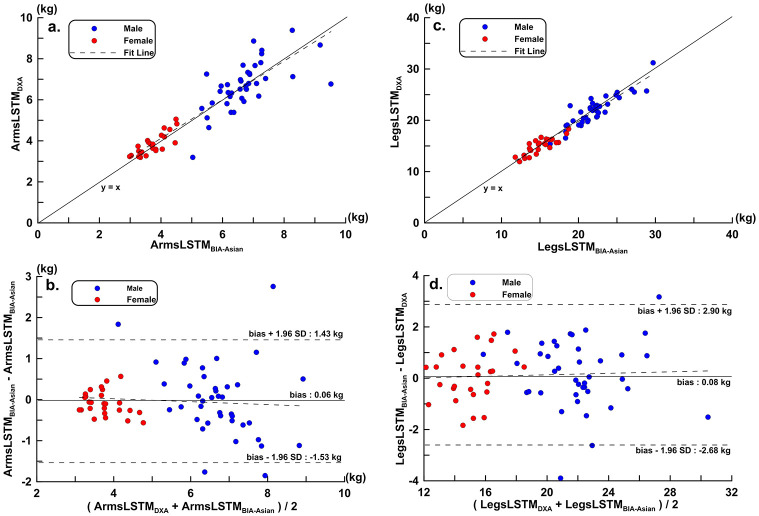
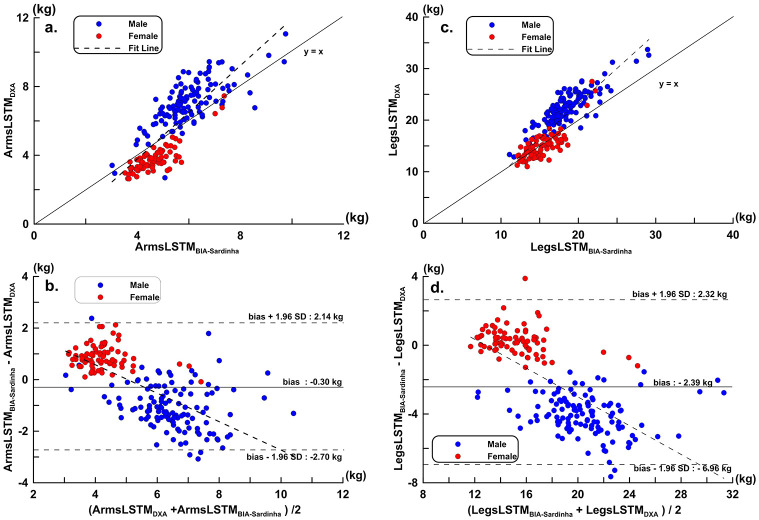
Estimation equation "ArmsLSTMBIA-Asian = 0.096 h2/R- 1.132 Sex + 0.030 Weight + 0.022 Xc- 0.022 h + 0.905, r2 = 0.855, SEE = 0.757 kg, n = 132" and "LegsLSTMBIA Asian = 0.197h2/R" + 0.120 h- 1.242 Sex + 0.055 Weight- 0.052 Age + 0.033 Xc -16.136, r2 = 0.916, SEE = 1.431 kg, n = 132" were obtained from MG. Using DXA measurement results of VG for correlation analysis and Limit of Agreement (LOA) of Bland-Altman Plot, ArmsLST is 0.924, -1.53 to 1.43 kg, and LegsLST is 0.957, -2.68 to 2.90 kg.
The established single-frequency BIA hand-to-foot (whole body) estimation equation quickly and accurately estimates LSTM of the arms and legs of Asian athletes.
四肢的瘦体组织质量(LSTM)约占总骨骼肌质量的 63%。对于运动员来说,测量肢体 LSTM 是快速估计骨骼肌质量的基础。本研究旨在使用生物电阻抗分析(BIA)建立亚洲运动员的 LSTM 估计方程。
共纳入来自中国台湾不同运动项目的 198 名运动员(男性 121 名,女性 77 名;平均年龄 22.04±5.57 岁)。将受试者随机分为建模组(MG)的 2/3(n=132)和验证组(VG)的 1/3(n=68)。使用 InBody S-10,在受试者仰卧位时,从右手掌到右脚掌以 50 kHz 测量电阻和电抗。预测变量为身高(h)、体重(W)、年龄、性别、Xc、电阻指数(RI;RI=h2/R)。通过双能 X 射线吸收法(DXA)测量的手臂和腿部 LSTM 为反应变量。采用多元逐步回归分析方法建立 BIA 估计方程,分别为 ArmsLSTMBIA-Asian 和 LegsLSTMBIA-Asian。通过交叉验证确认估计方程的性能。
从 MG 中得到了估计方程“ArmsLSTMBIA-Asian=0.096h2/R-1.132Sex+0.030Weight+0.022Xc-0.022h+0.905,r2=0.855,SEE=0.757kg,n=132”和“LegsLSTMBIA Asian=0.197h2/R+0.120h-1.242Sex+0.055Weight-0.052Age+0.033Xc-16.136,r2=0.916,SEE=1.431kg,n=132”。使用 VG 的 DXA 测量结果进行相关性分析和 Bland-Altman 图的 LOA,手臂 LSTM 为 0.924,-1.53 至 1.43kg,腿部 LSTM 为 0.957,-2.68 至 2.90kg。
建立的单频 BIA 手到脚(全身)估计方程可以快速准确地估计亚洲运动员的手臂和腿部 LSTM。