ICAR-National Institute of Veterinary Epidemiology and Disease Informatics (NIVEDI), Ramagondanahalli, Yelahanka, Post Box-6450, Bengaluru, Karnataka, 560064, India.
Florida Medical Entomology Laboratory, Department of Entomology and Nematology, IFAS, University of Florida, 200 9th St SE, Vero Beach, FL, 32962, USA.
Sci Rep. 2024 Aug 27;14(1):19928. doi: 10.1038/s41598-024-67736-w.
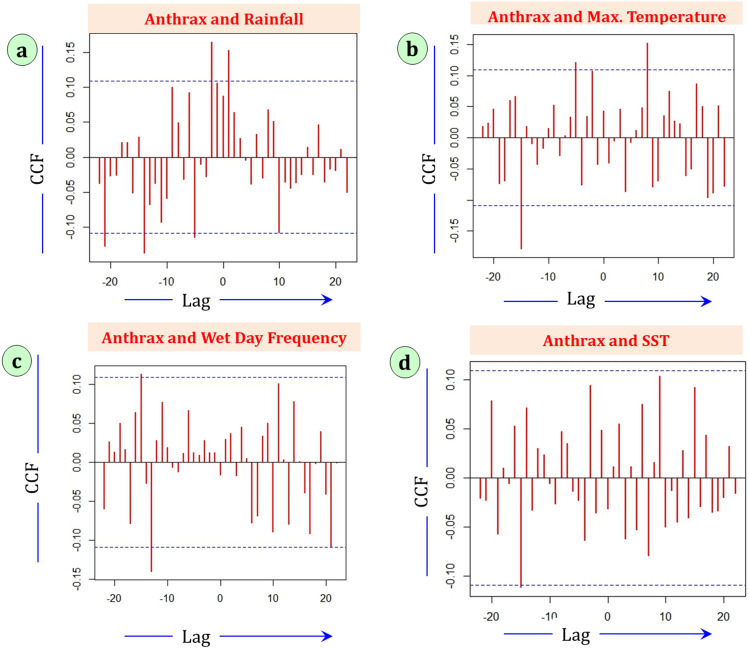
Anthrax is an economically important zoonotic disease affecting both livestock and humans. The disease is caused by a spore forming bacterium, Bacillus anthracis, and is considered endemic to the state of Karnataka, India. It is critical to quantify the role of climatic factors in determining the temporal pattern of anthrax outbreaks, so that reliable forecasting models can be developed. These models will aid in establishing public health surveillance and guide strategic vaccination programs, which will reduce the economic loss to farmers, and prevent the spill-over of anthrax from livestock to humans. In this study, correlation and coherence between time series of anthrax outbreaks in livestock (1987-2016) and meteorological variables and Sea Surface Temperature anomalies (SST) were identified using a combination of cross-correlation analyses, spectral analyses (wavelets and empirical mode decomposition) and further quantified using a Bayesian time series regression model accounting for temporal autocorrelation. Monthly numbers of anthrax outbreaks were positively associated with a lagged effect of rainfall and wet day frequency. Long-term periodicity in anthrax outbreaks (approximately 6-8 years) was coherent with the periodicity in SST anomalies and outbreak numbers increased with decrease in SST anomalies. These findings will be useful in planning long-term anthrax prevention and control strategies in Karnataka state of India.
炭疽是一种经济上重要的人畜共患疾病,影响着牲畜和人类。该病由一种形成孢子的细菌——炭疽芽孢杆菌引起,被认为是印度卡纳塔克邦的地方病。定量评估气候因素在确定炭疽疫情时间模式中的作用至关重要,以便能够开发出可靠的预测模型。这些模型将有助于建立公共卫生监测,并指导战略疫苗接种计划,从而减少农民的经济损失,并防止炭疽从牲畜向人类传播。在这项研究中,使用交叉相关分析、光谱分析(小波和经验模态分解)相结合的方法,确定了牲畜炭疽疫情(1987-2016 年)与气象变量和海表温度异常(SST)时间序列之间的相关性和相干性,并进一步使用贝叶斯时间序列回归模型进行量化,该模型考虑了时间自相关。炭疽疫情的月发生次数与降雨和湿润日频率的滞后效应呈正相关。炭疽疫情的长周期(约 6-8 年)与 SST 异常的周期一致,并且随着 SST 异常的减少,疫情数量增加。这些发现将有助于规划印度卡纳塔克邦的长期炭疽预防和控制策略。