Lim Je-Oh, Kim Woong-Il, Pak So-Won, Lee Se-Jin, Moon Changjong, Shin In-Sik, Kim Sung-Hwan, Kim Jong-Choon
College of Veterinary Medicine and BK21 FOUR Program, Chonnam National University, Gwangju 61186, Republic of Korea.
Herbal Medicine Resources Research Center, Korea Institute of Oriental Medicine, Naju 58245, Republic of Korea.
Antioxidants (Basel). 2024 Aug 9;13(8):972. doi: 10.3390/antiox13080972.
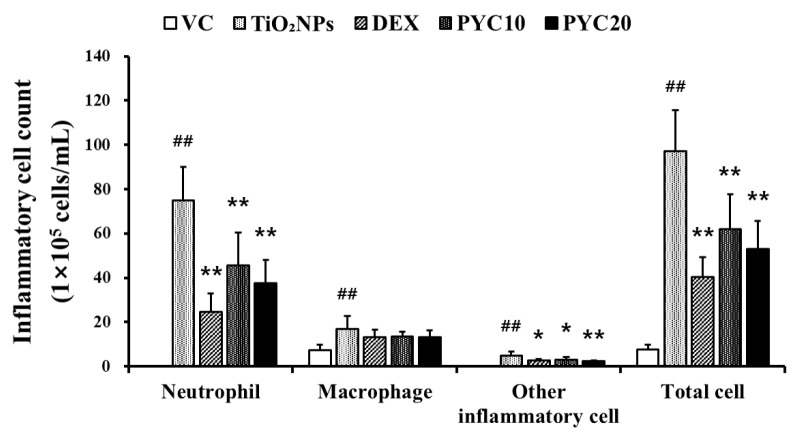
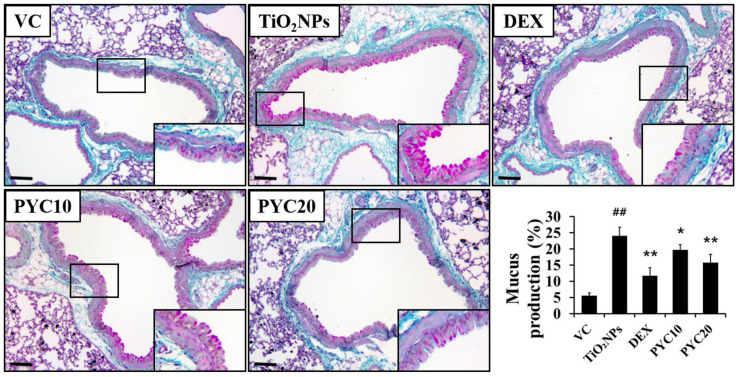
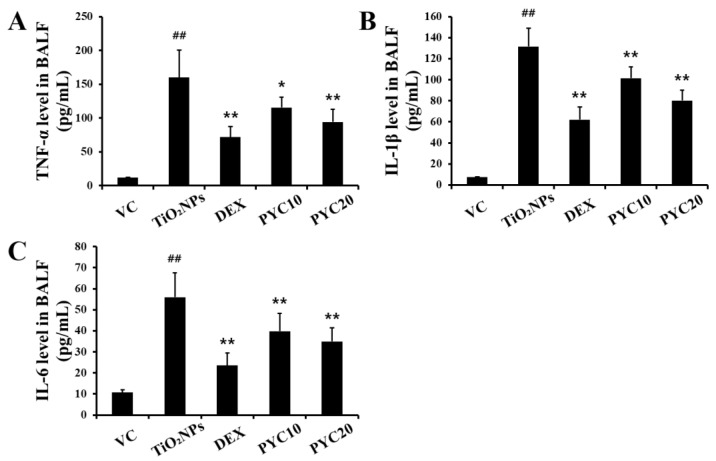
Titanium dioxide nanoparticles (TiONPs) are used in products that are applied to the human body, such as cosmetics and food, but their biocompatibility remains controversial. Pycnogenol (PYC), a natural extract of pine bark, exerts anti-inflammatory and antioxidant effects. In this study, we investigated whether PYC effectively alleviates pulmonary toxicity induced by airway exposure to TiONPs, and the beneficial effects of PYC were explained through the analysis of changes to the mechanism of cytotoxicity. TiONPs induced pulmonary inflammation and mucus production, increased the levels of malondialdehyde, and upregulated thioredoxin-interacting protein (TXNIP) and cleaved-caspase 3 (Cas3) in the lungs of mice. However, PYC treatment reduced the levels of all toxicity markers of TiONPs and restored glutathione levels. These antioxidant and anti-inflammatory effects of PYC were also demonstrated in TiONP-exposed human airway epithelial cells by increasing the mRNA levels of antioxidant enzymes and decreasing the expression of TXNIP, cleaved-Cas3, and inflammatory mediators. Taken together, our results showed that PYC attenuated TiONP-induced lung injury via TXNIP downregulation. Therefore, our results suggest the potential of PYC as an effective anti-inflammatory and antioxidant agent against TiONP-induced pulmonary toxicity.
二氧化钛纳米颗粒(TiONPs)被用于应用于人体的产品中,如化妆品和食品,但其生物相容性仍存在争议。碧萝芷(PYC)是一种松树皮天然提取物,具有抗炎和抗氧化作用。在本研究中,我们调查了PYC是否能有效减轻气道暴露于TiONPs所致的肺毒性,并通过分析细胞毒性机制的变化来解释PYC的有益作用。TiONPs可诱导小鼠肺部炎症和黏液分泌,增加丙二醛水平,并上调硫氧还蛋白相互作用蛋白(TXNIP)和裂解的半胱天冬酶3(Cas3)水平。然而,PYC处理降低了TiONPs所有毒性标志物的水平,并恢复了谷胱甘肽水平。PYC的这些抗氧化和抗炎作用在暴露于TiONPs的人气道上皮细胞中也得到了证实,表现为抗氧化酶mRNA水平升高,TXNIP、裂解的Cas3和炎症介质的表达降低。综上所述,我们的结果表明PYC通过下调TXNIP减轻了TiONP诱导的肺损伤。因此,我们的结果提示PYC作为一种有效的抗炎和抗氧化剂对抗TiONP诱导的肺毒性的潜力。