Greselin Martina, Lu Po-Jui, Melie-Garcia Lester, Ocampo-Pineda Mario, Galbusera Riccardo, Cagol Alessandro, Weigel Matthias, de Oliveira Siebenborn Nina, Ruberte Esther, Benkert Pascal, Müller Stefanie, Finkener Sebastian, Vehoff Jochen, Disanto Giulio, Findling Oliver, Chan Andrew, Salmen Anke, Pot Caroline, Bridel Claire, Zecca Chiara, Derfuss Tobias, Lieb Johanna M, Diepers Michael, Wagner Franca, Vargas Maria I, Pasquier Renaud Du, Lalive Patrice H, Pravatà Emanuele, Weber Johannes, Gobbi Claudio, Leppert David, Kim Olaf Chan-Hi, Cattin Philippe C, Hoepner Robert, Roth Patrick, Kappos Ludwig, Kuhle Jens, Granziera Cristina
Translational Imaging in Neurology (ThINk) Basel, Department of Biomedical Engineering, Faculty of Medicine, University Hospital Basel, University of Basel, 4123 Basel, Switzerland.
Department of Neurology, University Hospital Basel, 4031 Basel, Switzerland.
Bioengineering (Basel). 2024 Aug 22;11(8):858. doi: 10.3390/bioengineering11080858.
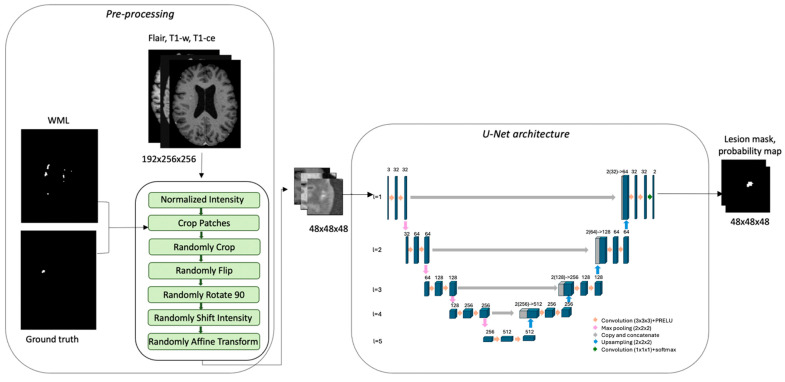
The detection of contrast-enhancing lesions (CELs) is fundamental for the diagnosis and monitoring of patients with multiple sclerosis (MS). This task is time-consuming and suffers from high intra- and inter-rater variability in clinical practice. However, only a few studies proposed automatic approaches for CEL detection. This study aimed to develop a deep learning model that automatically detects and segments CELs in clinical Magnetic Resonance Imaging (MRI) scans. A 3D UNet-based network was trained with clinical MRI from the Swiss Multiple Sclerosis Cohort. The dataset comprised 372 scans from 280 MS patients: 162 showed at least one CEL, while 118 showed no CELs. The input dataset consisted of T1-weighted before and after gadolinium injection, and FLuid Attenuated Inversion Recovery images. The sampling strategy was based on a white matter lesion mask to confirm the existence of real contrast-enhancing lesions. To overcome the dataset imbalance, a weighted loss function was implemented. The Dice Score Coefficient and True Positive and False Positive Rates were 0.76, 0.93, and 0.02, respectively. Based on these results, the model developed in this study might well be considered for clinical decision support.
检测对比增强病灶(CELs)是多发性硬化症(MS)患者诊断和监测的基础。在临床实践中,这项任务耗时且存在较高的评分者内和评分者间变异性。然而,只有少数研究提出了用于CEL检测的自动方法。本研究旨在开发一种深度学习模型,用于在临床磁共振成像(MRI)扫描中自动检测和分割CELs。基于3D UNet的网络使用来自瑞士多发性硬化症队列的临床MRI进行训练。该数据集包含来自280名MS患者的372次扫描:162次显示至少一个CEL,而118次未显示CEL。输入数据集包括钆注射前后的T1加权图像以及液体衰减反转恢复图像。采样策略基于白质病变掩码以确认真实对比增强病灶的存在。为克服数据集不平衡问题,实施了加权损失函数。Dice评分系数、真阳性率和假阳性率分别为0.76、0.93和0.02。基于这些结果,本研究开发的模型很可能可用于临床决策支持。