Department of Biomaterials and Composites, Faculty of Materials Science and Ceramics, AGH University of Krakow, Al. Mickiewicza 30, 30-059 Krakow, Poland.
Department of Rubber and Plastics Technology, Madras Institute of Technology Campus, Anna University, Chromepet, Chennai 600 044, Tamil Nadu, India.
Molecules. 2024 Aug 12;29(16):3826. doi: 10.3390/molecules29163826.
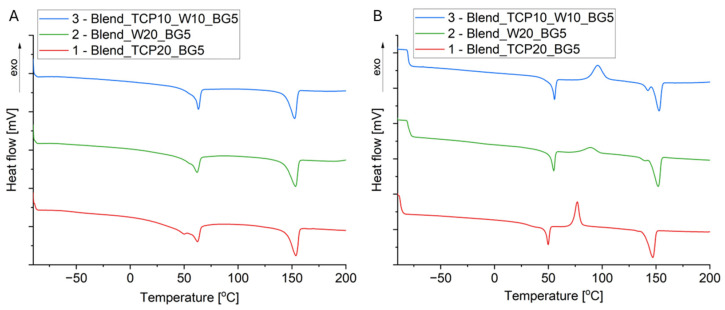
Bone tissue exhibits self-healing properties; however, not all defects can be repaired without surgical intervention. Bone tissue engineering offers artificial scaffolds, which can act as a temporary matrix for bone regeneration. The aim of this study was to manufacture scaffolds made of poly(lactic acid), poly(ε-caprolactone), poly(propylene fumarate), and poly(ethylene glycol) modified with bioglass, beta tricalcium phosphate (TCP), and/or wollastonite (W) particles. The scaffolds were fabricated using a gel-casting method and observed with optical and scanning electron microscopes. Attenuated total reflectance-Fourier transform infrared (ATR-FTIR), differential scanning calorimetry (DSC), thermogravimetry (TG), wettability, and degradation tests were conducted. The highest content of TCP without W in the composition caused the highest hydrophilicity (water contact angle of 61.9 ± 6.3°), the fastest degradation rate (7% mass loss within 28 days), moderate ability to precipitate CaP after incubation in PBS, and no cytotoxicity for L929 cells. The highest content of W without TCP caused the highest hydrophobicity (water contact angle of 83.4 ± 1.7°), the lowest thermal stability, slower degradation (3% mass loss within 28 days), and did not evoke CaP precipitation. Moreover, some signs of cytotoxicity on day 1 were observed. The samples with both TCP and W showed moderate properties and the best cytocompatibility on day 4. Interestingly, they were covered with typical cauliflower-like hydroxyapatite deposits after incubation in phosphate-buffered saline (PBS), which might be a sign of their excellent bioactivity.
骨组织具有自我修复的特性;然而,并非所有的缺损都可以在不进行手术干预的情况下得到修复。骨组织工程提供了人工支架,这些支架可以作为骨再生的临时基质。本研究的目的是制造由聚乳酸、聚己内酯、聚丙交酯和聚乙二醇制成的支架,并对其进行生物玻璃、β-磷酸三钙(TCP)和/或硅灰石(W)颗粒的改性。支架采用凝胶浇铸法制造,并通过光学显微镜和扫描电子显微镜进行观察。进行了衰减全反射傅里叶变换红外光谱(ATR-FTIR)、差示扫描量热法(DSC)、热重分析(TG)、润湿性和降解试验。在组成中不含 W 的 TCP 含量最高导致了最高的亲水性(水接触角为 61.9 ± 6.3°)、最快的降解速度(28 天内 7%的质量损失)、在 PBS 孵育后沉淀 CaP 的适度能力以及对 L929 细胞无细胞毒性。在组成中不含 TCP 的 W 含量最高导致了最高的疏水性(水接触角为 83.4 ± 1.7°)、最低的热稳定性、较慢的降解速度(28 天内 3%的质量损失),并且没有引发 CaP 沉淀。此外,在第 1 天观察到一些细胞毒性的迹象。在第 4 天,同时含有 TCP 和 W 的样品表现出中等的特性和最佳的细胞相容性。有趣的是,它们在磷酸盐缓冲盐水(PBS)中孵育后被典型的菜花状羟基磷灰石沉积物覆盖,这可能是其优异的生物活性的标志。