School of Civil and Environmental Engineering, Nanchang Institute of Science and Technology, Nanchang 330108, China.
Department of Biological and Health Sciences, Pak-Austria Fachhochschule: Institute of Applied Sciences and Technology, Khanpur Road Haripur 22621, Pakistan.
Molecules. 2024 Aug 13;29(16):3838. doi: 10.3390/molecules29163838.
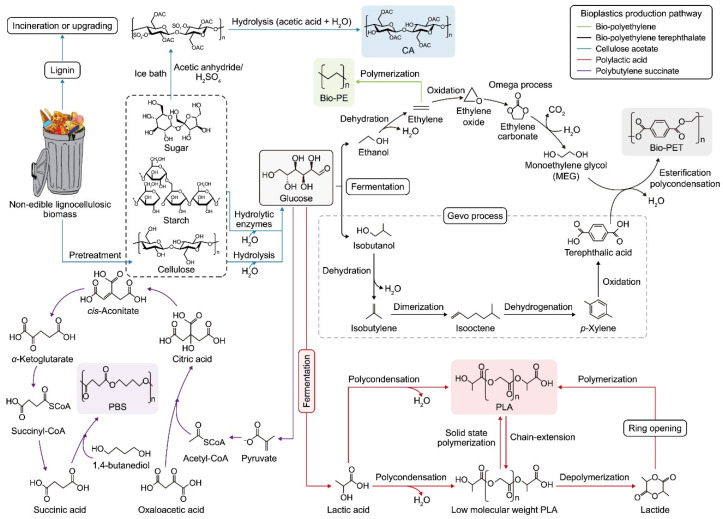
Lignocellulose is a major biopolymer in plant biomass with a complex structure and composition. It consists of a significant amount of high molecular aromatic compounds, particularly vanillin, syringeal, ferulic acid, and muconic acid, that could be converted into intracellular metabolites such as polyhydroxyalkanoates (PHA) and hydroxybutyrate (PHB), a key component of bioplastic production. Several pre-treatment methods were utilized to release monosaccharides, which are the precursors of the relevant pathway. The consolidated bioprocessing of lignocellulose-capable microbes for biomass depolymerization was discussed in this study. Carbon can be stored in a variety of forms, including PHAs, PHBs, wax esters, and triacylglycerides. From a biotechnology standpoint, these compounds are quite adaptable due to their precursors' utilization of hydrogen energy. This study lays the groundwork for the idea of lignocellulose valorization into value-added products through several significant dominant pathways.
木质纤维素是植物生物质中的一种主要生物聚合物,具有复杂的结构和组成。它由大量的高分子芳香族化合物组成,特别是香草醛、松柏醛、阿魏酸和粘康酸,这些化合物可以转化为细胞内代谢物,如聚羟基烷酸(PHA)和羟基丁酸(PHB),这是生物塑料生产的关键成分。本研究讨论了利用木质纤维素能力强的微生物进行生物量解聚的综合生物加工。碳可以以多种形式储存,包括 PHAs、PHB、蜡酯和三酰基甘油。从生物技术的角度来看,由于它们的前体利用氢能,这些化合物具有很强的适应性。本研究通过几条重要的优势途径为木质纤维素增值为高附加值产品的理念奠定了基础。