Herbert Wertheim School of Public Health and Longevity Science, University of California San Diego, La Jolla, CA 92093-0725, USA.
Department of Family Medicine, School of Medicine, University of California San Diego, La Jolla, CA 92093-0725, USA.
Nutrients. 2024 Aug 19;16(16):2765. doi: 10.3390/nu16162765.
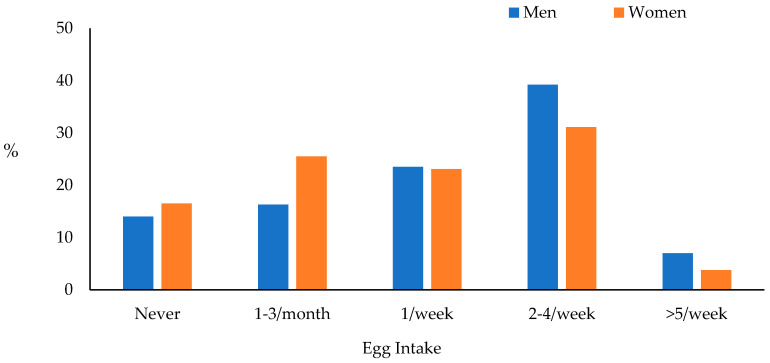
The effect of dietary cholesterol on cognitive function is debatable. While eggs contain high levels of dietary cholesterol, they provide nutrients beneficial for cognitive function. This study examined the effects of egg consumption on change in cognitive function among 890 ambulatory adults (N = 357 men; N = 533 women) aged ≥55 years from the Rancho Bernardo Study who attended clinic visits in 1988-1991 and 1992-1996. Egg intake was obtained in 1988-1991 with a food frequency questionnaire. The Mini-Mental Status Exam (MMSE), Trails B, and category fluency were administered at both visits to assess cognitive performance. Sex-specific multiple regression analyses tested associations of egg intake with changes in cognitive function after adjustment for confounders. The mean time between visits was 4.1 ± 0.5 years; average ages were 70.1 ± 8.4 in men and 71.5 ± 8.8 in women ( = 0.0163). More men consumed eggs at higher levels than women; while 14% of men and 16.5% of women reported never eating eggs, 7.0% of men and 3.8% of women reported intakes ≥5/week ( = 0.0013). In women, after adjustment for covariates, egg consumption was associated with decline in category fluency (beta = -0.10, = 0.0241). Other associations were nonsignificant in women, and no associations were found in men. Results suggest that egg consumption has a small beneficial effect on semantic memory in women. The lack of decline observed in both sexes suggests that egg consumption does not have detrimental effects and may even have a role in the maintenance of cognitive function.
饮食胆固醇对认知功能的影响仍存在争议。虽然鸡蛋含有较高水平的饮食胆固醇,但它们也提供了对认知功能有益的营养物质。本研究旨在探讨鸡蛋摄入对 890 名年龄≥55 岁的、处于社区活动状态的成年人(男性 357 人,女性 533 人)认知功能变化的影响,这些成年人来自 Rancho Bernardo 研究,并于 1988-1991 年和 1992-1996 年参加了临床随访。鸡蛋摄入量于 1988-1991 年通过食物频率问卷进行评估。两次随访时均采用简易精神状态检查(MMSE)、Trails B 和类别流畅性测试评估认知表现。性别特异性多元回归分析检验了鸡蛋摄入量与调整混杂因素后认知功能变化之间的关联。两次随访之间的平均时间为 4.1±0.5 年;男性平均年龄为 70.1±8.4 岁,女性为 71.5±8.8 岁( = 0.0163)。与女性相比,更多的男性以较高水平摄入鸡蛋;尽管 14%的男性和 16.5%的女性报告从不食用鸡蛋,但 7.0%的男性和 3.8%的女性报告每周食用≥5 个鸡蛋( = 0.0013)。在女性中,调整协变量后,鸡蛋摄入量与类别流畅性下降相关(β= -0.10, = 0.0241)。女性的其他关联无统计学意义,而男性则没有发现任何关联。结果表明,鸡蛋摄入对女性的语义记忆有较小的有益影响。在两性中均未观察到下降,这表明鸡蛋摄入没有不良影响,甚至可能在维持认知功能方面发挥作用。