Yang Yong, Yang Zhi, Ferguson David Kay
Co-Innovation Center for Sustainable Forestry in Southern China, State Key Laboratory of Tree Genetics and Breeding, College of Life Sciences, Nanjing Forestry University, Nanjing 210037, China.
Department of Paleontology, University of Vienna, 1010 Vienna, Austria.
Plants (Basel). 2024 Aug 8;13(16):2196. doi: 10.3390/plants13162196.
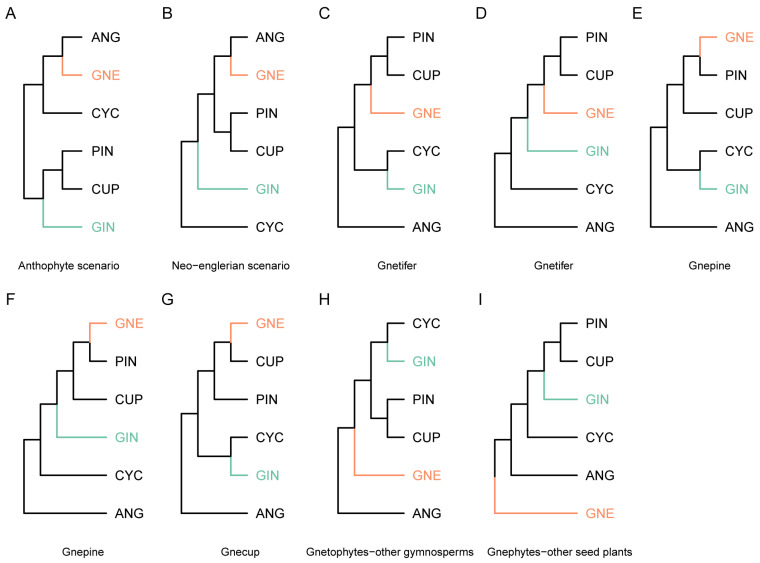
Gymnosperms originated in the Middle Devonian and have experienced a long evolutionary history with pulses of speciation and extinction, which resulted in the four morphologically distinct extant groups, i.e., cycads, , conifers and gnetophytes. For over a century, the systematic relationships within the extant gymnosperms have been debated because different authors emphasized different characters. Recent phylogenomic studies of gymnosperms have given a consistent topology, which aligns well with extant gymnosperms classified into three classes, five subclasses, eight orders, and 13 families. Here, we review the historical opinions of systematics of gymnosperms with special reference to several problematic taxa and reconsider the evolution of some key morphological characters previously emphasized by taxonomists within a phylogenomic context. We conclude that (1) cycads contain two families, i.e., the Cycadaceae and the Zamiaceae; (2) is sister to cycads but not to conifers, with the similarities between and conifers being the result of parallel evolution including a monopodial growth pattern, pycnoxylic wood in long shoots, and the compound female cones, and the reproductive similarities between and cycads are either synapomorphic or plesiomorphic, e.g., the boat-shaped pollen, the branched pollen tube, and the flagellate sperms; (3) conifers are paraphyletic with gnetophytes nested within them, thus gnetophytes are derived conifers, and our newly delimited coniferophytes are equivalent to the Pinopsida and include three subclasses, i.e., Pinidae, Gnetidae, and Cupressidae; (4) fleshy cones of conifers originated multiple times, the Podocarpaceae are sister to the Araucariaceae, the Cephalotaxaceae and the Taxaceae comprise a small clade, which is sister to the Cupressaceae; (5) the Cephalotaxaceae are distinct from the Taxaceae, because the former family possesses typical female cones and the fleshy part of the seed is derived from the fleshiness of integument, while the latter family has reduced female cones and preserves no traces of the seed scale complexes.
裸子植物起源于泥盆纪中期,经历了漫长的进化历史,其间有物种形成和灭绝的波动,这导致了现存四个形态上不同的类群,即苏铁、银杏、松柏类和买麻藤类。一个多世纪以来,现存裸子植物的系统发育关系一直存在争议,因为不同的作者强调不同的特征。最近对裸子植物的系统发育基因组学研究给出了一个一致的拓扑结构,这与现存裸子植物分为三个纲、五个亚纲、八个目和13个科的分类情况吻合得很好。在这里,我们回顾裸子植物系统学的历史观点,特别提及几个有问题的分类群,并在系统发育基因组学背景下重新考虑分类学家之前强调的一些关键形态特征的进化。我们得出以下结论:(1)苏铁包括两个科,即苏铁科和泽米科;(2)银杏是苏铁的姐妹群,而不是松柏类的姐妹群,银杏与松柏类之间的相似性是平行进化的结果,包括单轴生长模式、长枝上的紧密木质部以及复合雌球果,银杏与苏铁之间的生殖相似性要么是共衍征要么是祖征,例如船形花粉、分枝花粉管和具鞭毛精子;(3)松柏类是并系群,买麻藤类嵌套在其中,因此买麻藤类是衍生的松柏类,我们新划定的松柏植物门相当于松柏纲,包括三个亚纲,即松亚纲、买麻藤亚纲和柏亚纲;(4)松柏类的肉质球果多次起源,罗汉松科是南洋杉科的姐妹群,三尖杉科和红豆杉科组成一个小分支,是柏科的姐妹群;(5)三尖杉科与红豆杉科不同,因为前者有典型的雌球果,种子的肉质部分源自珠被的肉质化,而后者雌球果退化,种子鳞复合体无痕迹留存。