
通过无监督机器学习识别的难治性肌肉骨骼疼痛综合征中的疾病表型
Disease Phenotypes in Refractory Musculoskeletal Pain Syndromes Identified by Unsupervised Machine Learning.
作者信息
Hügle Thomas, Prétat Tiffany, Suter Marc, Lovejoy Chris, Ming Azevedo Pedro
机构信息
University Hospital Lausanne and University of Lausanne, Lausanne, Switzerland.
出版信息
ACR Open Rheumatol. 2024 Nov;6(11):790-798. doi: 10.1002/acr2.11699. Epub 2024 Aug 29.
OBJECTIVE
Overlapping chronic pain syndromes, including fibromyalgia, are heterogeneous and often treatment-resistant entities carrying significant socioeconomic burdens. Individualized treatment approaches from both a somatic and psychological side are necessary to improve patient care. The objective of this study was to identify and visualize patient clusters in refractory musculoskeletal pain syndromes through an extensive set of clinical variables, including immunologic, psychosomatic, wearable, and sleep biomarkers.
METHODS
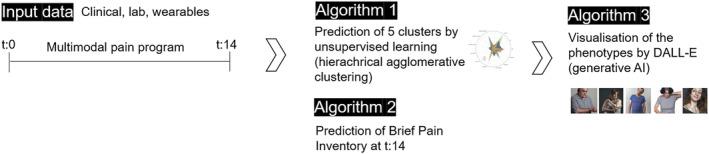
Data were collected during a multimodal pain program involving 202 patients. Seventy-eight percent of the patients fulfilled the criteria for fibromyalgia, 77% had a concomitant psychiatric-mediated disorder, and 22% a concomitant rheumatic immune-mediated disorder. Five patient phenotypes were identified by hierarchical agglomerative clustering as a form of unsupervised learning, and a predictive model for the Brief Pain Inventory (BPI) response was generated. Based on the clustering data, digital personas were created with DALL-E (OpenAI).
RESULTS
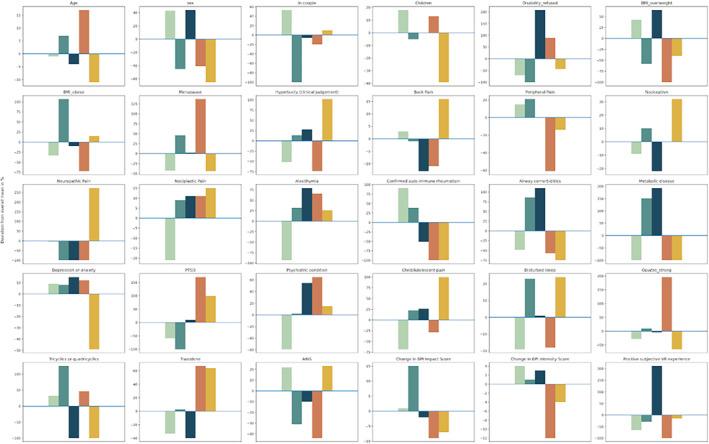
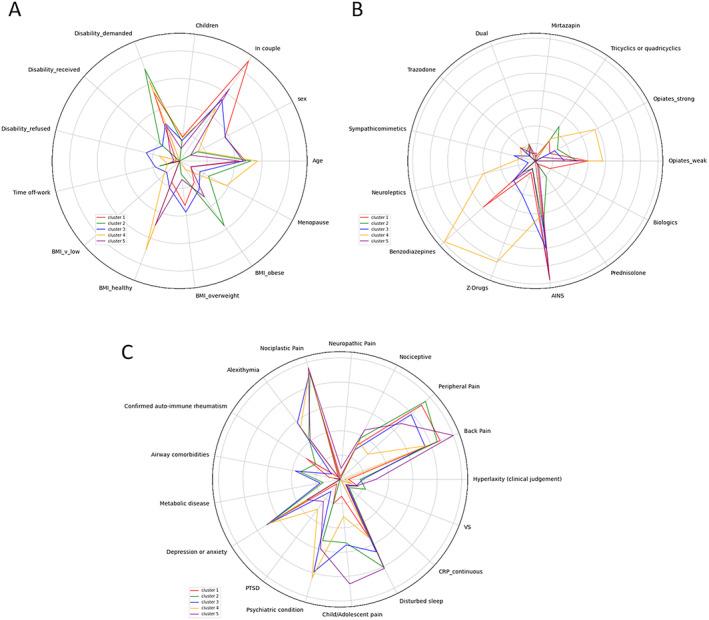
The most relevant distinguishing factors among clusters were living alone, body mass index, peripheral joint pain, alexithymia, psychiatric comorbidity, childhood pain, neuroleptic or benzodiazepine medication, and response to virtual reality. Having an immune-mediated disorder was not discriminatory. Three of five clusters responded to the multimodal treatment in terms of pain (BPI intensity), one cluster responded in terms of functional improvement (BPI interference), and one cluster notably responded to the virtual reality intervention. The independent predictive model confirmed strong opioids, trazodone, neuroleptic treatment, and living alone as the most important negative predictive factors for reduced pain after the program.
CONCLUSION
Our model identified and visualized clinically relevant chronic musculoskeletal pain subtypes and predicted their response to multimodal treatment. Such digital personas and avatars may play a future role in the design of personalized therapeutic modalities and clinical trials.
目的
包括纤维肌痛在内的重叠性慢性疼痛综合征具有异质性,且往往难以治疗,给社会经济带来重大负担。从躯体和心理两方面采取个体化治疗方法对于改善患者护理至关重要。本研究的目的是通过一系列广泛的临床变量,包括免疫、身心、可穿戴和睡眠生物标志物,识别并可视化难治性肌肉骨骼疼痛综合征中的患者集群。
方法
在一个涉及202名患者的多模式疼痛项目中收集数据。78%的患者符合纤维肌痛标准,77%伴有精神介导的疾病,22%伴有风湿免疫介导的疾病。通过层次凝聚聚类这种无监督学习形式识别出五种患者表型,并生成了简明疼痛量表(BPI)反应的预测模型。基于聚类数据,使用DALL-E(OpenAI)创建了数字角色。
结果
各集群之间最相关的区分因素包括独居、体重指数、外周关节疼痛、述情障碍、精神共病、童年疼痛、使用抗精神病药物或苯二氮䓬类药物以及对虚拟现实的反应。患有免疫介导的疾病并无区分作用。五个集群中有三个在疼痛方面(BPI强度)对多模式治疗有反应,一个集群在功能改善方面(BPI干扰)有反应,一个集群对虚拟现实干预有显著反应。独立预测模型证实,强效阿片类药物、曲唑酮、抗精神病治疗和独居是该项目后疼痛减轻的最重要负性预测因素。
结论
我们的模型识别并可视化了临床上相关的慢性肌肉骨骼疼痛亚型,并预测了它们对多模式治疗的反应。此类数字角色和虚拟形象可能在个性化治疗模式设计和临床试验中发挥未来作用。

 Zotero 插件