School of Public Health, College of Health Sciences and Medicine, Dilla University, Dilla, Ethiopia.
Department of Psychiatry, College of Health Sciences and Medicine, Dilla University, Dilla, Ethiopia.
BMC Psychiatry. 2024 Aug 30;24(1):588. doi: 10.1186/s12888-024-06047-w.
In almost every country in the world, mental health problems are alarmingly on the rise. There are various myths and beliefs regarding mental health across various communities' that deviate from the scientific view. This may negatively affect treatment seeking and adherence among people with mental illness. We aimed to systematically review community perceptions of mental health problems in Ethiopia.
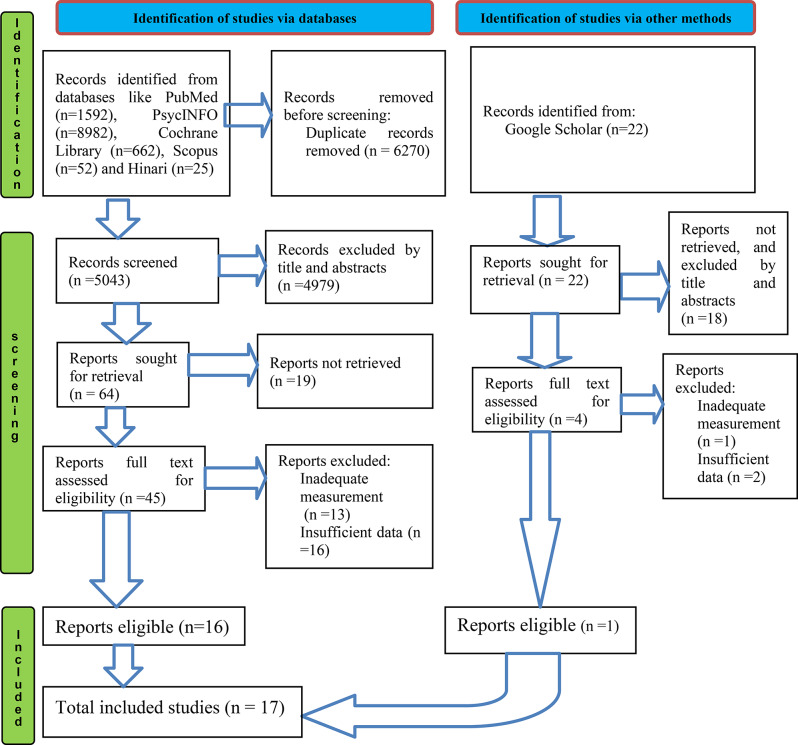
MEDLINE/Pub Med, PsycINFO, Cochrane Library, Scopus/Science Direct, Hinari, and Google Scholar were systematically searched. The review was carried out following a mixed-method narrative synthesis approach and the Preferred Reporting Items for Systematic Reviews and Meta-Analyses (PRISMA) guideline. Five qualitative and twelve quantitative primary studies that focused on the community's perceptions of mental health problems in Ethiopia were included. The Joanna Briggs Institute (JBI) guidance for conducting a mixed-method systematic review approach was used. A narrative synthesis following thematic analysis was conducted using a combination of the transformed quantitative data and the data from qualitative studies.
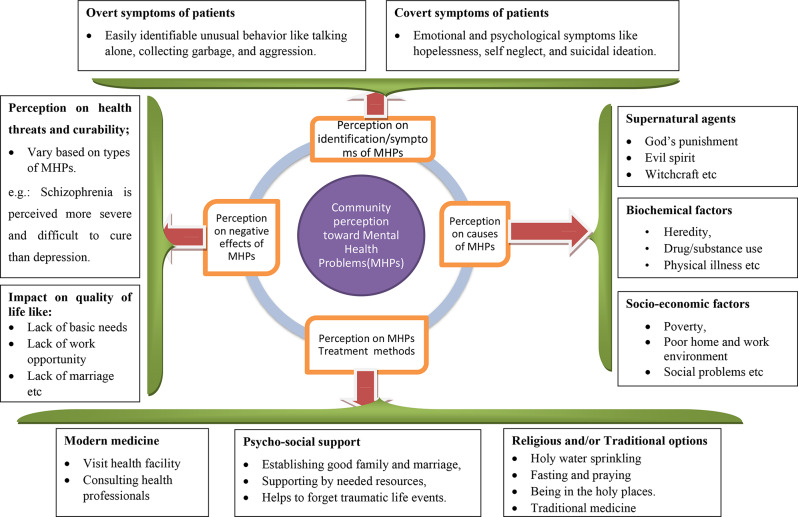
The review findings were classified into four domains, which are: perceived causes, identification symptoms, severity of mental disorders, and preferred treatment options. The community's perceptions of the causes of mental health problems consist of supernatural agents, socio-economic factors, and biochemical factors. Perceptions of treatment options comprise: religious treatment, modern medicine, psychosocial support, and traditional treatment.
A variety of community perceptions towards mental health problems were seen. The community's perceptions vary from person to person and among types of mental health problems. Considering community-held beliefs helps programmers and implementers to design prevention, control, and management strategies for mental health problems.
在世界上几乎每个国家,精神健康问题都惊人地呈上升趋势。在不同社区中,存在着各种偏离科学观点的精神健康神话和观念。这可能会对精神疾病患者的求诊和治疗依从性产生负面影响。我们旨在系统地回顾埃塞俄比亚社区对精神健康问题的看法。
我们系统地检索了 MEDLINE/Pub Med、PsycINFO、Cochrane 图书馆、Scopus/Science Direct、Hinari 和 Google Scholar。该综述采用混合方法叙述性综合方法进行,并遵循系统评价和荟萃分析的 Preferred Reporting Items(PRISMA)指南。纳入了五项专注于埃塞俄比亚社区对精神健康问题看法的定性和十二项定量初级研究。采用乔安娜·布里格斯研究所(JBI)的混合方法系统评价方法指南进行了混合方法系统评价。采用主题分析的叙述性综合,结合转化后的定量数据和定性研究的数据进行分析。
综述结果分为四个领域,分别是:感知原因、识别症状、精神障碍严重程度和首选治疗方案。社区对精神健康问题的成因的看法包括超自然因素、社会经济因素和生物化学因素。对治疗方案的看法包括:宗教治疗、现代医学、心理社会支持和传统治疗。
对精神健康问题存在着各种社区看法。社区的看法因人而异,也因不同类型的精神健康问题而异。考虑到社区的信仰有助于规划人员和实施者设计精神健康问题的预防、控制和管理策略。