Department of Hematology, Affiliated Hospital 6 of Nantong University, 02 Xinduxi Road, Yancheng, 224000, China.
Department of Hematology, Yancheng Third People's Hospital, 02 Xinduxi Road, Yancheng, 224000, China.
BMC Neurol. 2024 Aug 31;24(1):306. doi: 10.1186/s12883-024-03818-6.
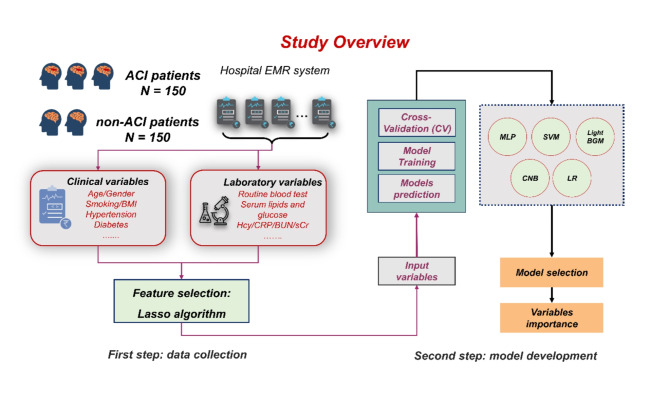
The aim of this study was to develop machine learning-based models for predicting acute cerebral infarction (ACI) in patients.
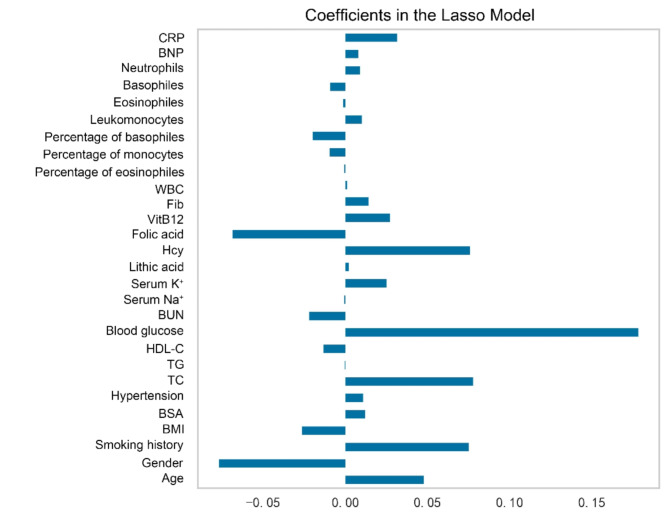
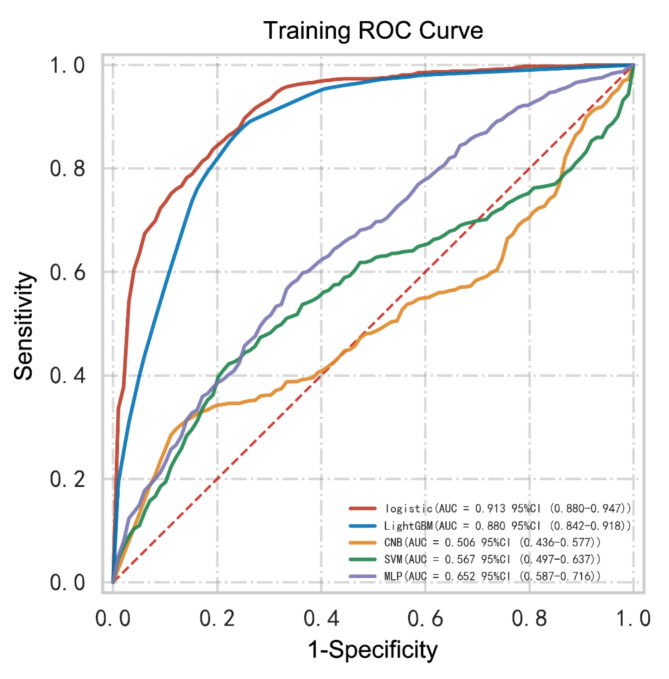
We extracted the data of ACI patients and non-ACI patients (as control) from two hospitals. The Lasso algorithm was employed to select the most crucial features associated with ACI. Five machine learning algorithms-based models were trained, which was performed with 10-fold cross-validation. Then, the area under the receiver operating characteristic curve (AUC), accuracy, and F1-score were calculated in the training models. Accordingly, the training models with excellent performance was selected as the final predictive model. The relative importance of variables was analyzed and ranked.
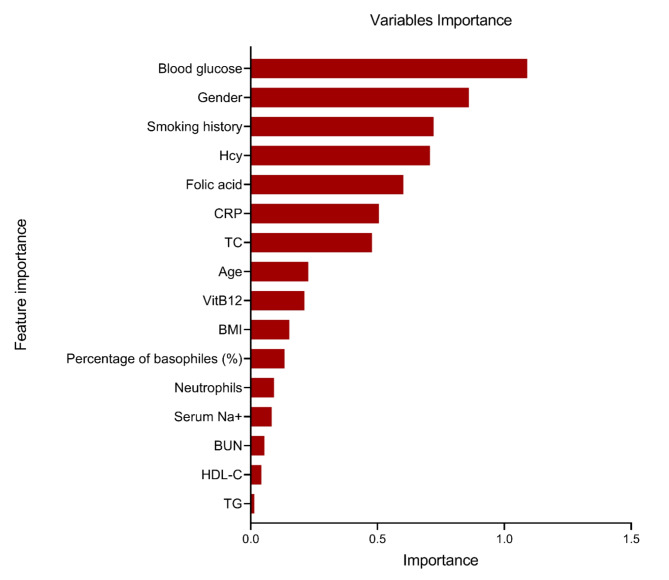
A total of 150 patients were diagnosed with ACI (50.00%), with a higher proportion of males (70.67% vs. 44.00%) compared to the non-ACI patients. The logistic regression model exhibited a good performance in predicting ACI in the training set, as evidenced by its highest AUC, accuracy, sensitivity, and F1-score. Furthermore, feature importance analysis showed that blood glucose, gender, smoking history, serum homocysteine, folic acid, and C-reactive protein were the top six crucial variables of the logistic regression.
In our work, the ACI risk prediction model developed by the logistic regression exhibited excellent performance. This could contribute to the identification of risk variables for ACI patients and enables clinicians timely and effective interventions.
本研究旨在开发基于机器学习的模型,以预测患者的急性脑梗死(ACI)。
我们从两家医院提取了 ACI 患者和非 ACI 患者(作为对照)的数据。使用 Lasso 算法选择与 ACI 最相关的关键特征。使用 10 折交叉验证训练了基于 5 种机器学习算法的模型。然后,在训练模型中计算了受试者工作特征曲线下的面积(AUC)、准确性和 F1 分数。根据这些结果,选择性能优异的训练模型作为最终预测模型。对变量的相对重要性进行了分析和排序。
共诊断出 150 例 ACI 患者(50.00%),其中男性比例(70.67%比 44.00%)高于非 ACI 患者。逻辑回归模型在训练集中对 ACI 的预测表现良好,其 AUC、准确性、敏感性和 F1 分数最高。此外,特征重要性分析表明,血糖、性别、吸烟史、血清同型半胱氨酸、叶酸和 C 反应蛋白是逻辑回归的前六个关键变量。
在我们的工作中,逻辑回归开发的 ACI 风险预测模型表现出优异的性能。这有助于确定 ACI 患者的风险变量,并使临床医生能够及时有效地进行干预。