
外源水杨酸处理通过调节次级代谢产物的产生来增强抗病性。 (原句“enhances the disease resistance of by”表述有误,推测完整句子可能是“enhances the disease resistance of plants by” ,这里按推测后的完整意思翻译)
Exogenous salicylic acid treatment enhances the disease resistance of by regulating secondary metabolite production.
作者信息
Hou Jiae, Ai Mingtao, Li Jianbin, Cui Xiuming, Liu Yuan, Yang Qian
机构信息
Faculty of Life Science and Technology, Kunming University of Science and Technology, Kunming, China.
Key Laboratory of Panax notoginseng Resources Sustainable Development and Utilization of State Administration of Traditional Chinese Medicine, Kunming, China.
出版信息
Front Plant Sci. 2024 Aug 16;15:1428272. doi: 10.3389/fpls.2024.1428272. eCollection 2024.
INTRODUCTION
Salicylic acid (SA) is a phenolic compound widely found in plants. It plays a key role in exerting plant disease resistance. Ha & Grushv., a valuable medicinal plant, contains high levels of phenolic compounds, which contribute significantly to the resilience of the plant against stress. However, the precise role of SA in regulating the synthesis of secondary metabolites in remains elusive.
METHODS
Two-year-old seedlings were treated with exogenous SA. We systematically assessed the changes in the physiological parameters of SA-treated leaves, employing transcriptome and metabolome analyses to elucidate the underlying mechanisms.
RESULTS
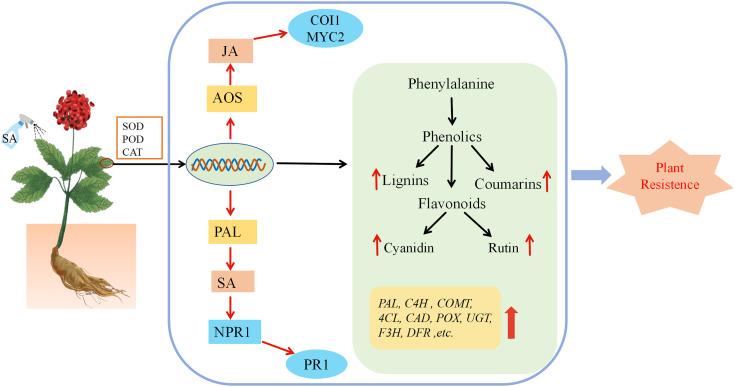
Our results revealed a significant improvement of the plant's antioxidant capacity at 6 h post-treatment. Furthermore, exogenous SA treatment promoted the biosynthesis of lignin and flavonoids such as rutin, coumarin, and cyanidin. In addition, it increased the levels of endogenous SA and jasmonic acid (JA), promoting the disease resistance of the plants. Thus, SA pretreatment enhanced the defense of P. vietnamensis against pathogens.
CONCLUSIONS
Our study provided novel insights into the potential molecular mechanisms underlying SA-mediated biosynthesis of secondary metabolites. Furthermore, our results provided a theoretical foundation for optimizing the cultivation practices of and the application of SA as a plant immunomodulator.
引言
水杨酸(SA)是一种广泛存在于植物中的酚类化合物。它在发挥植物抗病性方面起着关键作用。珍贵药用植物越南槐(Ha & Grushv.)含有高水平的酚类化合物,这对植物抵御胁迫的恢复力有显著贡献。然而,SA在调控越南槐次生代谢产物合成中的精确作用仍不清楚。
方法
用外源SA处理两年生越南槐幼苗。我们系统评估了SA处理的越南槐叶片生理参数的变化,采用转录组和代谢组分析来阐明潜在机制。
结果
我们的结果显示,处理后6小时植物的抗氧化能力有显著提高。此外,外源SA处理促进了木质素和黄酮类化合物如芦丁、香豆素和花青素的生物合成。此外,它还增加了内源SA和茉莉酸(JA)的水平,促进了植物的抗病性。因此,SA预处理增强了越南槐对病原体的防御能力。
结论
我们的研究为SA介导的次生代谢产物生物合成的潜在分子机制提供了新的见解。此外,我们的结果为优化越南槐的栽培实践以及SA作为植物免疫调节剂的应用提供了理论基础。




 Zotero 插件