Department of Pulmonary and Critical Care Medicine, Shenzhen Hospital, Peking University, Shenzhen, Guangdong, China.
Department of Pulmonary and Critical Care Medicine, The Eighth Affiliated Hospital, Sun Yat-sen University, Shenzhen, Guangdong, China.
Ann Med. 2024 Dec;56(1):2397090. doi: 10.1080/07853890.2024.2397090. Epub 2024 Sep 2.
The quick sequential [sepsis-related] organ failure assessment (qSOFA) acts as a prompt to consider possible sepsis. The contributions of individual qSOFA elements to assessment of severity and for prediction of mortality remain unknown.
A total of 3974 patients with community-acquired pneumonia were recruited to an observational prospective cohort study. The area under the receiver operating characteristic curve (AUROC), odds ratio, relative risk and Youden's index were employed to assess discrimination.
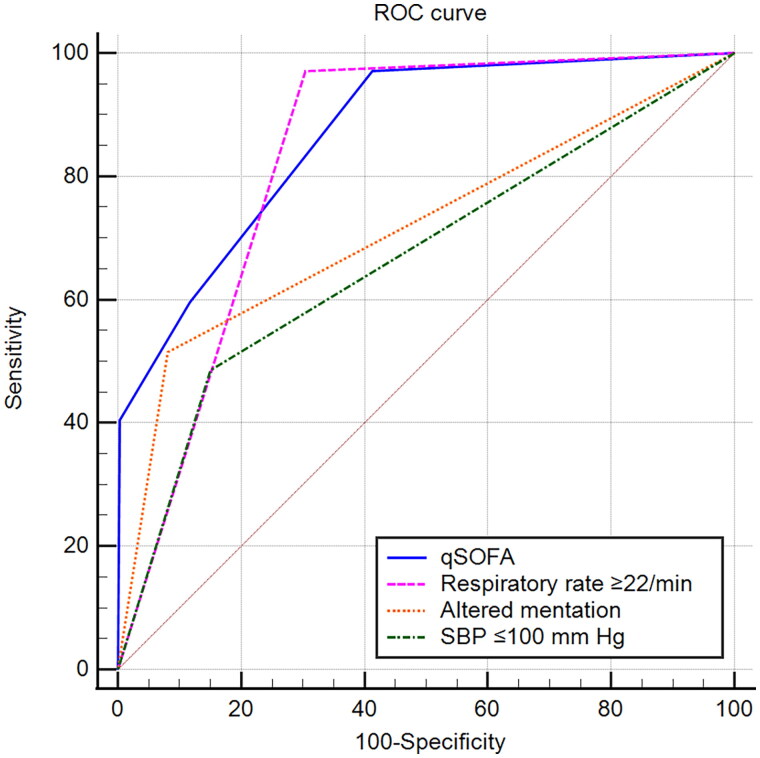
Respiratory rate ≥22/min demonstrated the most superior diagnostic value, indicated by largest odds ratio, relative risk and AUROC, and maximum Youden's index for mortality. However, the indices for altered mentation and systolic blood pressure (SBP) ≤100 mm Hg decreased notably in turn. The predictive validities of respiratory rate ≥22/min, altered mentation and SBP ≤100 mm Hg were good, adequate and poor for mortality, indicated by AUROC (0.837, 0.734 and 0.671, respectively). Respiratory rate ≥22/min showed the strongest associations with SOFA scores, pneumonia severity index, hospital length of stay and costs. However, SBP ≤100 mm Hg was most weakly correlated with the indices.
Respiratory rate ≥22/min made the greatest contribution to parsimonious qSOFA to assess severity and predict mortality. However, the contributions of altered mentation and SBP ≤100 mm Hg decreased strikingly in turn. It is the first known prospective evidence of the contributions of individual qSOFA elements to assessment of severity and for prediction of mortality, which might have implications for more accurate clinical triage decisions.
快速序贯 [与脓毒症相关的] 器官衰竭评估(qSOFA)可作为考虑可能发生脓毒症的提示。各个 qSOFA 元素对严重程度评估和死亡率预测的贡献仍不清楚。
共招募了 3974 名社区获得性肺炎患者参与一项观察性前瞻性队列研究。采用受试者工作特征曲线下面积(AUROC)、优势比、相对风险和 Youden 指数来评估区分度。
呼吸频率≥22/min 具有最大的诊断价值,表现为最大的优势比、相对风险和 AUROC,以及最大的用于死亡率的 Youden 指数。然而,改变意识状态和收缩压(SBP)≤100mmHg 的指标则依次显著降低。呼吸频率≥22/min、改变意识状态和 SBP≤100mmHg 对死亡率的预测准确性分别为良好、足够和较差,AUROC 值分别为 0.837、0.734 和 0.671。呼吸频率≥22/min 与 SOFA 评分、肺炎严重指数、住院时间和费用的相关性最强。然而,SBP≤100mmHg 与这些指标的相关性最弱。
呼吸频率≥22/min 对简化 qSOFA 评估严重程度和预测死亡率的贡献最大。然而,改变意识状态和 SBP≤100mmHg 的贡献则依次显著降低。这是首次已知的关于各个 qSOFA 元素对严重程度评估和死亡率预测的贡献的前瞻性证据,可能对更准确的临床分诊决策具有重要意义。