Chen Anthony, Lax Stephanie J, Grainge Matthew J, Lanyon Peter C, Pearce Fiona A
Lifespan and Population Health, School of Medicine, University of Nottingham, Nottingham, UK.
Department of Rheumatology, Nottingham University Hospitals NHS Trust, Nottingham, UK.
Rheumatol Adv Pract. 2024 Jul 27;8(3):rkae086. doi: 10.1093/rap/rkae086. eCollection 2024.
To comprehensively review systematic reviews of prevalence, incidence, and mortality of Raynaud's, Sjögren's and Scleroderma, and to identify any research gaps.
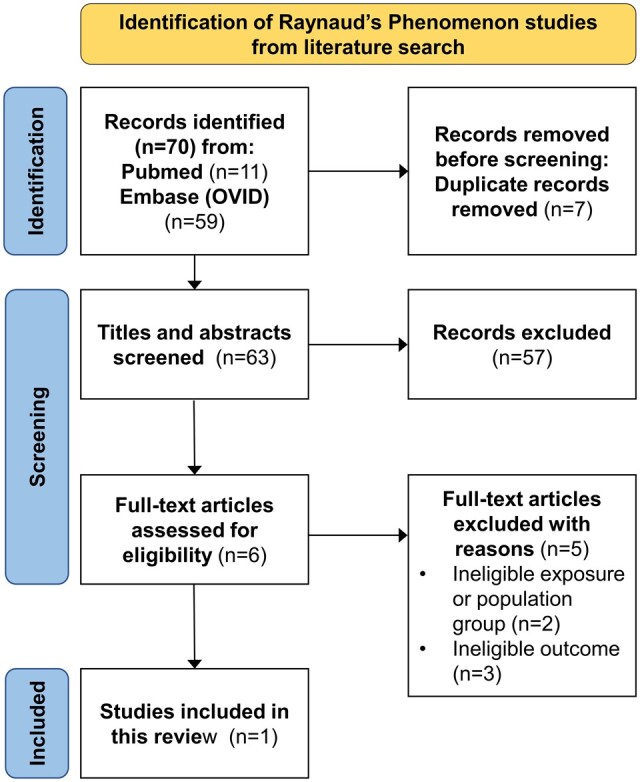
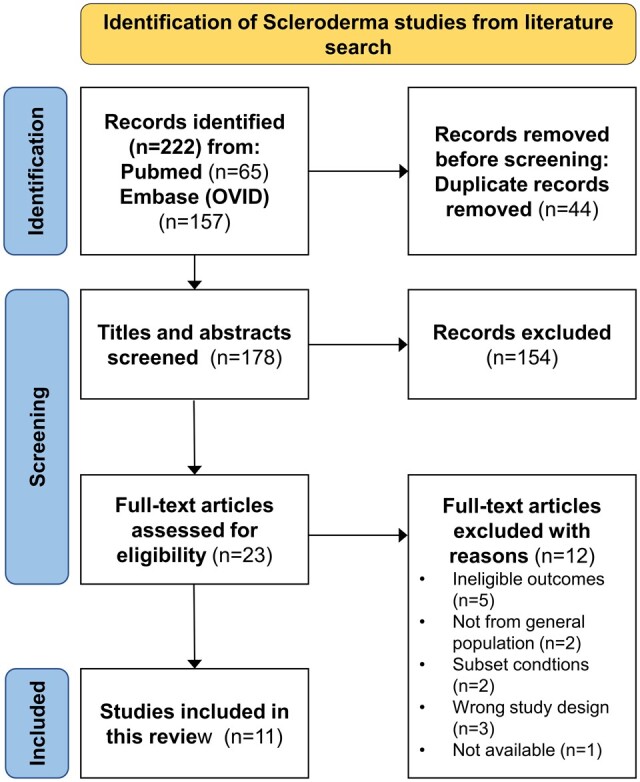
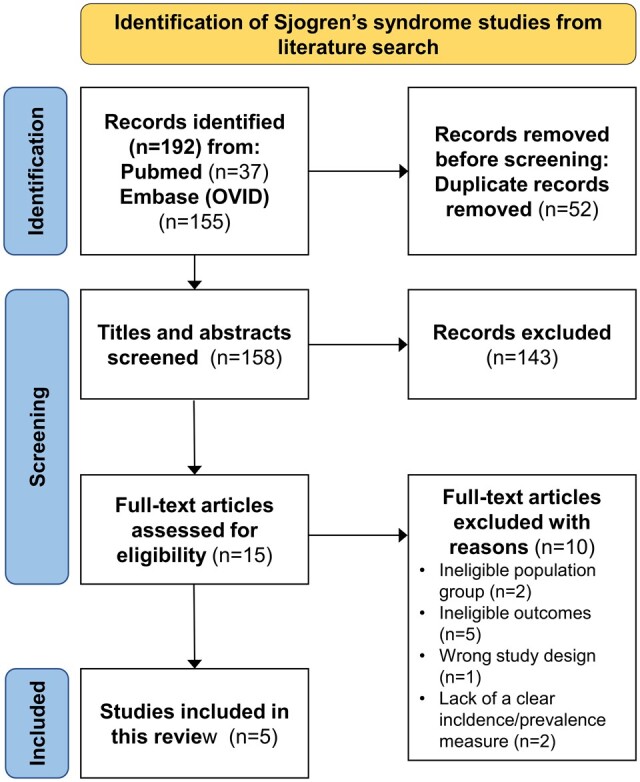
An umbrella review of English language systematic reviews was undertaken using PubMed and Embase (OVID) covering the period 2000-2023 (PROSPERO CRD42023434865). The estimate and its corresponding 95% confidence interval were reported when available from each systematic review. The quality of systematic reviews was assessed using the Scottish Intercollegiate Guidelines Network (SIGN) tool. A narrative synthesis was undertaken.
Seventeen systematic reviews were identified, of which 1 was for RP, 5 for Sjögren's and 11 for Scleroderma. There were some high-quality systematic reviews for Sjögren's and mortality of Scleroderma. However, there were only low-quality systematic reviews of prevalence and incidence of RP and Scleroderma. Furthermore, there were no systematic reviews for the mortality of RP. For RP, the pooled prevalence was 4850 per 100 000; pooled annual incidence was 250 per 100 000. For Sjögren's, prevalence was 60-70 per 100 000; annual incidence was 6.92 per 100 000 and the pooled standardized mortality ratio ranged from 1.38 to 1.48. For Scleroderma, pooled prevalence ranged from 17.6 to 23 per 100 000; annual incidence was 1.4 per 100 000; and the pooled standardized mortality ratio ranged from 2.72 to 3.53.
The outcomes of RP were less well described compared with Sjögren's and Scleroderma. There was a lack of high-quality systematic reviews for the prevalence and incidence of RP and Scleroderma. Therefore, further studies and systematic reviews with rigorous case definitions, assessing different ethnic groups are warranted in this area.
全面回顾关于雷诺现象、干燥综合征和硬皮病的患病率、发病率及死亡率的系统评价,并找出研究空白。
使用PubMed和Embase(OVID)对2000年至2023年期间的英文系统评价进行伞状综述(PROSPERO注册号:CRD42023434865)。若各系统评价中有可用数据,则报告估计值及其相应的95%置信区间。使用苏格兰校际指南网络(SIGN)工具评估系统评价的质量,并进行叙述性综合分析。
共识别出17项系统评价,其中1项关于雷诺现象,5项关于干燥综合征,11项关于硬皮病。有一些关于干燥综合征和硬皮病死亡率的高质量系统评价。然而,关于雷诺现象和硬皮病的患病率及发病率,仅有低质量的系统评价。此外,尚无关于雷诺现象死亡率的系统评价。对于雷诺现象,合并患病率为每10万人4850例;合并年发病率为每10万人250例。对于干燥综合征,患病率为每10万人60 - 70例;年发病率为每10万人6.92例,合并标准化死亡率在1.38至&1.48之间。对于硬皮病,合并患病率在每10万人17.6至23例之间;年发病率为每10万人1.4例;合并标准化死亡率在2.72至3.53之间。
与干燥综合征和硬皮病相比,雷诺现象的相关结果描述较少。缺乏关于雷诺现象和硬皮病患病率及发病率的高质量系统评价。因此,该领域有必要开展进一步研究以及采用严格病例定义、评估不同种族群体的系统评价。