Department of Social Medical Sciences, Graduate School of Medicine, International University of Health and Welfare, Tokyo, Japan.
Patient Engagement Frontier Medical Science, KAKEHASHI Inc., Tokyo, Japan.
J Diabetes Investig. 2024 Nov;15(11):1604-1613. doi: 10.1111/jdi.14302. Epub 2024 Sep 3.
AIMS/INTRODUCTION: The study aim was to investigate sulfonylurea prescription patterns in elderly patients (age ≥65 years) with type 2 diabetes mellitus in Japan. Sulfonylurea use among older adults has been insufficiently examined, despite the associated risks of hypoglycemia.
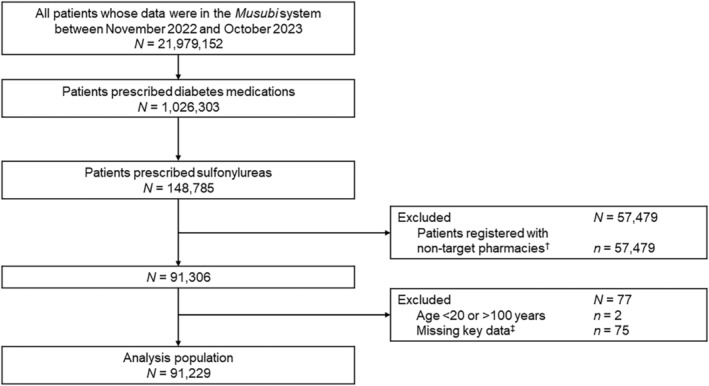
This retrospective cross-sectional survey entailed analysis of Japanese pharmacy data, extracted from the Musubi database, for patients (age 20-100 years) prescribed sulfonylureas between November 2022 and October 2023. Dose distribution, adherence to the Diabetes Treatment Guidelines for the Elderly 2023 and coprescription of other diabetes medications were investigated.
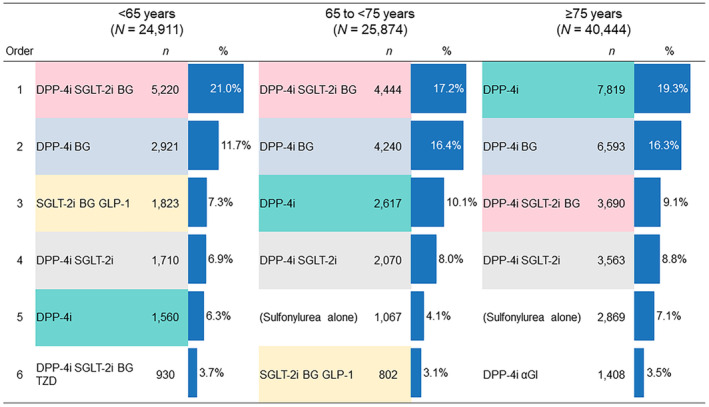
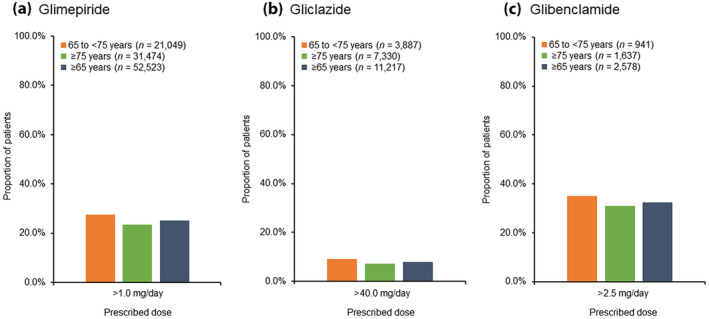
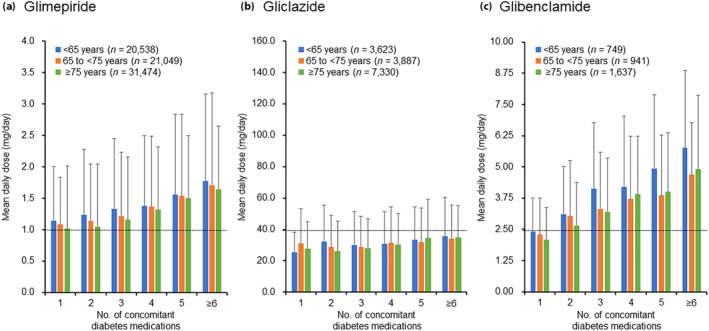
Of the total 91,229 patients, 80.1% were prescribed glimepiride, 16.3% gliclazide and 3.6% glibenclamide. In patients aged ≥65 years, exceeding the recommended dose (>1 mg/day for glimepiride, >40 mg/day for gliclazide) was numerically higher for glimepiride (25.0%) than for gliclazide (7.8%). The most common prescribing patterns were quadruple therapy with a sulfonylurea, a dipeptidyl peptidase-4 inhibitor, an sodium-glucose transporter 2 inhibitor and a biguanide in patients aged 65 to <75 years, and dual therapy with a sulfonylurea and a dipeptidyl peptidase-4 inhibitor in patients aged ≥75 years. Unfortunately, glinide was coprescribed for 338 (0.5%) of elderly patients. Insulin was coprescribed for 3,682 (5.6%) of elderly patients.
Analysis of real-world sulfonylurea prescription data found guideline non-adherence, namely, excessive prescription of glimepiride, use of glibenclamide in elderly patients, and common coprescription with dipeptidyl peptidase-4 inhibitors. These findings might provide an opportunity to reconsider the treatment of patients with type 2 diabetes mellitus who are over-prescribed sulfonylureas to reduce residual risks, such as hypoglycemia.
目的/引言:本研究旨在调查日本老年(≥65 岁)2 型糖尿病患者磺酰脲类药物的处方模式。尽管低血糖相关风险较高,但老年人群中磺酰脲类药物的使用情况尚未得到充分研究。
这是一项回顾性的横断面调查,分析了 2022 年 11 月至 2023 年 10 月期间在 Musubi 数据库中开具磺酰脲类药物的患者(年龄 20-100 岁)的日本药房数据。研究了剂量分布、是否遵循 2023 年老年糖尿病治疗指南以及是否联合使用其他糖尿病药物。
在总共 91229 名患者中,80.1%的患者开的是格列美脲,16.3%的患者开的是格列齐特,3.6%的患者开的是格列本脲。在≥65 岁的患者中,格列美脲超剂量(格列美脲>1mg/天,格列齐特>40mg/天)的比例高于格列齐特(25.0%比 7.8%)。在 65-<75 岁的患者中,最常见的处方模式是磺酰脲类药物、二肽基肽酶-4 抑制剂、钠-葡萄糖转运蛋白 2 抑制剂和二甲双胍的四联疗法,而≥75 岁的患者则是磺酰脲类药物和二肽基肽酶-4 抑制剂的二联疗法。遗憾的是,格列奈类药物与 338 名(0.5%)老年患者同时处方。3682 名(5.6%)老年患者同时处方胰岛素。
对磺酰脲类药物处方的真实世界数据进行分析发现,存在不遵循指南的情况,即格列美脲处方过多、老年患者使用格列本脲以及与二肽基肽酶-4 抑制剂常见联合用药。这些发现可能为重新考虑过度处方磺酰脲类药物的 2 型糖尿病患者的治疗提供机会,以降低低血糖等残留风险。