Alom Shahin, Daneshkhah Ali, Acosta Nicolas, Anthony Nick, Liwag Emily Pujadas, Backman Vadim, Gaire Sunil Kumar
Department of Electrical and Computer Engineering, North Carolina Agricultural and Technical State University, Greensboro, NC 27411, USA.
Department of Biomedical Engineering, Northwestern University, Evanston, IL 60208, USA.
bioRxiv. 2024 Aug 21:2024.08.20.608885. doi: 10.1101/2024.08.20.608885.
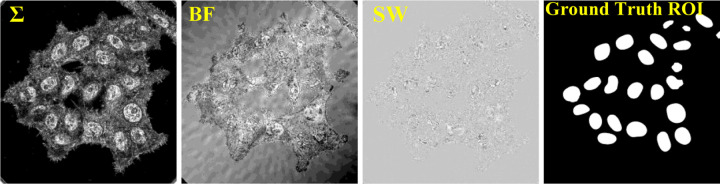
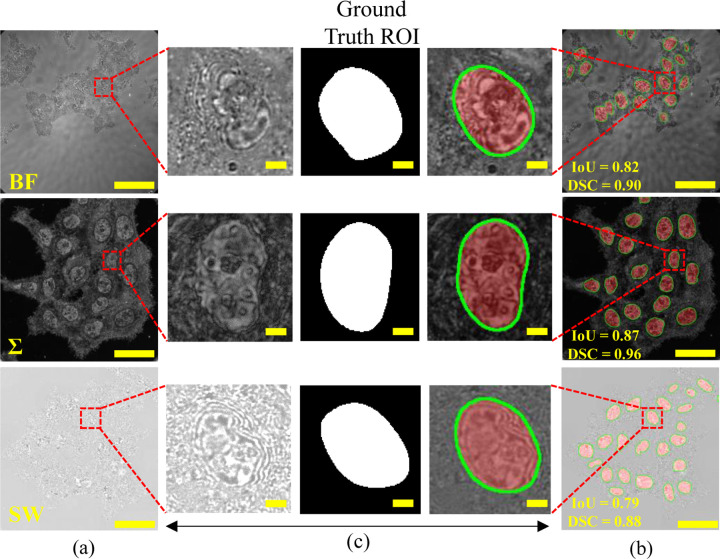
Chromatin-sensitive Partial Wave Spectroscopic (csPWS) microscopy offers a non-invasive glimpse into the mass density distribution of cellular structures at the nanoscale, leveraging the spectroscopic information. Such capability allows us to analyze the chromatin structure and organization and the global transcriptional state of the cell nuclei for the study of its role in carcinogenesis. Accurate segmentation of the nuclei in csPWS microscopy images is an essential step in isolating them for further analysis. However, manual segmentation is error-prone, biased, time-consuming, and laborious, resulting in disrupted nuclear boundaries with partial or over-segmentation. Here, we present an innovative deep-learning-driven approach to automate the accurate nuclei segmentation of label-free live cell csPWS microscopy imaging data. Our approach, csPWS-seg, harnesses the Convolutional Neural Networks-based U-Net model with an attention mechanism to automate the accurate cell nuclei segmentation of csPWS microscopy images. We leveraged the structural, physical, and biological differences between the cytoplasm, nucleus, and nuclear periphery to construct three distinct csPWS feature images for nucleus segmentation. Using these images of HCT116 cells, csPWS-seg achieved superior performance with a median Intersection over Union (IoU) of 0.80 and a Dice Similarity Coefficient (DSC) score of 0.88. The csPWS-seg overcame the segmentation performance over the baseline U-Net model and another attention-based model, SE-U-Net, marking a significant improvement in segmentation accuracy. Further, we analyzed the performance of our proposed model with four loss functions: binary cross-entropy loss, focal loss, dice loss, and Jaccard loss. The csPWS-seg with focal loss provided the best results compared to other loss functions. The automatic and accurate nuclei segmentation offered by the csPWS-seg not only automates, accelerates, and streamlines csPWS data analysis but also enhances the reliability of subsequent chromatin analysis research, paving the way for more accurate diagnostics, treatment, and understanding of cellular mechanisms for carcinogenesis.
染色质敏感的部分波谱显微镜(csPWS)利用光谱信息,能够对纳米尺度下细胞结构的质量密度分布进行非侵入性观察。这种能力使我们能够分析染色质的结构和组织以及细胞核的整体转录状态,以研究其在致癌过程中的作用。在csPWS显微镜图像中准确分割细胞核是将其分离出来进行进一步分析的关键步骤。然而,手动分割容易出错、存在偏差、耗时且费力,会导致核边界中断,出现部分分割或过度分割的情况。在此,我们提出一种创新的深度学习驱动方法,用于自动准确分割无标记活细胞csPWS显微镜成像数据中的细胞核。我们的方法csPWS-seg利用基于卷积神经网络的U-Net模型并结合注意力机制,自动准确分割csPWS显微镜图像中的细胞核。我们利用细胞质、细胞核和核周之间的结构、物理和生物学差异,构建了三张不同的用于细胞核分割的csPWS特征图像。使用这些HCT116细胞的图像,csPWS-seg表现出色,平均交并比(IoU)为0.80,骰子相似系数(DSC)得分为0.88。csPWS-seg在分割性能上超过了基线U-Net模型和另一个基于注意力的模型SE-U-Net,在分割精度上有显著提高。此外,我们用四种损失函数分析了我们提出的模型的性能:二元交叉熵损失、焦点损失、骰子损失和杰卡德损失。与其他损失函数相比,采用焦点损失的csPWS-seg提供了最佳结果。csPWS-seg提供的自动且准确的细胞核分割不仅使csPWS数据分析自动化、加速并简化,还提高了后续染色质分析研究的可靠性,为更准确的诊断、治疗以及理解致癌的细胞机制铺平了道路。