Jan Tawseefa, Negi Rajeshwari, Sharma Babita, Kumar Sanjeev, Singh Sangram, Rai Ashutosh Kumar, Shreaz Sheikh, Rustagi Sarvesh, Chaudhary Nisha, Kaur Tanvir, Kour Divjot, Sheikh Mohd Aaqib, Kumar Krishan, Yadav Ajar Nath, Ahmed Naseer
Department of Food Technology, Dr. Khem Singh Gill Akal College of Agriculture, Eternal University, Baru Sahib, Sirmaur, Himachal Pradesh, India.
Department of Genetics, Plant Breeding and Biotechnology, Dr. Khem Singh Gill Akal College of Agriculture, Eternal University, Baru Sahib, Sirmaur, Himachal Pradesh, India.
Heliyon. 2024 Aug 12;10(16):e35980. doi: 10.1016/j.heliyon.2024.e35980. eCollection 2024 Aug 30.
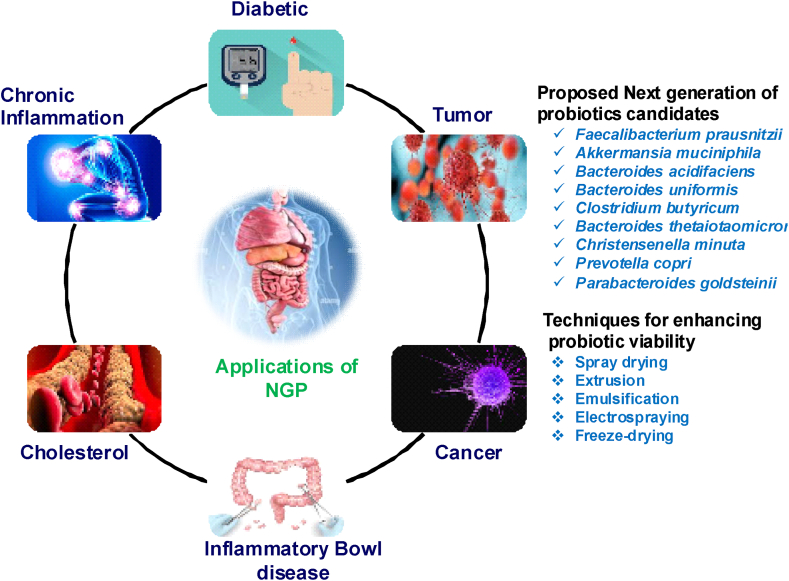
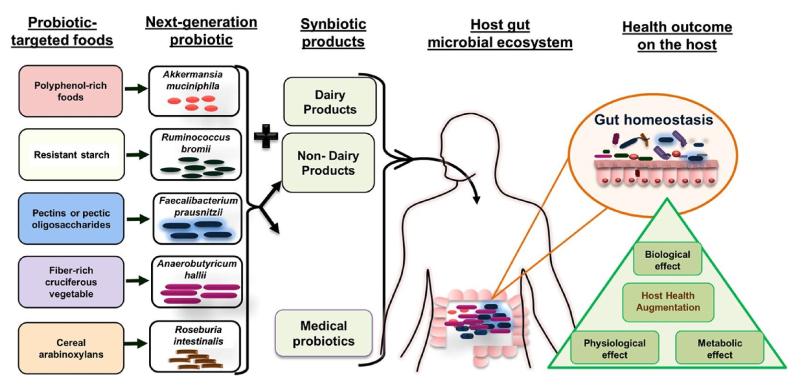
Over recent years, the scientific community has acknowledged the crucial role of certain microbial strains inhabiting the intestinal ecosystem in promoting human health, and participating in various beneficial functions for the host. These microorganisms are now referred to as next-generation probiotics and are currently considered as biotherapeutic products and food or nutraceutical supplements. However, the majority of next-generation probiotic candidates pose nutritional demands and exhibit high sensitivity towards aerobic conditions, leading to numerous technological hurdles in large-scale production. This underscores the need for the development of suitable delivery systems capable of enhancing the viability and functionality of these probiotic strains. Currently, potential candidates for next generation probiotics (NGP) are being sought among gut bacteria linked to health, which include strains from the genera Bacteroids, , and . In contrast to spp. and spp., NGP, particularly Bacteroids spp. and spp., appear to exhibit greater ambiguity regarding their potential to induce infectious diseases. The present review provides a comprehensive overview of NGPs in terms of their health beneficial effects, regulation framework and risk assessment targeting relevant criteria for commercialization in food and pharmaceutical markets.
近年来,科学界已经认识到栖息在肠道生态系统中的某些微生物菌株在促进人类健康以及参与宿主各种有益功能方面的关键作用。这些微生物现在被称为下一代益生菌,目前被视为生物治疗产品以及食品或营养补充剂。然而,大多数下一代益生菌候选菌株对营养有需求,并且对有氧条件表现出高度敏感性,这导致大规模生产中存在众多技术障碍。这凸显了开发能够提高这些益生菌菌株活力和功能的合适递送系统的必要性。目前,正在与健康相关的肠道细菌中寻找下一代益生菌(NGP)的潜在候选菌株,其中包括拟杆菌属、[此处原文缺失部分内容]属和[此处原文缺失部分内容]属的菌株。与[此处原文缺失部分内容]属和[此处原文缺失部分内容]属的菌株相比,NGP,特别是拟杆菌属和[此处原文缺失部分内容]属的菌株,在引发传染病的可能性方面似乎表现出更大的不确定性。本综述从其对健康的有益影响、监管框架以及针对食品和药品市场商业化相关标准的风险评估等方面,对NGP进行了全面概述。