School of Computer Science and Technology, Shandong Jianzhu University, Jinan, People's Republic of China.
School of Artificial Intelligence, Beijing University of Posts and Telecommunications, Beijing, People's Republic of China.
Hum Brain Mapp. 2024 Sep;45(13):e70017. doi: 10.1002/hbm.70017.
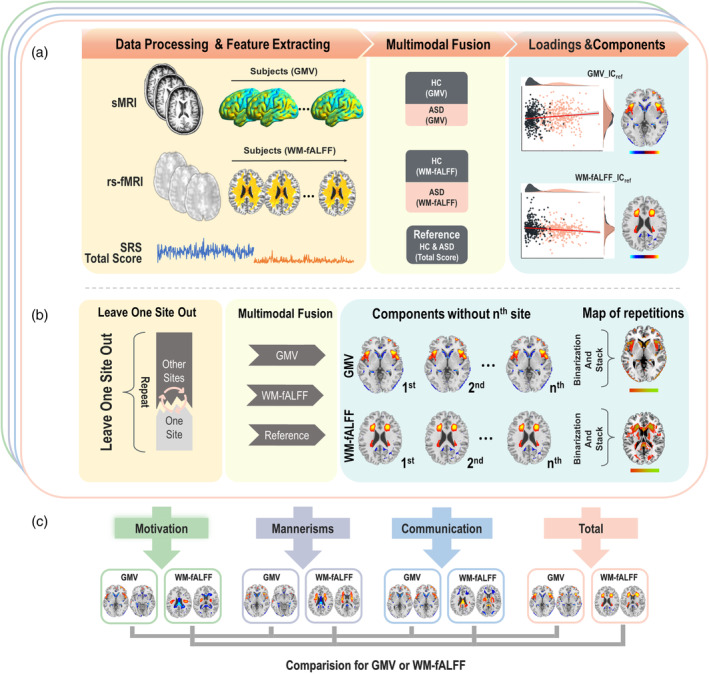
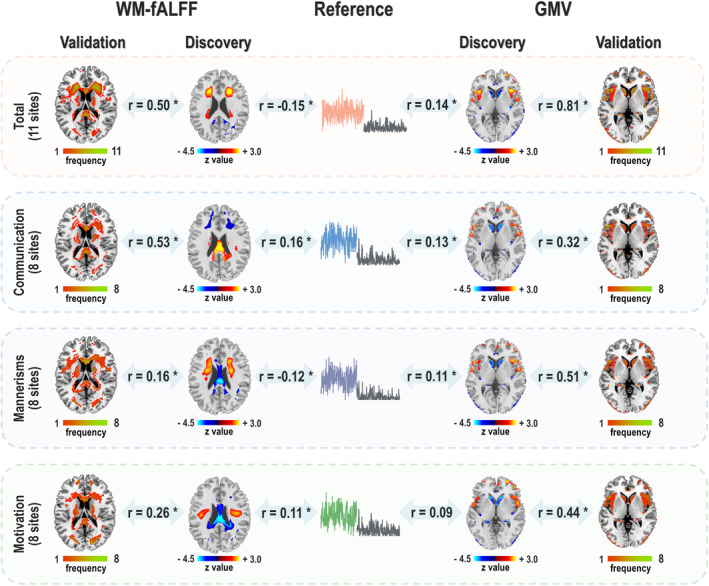
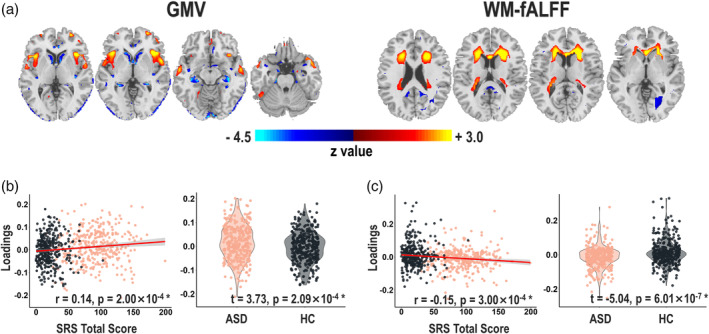
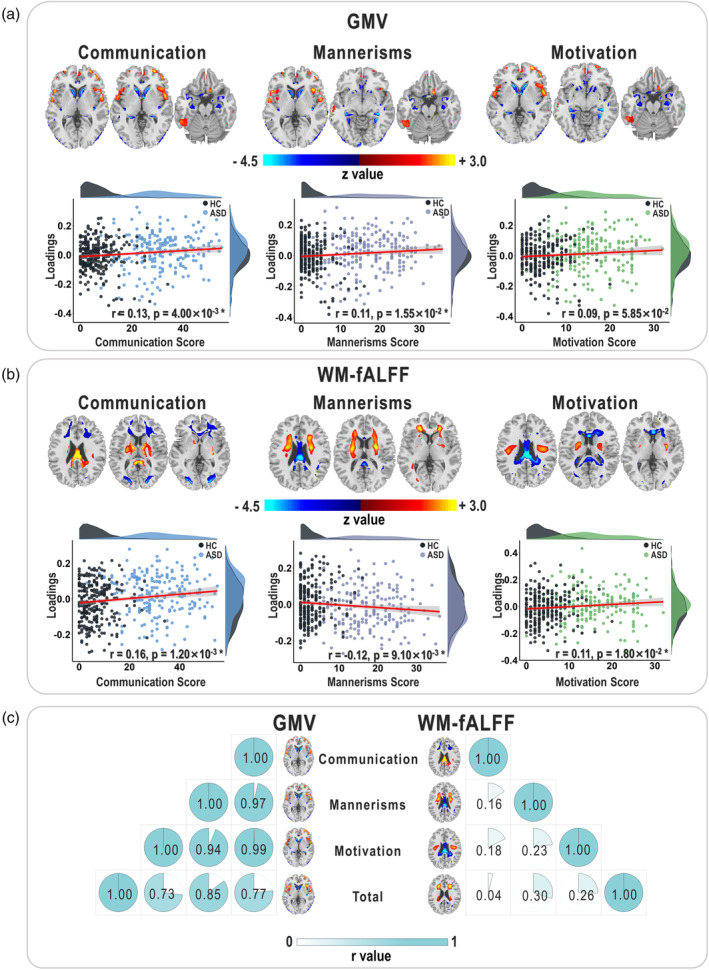
Atypical social impairments (i.e., impaired social cognition and social communication) are vital manifestations of autism spectrum disorder (ASD) patients, and the incidence rate of ASD is significantly higher in males than in females. Characterizing the atypical brain patterns underlying social deficits of ASD is significant for understanding the pathogenesis. However, there are no robust imaging biomarkers that are specific to ASD, which may be due to neurobiological complexity and limitations of single-modality research. To describe the multimodal brain patterns related to social deficits in ASD, we highlighted the potential functional role of white matter (WM) and incorporated WM functional activity and gray matter structure into multimodal fusion. Gray matter volume (GMV) and fractional amplitude of low-frequency fluctuations of WM (WM-fALFF) were combined by fusion analysis model adopting the social behavior. Our results revealed multimodal spatial patterns associated with Social Responsiveness Scale multiple scores in ASD. Specifically, GMV exhibited a consistent brain pattern, in which salience network and limbic system were commonly identified associated with all multiple social impairments. More divergent brain patterns in WM-fALFF were explored, suggesting that WM functional activity is more sensitive to ASD's complex social impairments. Moreover, brain regions related to social impairment may be potentially interconnected across modalities. Cross-site validation established the repeatability of our results. Our research findings contribute to understanding the neural mechanisms underlying social disorders in ASD and affirm the feasibility of identifying biomarkers from functional activity in WM.
非典型社交障碍(即社交认知和社交沟通受损)是自闭症谱系障碍(ASD)患者的重要表现,且 ASD 在男性中的发病率明显高于女性。ASD 患者社交缺陷的异常大脑模式特征对于理解发病机制具有重要意义。然而,目前还没有针对 ASD 的稳健影像学生物标志物,这可能是由于神经生物学的复杂性和单一模态研究的局限性。为了描述与 ASD 社交缺陷相关的多模态大脑模式,我们强调了白质(WM)的潜在功能作用,并将 WM 功能活动和灰质结构纳入多模态融合中。通过采用社会行为的融合分析模型,将灰质体积(GMV)和 WM 的低频波动分数振幅(WM-fALFF)进行融合分析。我们的研究结果揭示了与 ASD 社会反应量表多个分数相关的多模态空间模式。具体而言,GMV 表现出一致的大脑模式,其中突显网络和边缘系统通常与所有多个社交障碍有关。WM-fALFF 中探索到更多发散的大脑模式,表明 WM 功能活动对 ASD 复杂的社交障碍更为敏感。此外,与社交障碍相关的大脑区域可能在不同模态之间存在潜在的相互联系。跨站点验证建立了我们结果的可重复性。我们的研究结果有助于理解 ASD 中社交障碍的神经机制,并证实了从 WM 功能活动中识别生物标志物的可行性。