Universidade de São Paulo, Escola de Enfermagem de Ribeirão Preto, PAHO/WHO Collaborating Centre for Nursing Research Development, Ribeirão Preto, SP, Brazil.
Rev Lat Am Enfermagem. 2024 Aug 30;32:e4287. doi: 10.1590/1518-8345.6937.4287. eCollection 2024.
to analyze the availability (in terms of stock and composition) and accessibility (in terms of geographical distribution) of the nursing workforce in Brazil.
this is a descriptive, cross-sectional study with retrospective data collection, identified by combining databases available on institutional websites and structured according to indicators from the World Health Organization's "National Health Workforce Accounts". The study considered nursing professionals at senior level (nurses) and middle level (nursing auxiliaries and technicians). Indicators of stock, composition, distribution (by age group and gender) and the ratio of nurses to doctors were included.
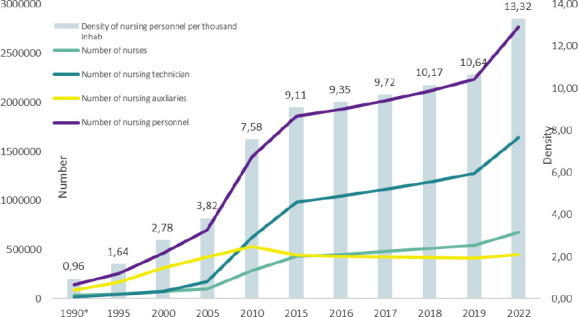
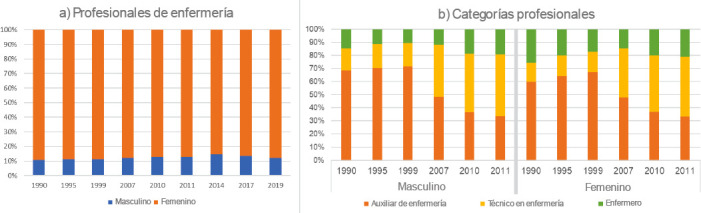
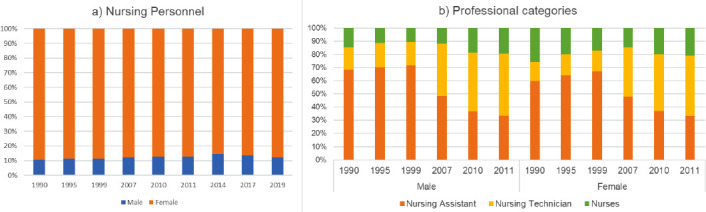
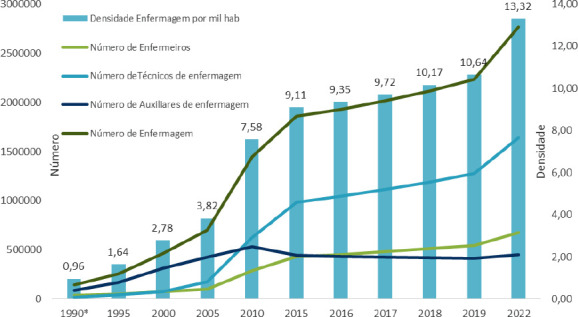
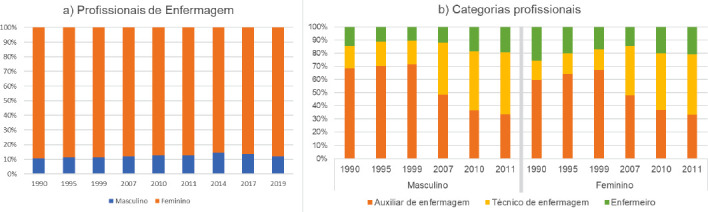
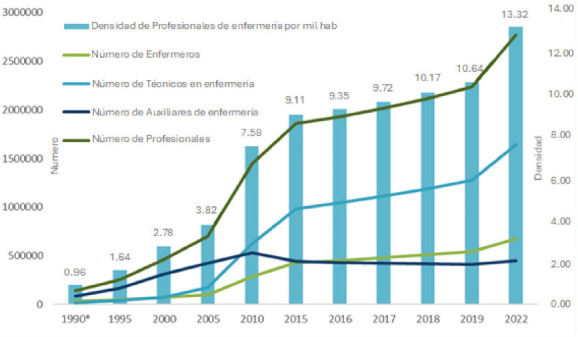
there was an increase in the number of personnel between 2005 and 2010, mainly in middle and technical level professionals. There are more personnel aged between 36 and 55, with a predominance of women in all categories, despite the increase in men. There was an uneven distribution of personnel across the country's regions, with the Southeast having the largest number of professionals. The ratio of nurses to doctors is less than one in the South and Southeast.
despite the large number of nurses, their distribution is uneven. The growth of nursing technicians has significantly outstripped that of nurses, indicating more intensive technical training policies than those found in higher education.
分析巴西护理劳动力的供应情况(库存和构成)和可及性(地理分布方面)。
这是一项描述性的、横断面研究,采用回顾性数据收集方法,通过合并机构网站上可用的数据库,并根据世界卫生组织“国家卫生人力账户”的指标进行组合来识别。该研究考虑了高级别(护士)和中级别(护理助理和技术员)的护理专业人员。纳入了库存、构成、分布(按年龄组和性别)以及护士与医生的比例等指标。
2005 年至 2010 年间,人员数量有所增加,主要是中级和技术级别的专业人员。36 至 55 岁的人员较多,所有类别中女性居多,尽管男性有所增加。人员在全国各地区的分布不均,东南部拥有最多的专业人员。南部和东南部的护士与医生比例不到 1:1。
尽管护士人数众多,但分布不均。护理技师的增长明显超过了护士,表明技术培训政策比高等教育更加密集。