Cazzaniga Giorgio, Del Carro Fabio, Eccher Albino, Becker Jan Ulrich, Gambaro Giovanni, Rossi Mattia, Pieruzzi Federico, Fraggetta Filippo, Pagni Fabio, L'Imperio Vincenzo
Department of Medicine and Surgery, Pathology, IRCCS Fondazione San Gerardo Dei Tintori, University of Milano-Bicocca, Via Pergolesi, 33, 20900, Monza, Italy.
Department of Medical and Surgical Sciences for Children and Adults, University of Modena and Reggio Emilia, University Hospital of Modena, Modena, Italy.
J Imaging Inform Med. 2025 Apr;38(2):1112-1119. doi: 10.1007/s10278-024-01248-x. Epub 2024 Sep 4.
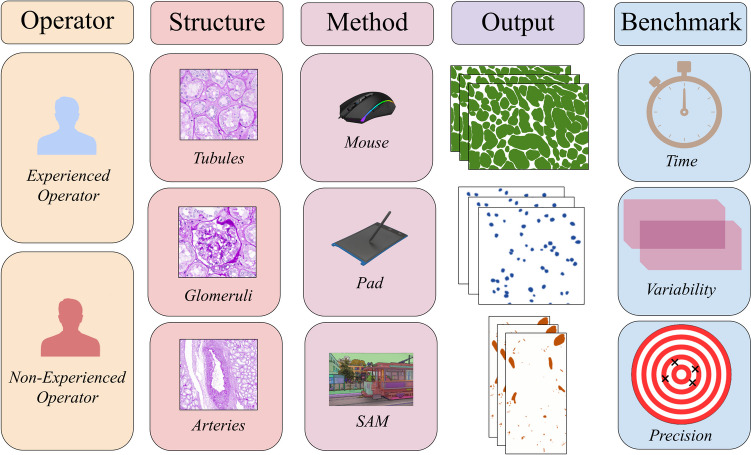
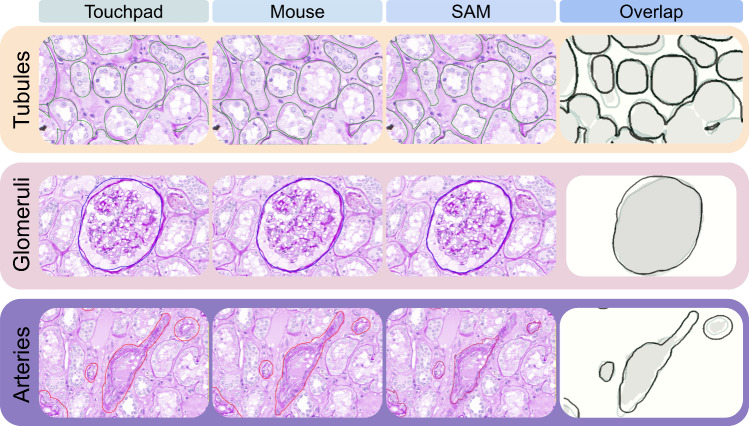
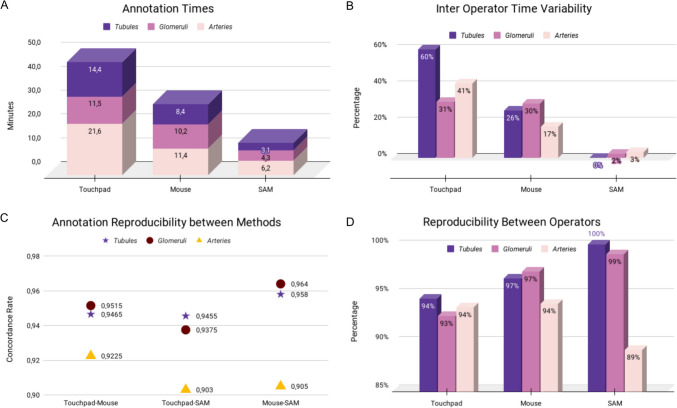
The development of reliable artificial intelligence (AI) algorithms in pathology often depends on ground truth provided by annotation of whole slide images (WSI), a time-consuming and operator-dependent process. A comparative analysis of different annotation approaches is performed to streamline this process. Two pathologists annotated renal tissue using semi-automated (Segment Anything Model, SAM)) and manual devices (touchpad vs mouse). A comparison was conducted in terms of working time, reproducibility (overlap fraction), and precision (0 to 10 accuracy rated by two expert nephropathologists) among different methods and operators. The impact of different displays on mouse performance was evaluated. Annotations focused on three tissue compartments: tubules (57 annotations), glomeruli (53 annotations), and arteries (58 annotations). The semi-automatic approach was the fastest and had the least inter-observer variability, averaging 13.6 ± 0.2 min with a difference (Δ) of 2%, followed by the mouse (29.9 ± 10.2, Δ = 24%), and the touchpad (47.5 ± 19.6 min, Δ = 45%). The highest reproducibility in tubules and glomeruli was achieved with SAM (overlap values of 1 and 0.99 compared to 0.97 for the mouse and 0.94 and 0.93 for the touchpad), though SAM had lower reproducibility in arteries (overlap value of 0.89 compared to 0.94 for both the mouse and touchpad). No precision differences were observed between operators (p = 0.59). Using non-medical monitors increased annotation times by 6.1%. The future employment of semi-automated and AI-assisted approaches can significantly speed up the annotation process, improving the ground truth for AI tool development.
病理学中可靠人工智能(AI)算法的开发通常依赖于通过全切片图像(WSI)标注提供的真实数据,这是一个耗时且依赖操作人员的过程。为简化这一过程,对不同的标注方法进行了对比分析。两名病理学家使用半自动设备(分割一切模型,即SAM)和手动设备(触摸板与鼠标)对肾组织进行标注。在不同方法和操作人员之间,就工作时间、可重复性(重叠率)和精确度(由两名肾脏病理专家给出0至10的准确度评分)进行了比较。评估了不同显示器对鼠标操作性能的影响。标注集中在三个组织区域:肾小管(57个标注)、肾小球(53个标注)和动脉(58个标注)。半自动方法最快,观察者间变异性最小,平均用时13.6±0.2分钟,差异(Δ)为2%,其次是鼠标(29.9±10.2分钟,Δ=24%)和触摸板(47.5±19.6分钟,Δ=45%)。SAM在肾小管和肾小球方面实现了最高的可重复性(重叠值分别为1和0.99,而鼠标为0.97,触摸板为0.94和0.93),不过SAM在动脉方面的可重复性较低(重叠值为0.89,而鼠标和触摸板均为0.94)。未观察到操作人员之间在精确度上存在差异(p=0.59)。使用非医用显示器会使标注时间增加6.1%。未来采用半自动和AI辅助方法可显著加快标注过程,为AI工具开发提供更好的真实数据。