Reilly Jamie, Shain Cory, Borghesani Valentina, Kuhnke Philipp, Vigliocco Gabriella, Peelle Jonathan E, Mahon Bradford Z, Buxbaum Laurel J, Majid Asifa, Brysbaert Marc, Borghi Anna M, De Deyne Simon, Dove Guy, Papeo Liuba, Pexman Penny M, Poeppel David, Lupyan Gary, Boggio Paulo, Hickok Gregory, Gwilliams Laura, Fernandino Leonardo, Mirman Daniel, Chrysikou Evangelia G, Sandberg Chaleece W, Crutch Sebastian J, Pylkkänen Liina, Yee Eiling, Jackson Rebecca L, Rodd Jennifer M, Bedny Marina, Connell Louise, Kiefer Markus, Kemmerer David, de Zubicaray Greig, Jefferies Elizabeth, Lynott Dermot, Siew Cynthia S Q, Desai Rutvik H, McRae Ken, Diaz Michele T, Bolognesi Marianna, Fedorenko Evelina, Kiran Swathi, Montefinese Maria, Binder Jeffrey R, Yap Melvin J, Hartwigsen Gesa, Cantlon Jessica, Bi Yanchao, Hoffman Paul, Garcea Frank E, Vinson David
Temple University, Philadelphia, PA, USA.
Massachusetts Institute of Technology, Cambridge, MA, USA.
Psychon Bull Rev. 2025 Feb;32(1):243-280. doi: 10.3758/s13423-024-02556-7. Epub 2024 Sep 4.
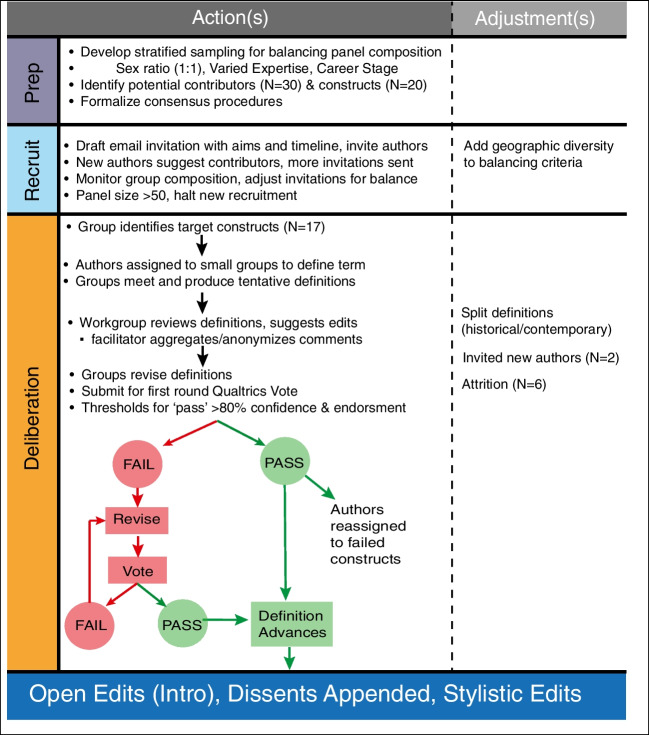
Tulving characterized semantic memory as a vast repository of meaning that underlies language and many other cognitive processes. This perspective on lexical and conceptual knowledge galvanized a new era of research undertaken by numerous fields, each with their own idiosyncratic methods and terminology. For example, "concept" has different meanings in philosophy, linguistics, and psychology. As such, many fundamental constructs used to delineate semantic theories remain underspecified and/or opaque. Weak construct specificity is among the leading causes of the replication crisis now facing psychology and related fields. Term ambiguity hinders cross-disciplinary communication, falsifiability, and incremental theory-building. Numerous cognitive subdisciplines (e.g., vision, affective neuroscience) have recently addressed these limitations via the development of consensus-based guidelines and definitions. The project to follow represents our effort to produce a multidisciplinary semantic glossary consisting of succinct definitions, background, principled dissenting views, ratings of agreement, and subjective confidence for 17 target constructs (e.g., abstractness, abstraction, concreteness, concept, embodied cognition, event semantics, lexical-semantic, modality, representation, semantic control, semantic feature, simulation, semantic distance, semantic dimension). We discuss potential benefits and pitfalls (e.g., implicit bias, prescriptiveness) of these efforts to specify a common nomenclature that other researchers might index in specifying their own theoretical perspectives (e.g., They said X, but I mean Y).
图尔文将语义记忆描述为一个庞大的意义库,它是语言和许多其他认知过程的基础。这种关于词汇和概念知识的观点开启了一个由众多领域进行研究的新时代,每个领域都有其独特的方法和术语。例如,“概念”在哲学、语言学和心理学中有不同的含义。因此,许多用于阐述语义理论的基本概念仍然定义不明确和/或晦涩难懂。构建特异性不足是目前心理学及相关领域面临的复制危机的主要原因之一。术语歧义阻碍了跨学科交流、可证伪性以及理论的渐进构建。许多认知子学科(如视觉、情感神经科学)最近通过制定基于共识的指导方针和定义来解决这些局限性。接下来的这个项目是我们为编制一个多学科语义术语表所做的努力,该术语表包含17个目标概念(如抽象性、抽象、具体性、概念、具身认知、事件语义、词汇语义、模态、表征、语义控制、语义特征、模拟、语义距离、语义维度)的简洁定义、背景、有原则的不同意见、一致性评级和主观置信度。我们讨论了这些为确定一个通用术语所做努力的潜在益处和陷阱(如隐性偏见、规范性),其他研究人员在阐述自己的理论观点时(如他们说的是X,但我的意思是Y)可能会以此为索引。