Department of Basic Public Health, Center for Disease Control and Prevention of Guangzhou, Guangzhou City, 510440, China.
Institute of Public Health, Guangzhou Medical University & Guangzhou Center for Disease Control and Prevention, Guangzhou City, 510440, China.
BMC Geriatr. 2024 Sep 4;24(1):732. doi: 10.1186/s12877-024-05319-0.
Central obesity was considered as a risk factor for falls among the older population. Waist circumference (WC), lipid accumulation product (LAP), visceral adiposity index (VAI), and the Chinese visceral adiposity index (CVAI) are considered as surrogate markers for abdominal fat deposition in increasing studies. Nevertheless, the longitudinal relationship between these indices and falls among the older population remains indistinct. This study aimed to explore the association between abdominal obesity indices and falls among older community-dwellers.
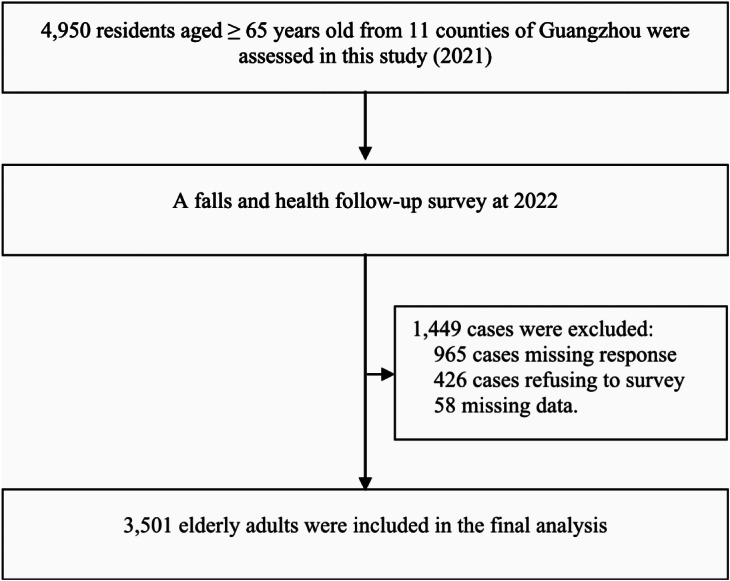
Our study included 3501 individuals aged ≥ 65 years from the Guangzhou Falls and Health Status Tracking Cohort at baseline in 2021 and then prospectively followed up in 2022. The outcome of interest was the occurrence of falls. The Kaplan-Meier curves and multivariable Cox regression analysis were used to explore the associations between abdominal obesity indices and falls. Moreover, the restricted cubic spline analysis (RCS) was conducted to test the non-linear relationships between abdominal obesity indices and hazards of falls incident.
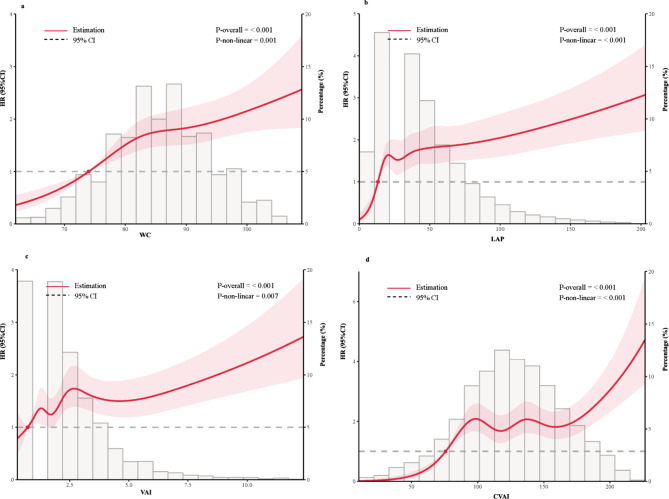
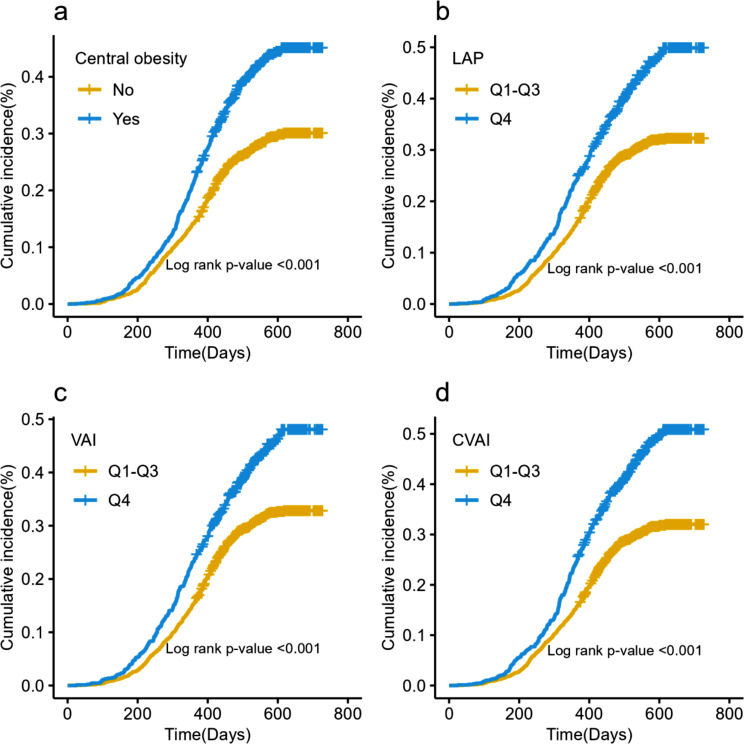
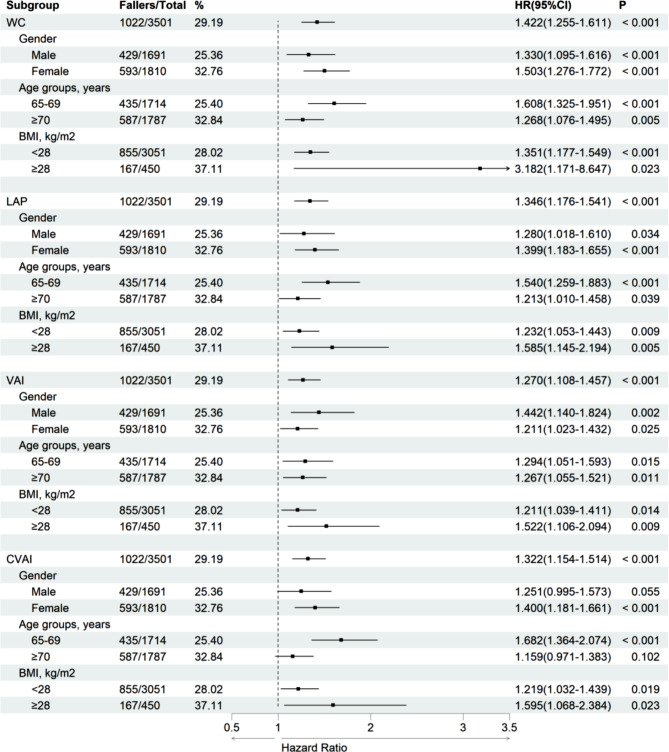
After a median follow-up period of 551 days, a total of 1022 participants experienced falls. The cumulative incidence rate of falls was observed to be higher among individuals with central obesity and those falling within the fourth quartile (Q4) of LAP, VAI, and CVAI. Participants with central obesity and those in Q4 of LAP, VAI, and CVAI were associated with higher risk of falls, with hazard ratios (HRs) of 1.422 (HR 95%CI: 1.255-1.611), 1.346 (1.176-1.541), 1.270 (1.108-1.457), 1.322 (1.154-1.514), respectively. Each 1-SD increment in WC, LAP, VAI, and CVAI was a significant increased risk of falls among participants. Subgroup analysis further revealed these results were basically stable and appeared to be significantly stronger among those females, aged 65-69 years, and with body mass index (BMI) ≥ 28 kg/m. Additionally, RCS curves showed an overall upward trend in the risk of falls as the abdominal indices increased.
Abdominal obesity indices, as WC, LAP, VAI, and CVAI were significantly associated with falls among older community-dwellers. Reduction of abdominal obesity indices might be suggested as the strategy of falls prevention.
中心性肥胖被认为是老年人跌倒的一个危险因素。腰围(WC)、脂积指数(LAP)、内脏脂肪指数(VAI)和中国内脏脂肪指数(CVAI)在越来越多的研究中被认为是腹部脂肪沉积的替代标志物。然而,这些指标与老年人跌倒之间的纵向关系仍不清楚。本研究旨在探讨社区老年人中腹部肥胖指标与跌倒之间的关系。
本研究纳入了 2021 年基线时年龄≥65 岁的来自广州跌倒和健康状况跟踪队列的 3501 名个体,并在 2022 年进行了前瞻性随访。主要结局是跌倒的发生。采用 Kaplan-Meier 曲线和多变量 Cox 回归分析探讨了腹部肥胖指标与跌倒之间的关系。此外,还进行了限制性立方样条分析(RCS)来检验腹部肥胖指标与跌倒发生率之间的非线性关系。
在中位随访 551 天后,共有 1022 名参与者发生跌倒。观察到中心性肥胖者和 LAP、VAI 和 CVAI 第 4 四分位(Q4)者的跌倒累积发生率较高。中心性肥胖和 LAP、VAI 和 CVAI Q4 的参与者与跌倒风险增加相关,风险比(HR)分别为 1.422(95%CI:1.255-1.611)、1.346(1.176-1.541)、1.270(1.108-1.457)和 1.322(1.154-1.514)。WC、LAP、VAI 和 CVAI 每增加 1-SD,参与者发生跌倒的风险显著增加。亚组分析进一步表明,这些结果基本稳定,在女性、65-69 岁年龄组和 BMI≥28kg/m2 者中更为明显。此外,RCS 曲线显示,随着腹部指数的增加,跌倒风险呈总体上升趋势。
腹部肥胖指标,如 WC、LAP、VAI 和 CVAI,与社区老年人跌倒显著相关。减少腹部肥胖指数可能被建议作为预防跌倒的策略。