Australian Centre for Health Services Innovation (AusHSI) and Centre for Healthcare Transformation, School of Public Health and Social Work, Queensland University of Technology, Brisbane, QLD, Australia.
Clinical Informatics Directorate, Metro South Health, Brisbane, QLD, Australia.
Implement Sci. 2024 Sep 4;19(1):62. doi: 10.1186/s13012-024-01391-7.
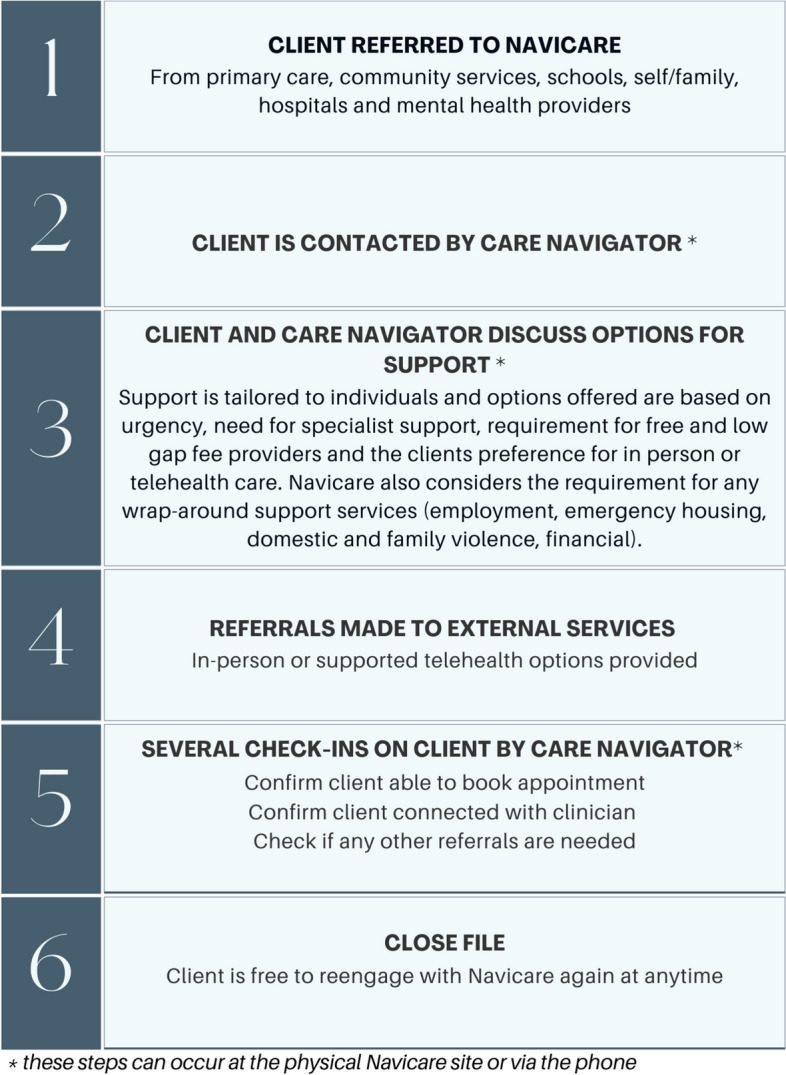
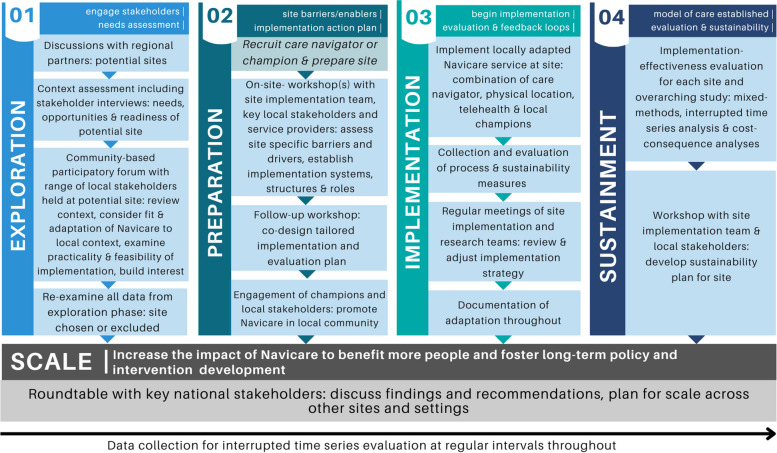
A dramatic decline in mental health of people worldwide in the early COVID-19 pandemic years has not recovered. In rural and remote Australia, access to appropriate and timely mental health services has been identified as a major barrier to people seeking help for mental ill-health. From 2020 to 2021 a care navigation model, Navicare, was co-designed with rural and remote communities in the Greater Whitsunday Region of Central Queensland in Australia. The Exploration, Preparation, Implementation and Sustainment (EPIS) framework was used to design and guide multiple aspects of a multisite study, The Bridging Study, to evaluate the implementation of Navicare in Australia.
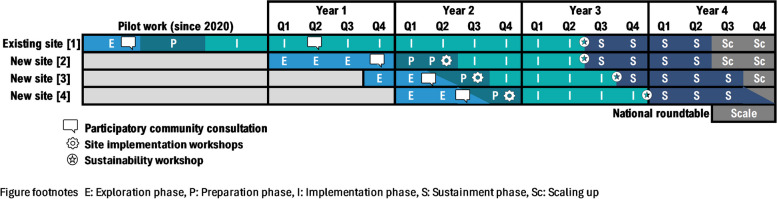
A community-engaged hybrid effectiveness-implementation study design will focus on the tailored implementation of Navicare at three new sites as well as monitoring implementation at an existing site established since 2021. Study outcomes assessed will include sustained access as the co-primary outcome (measured using access to Navicare mental health referral services) and Proctor's Implementation Outcomes of feasibility, acceptability, appropriateness, adoption, fidelity, implementation cost, and sustainability. Data collection for the implementation evaluation will include service usage data, community consultations, interviews, and workshops; analysed using mixed methods and guided by EPIS and other implementation frameworks. Pre-post effectiveness and cost-consequence study components are embedded in the implementation and sustainment phases, with comparison to pre-implementation data and value assessed for each EPIS phase using hospital, service, and resource allocation data. A scaling up strategy will be co-developed using a national roundtable forum in the final year of the study. Qualitative exploration of other aspects of the study (e.g., mechanisms of action and stakeholder engagement) will be conducted.
Our study will use tailoring to local sites and a community-engaged approach to drive implementation of a mental health care navigation service in rural and remote Australia, with expected benefits to mental healthcare access. This approach is consistent with policy recommendations nationally and internationally as building blocks for rural health including the World Health Organization Framework for Action on Strengthening Health Systems to Improve Health Outcomes.
Prospectively registered on April 2, 2024, on the Australian New Zealand Clinical Trials Registry, no. ACTRN12624000382572. https://anzctr.org.au/Trial/Registration/TrialReview.aspx?id=386665&isReview=true .
在 COVID-19 大流行早期,全球范围内人们的心理健康状况急剧下降,且尚未恢复。在澳大利亚的农村和偏远地区,人们发现获得适当和及时的心理健康服务是寻求精神健康帮助的主要障碍。从 2020 年到 2021 年,一种名为 Navicare 的护理导航模型与澳大利亚昆士兰州中部大惠特森德地区的农村和偏远社区共同设计。探索、准备、实施和维持(EPIS)框架被用于设计和指导一项多地点研究,即 Bridging 研究的多个方面,以评估 Navicare 在澳大利亚的实施情况。
一项社区参与的混合有效性-实施研究设计将侧重于在三个新地点实施 Navicare 的定制,以及监测自 2021 年以来建立的现有地点的实施情况。评估的研究结果将包括作为共同主要结果的持续获得(使用 Navicare 心理健康转介服务的获得情况来衡量)和 Proctor 的实施结果的可行性、可接受性、适宜性、采用、忠实度、实施成本和可持续性。实施评估的数据收集将包括服务使用数据、社区咨询、访谈和研讨会;使用混合方法进行分析,并由 EPIS 和其他实施框架指导。在实施和维持阶段嵌入了有效性和成本-效益研究部分,并将每个 EPIS 阶段的医院、服务和资源分配数据与实施前数据进行比较并进行评估。在研究的最后一年,将通过全国圆桌论坛共同制定扩大规模的战略。将对研究的其他方面(例如,作用机制和利益相关者参与)进行定性探索。
我们的研究将使用针对当地地点的定制化和社区参与方法,在澳大利亚的农村和偏远地区推动心理健康护理导航服务的实施,预计这将有利于获得精神保健服务。这种方法符合国家和国际政策建议,是加强卫生系统以改善健康结果的全球卫生框架的组成部分。
2024 年 4 月 2 日前瞻性注册于澳大利亚和新西兰临床试验注册中心,编号为 ACTRN12624000382572。https://anzctr.org.au/Trial/Registration/TrialReview.aspx?id=386665&isReview=true。