Stoesser N, George R, Aiken Z, Phan H T T, Lipworth S, Quan T P, Mathers A J, De Maio N, Seale A C, Eyre D W, Vaughan A, Swann J, Peto T E A, Crook D W, Cawthorne J, Dodgson A, Walker A S
Nuffield Department of Medicine, University of Oxford, Oxford, UK.
NIHR Health Protection Research Unit in Healthcare Associated Infections and Antimicrobial Resistance at University of Oxford in partnership with Public Health England, Nuffield Department of Medicine, Oxford, UK.
JAC Antimicrob Resist. 2024 Sep 3;6(5):dlae140. doi: 10.1093/jacamr/dlae140. eCollection 2024 Oct.
Healthcare-associated wastewater and asymptomatic patient reservoirs colonized by carbapenemase-producing Enterobacterales (CPE) contribute to nosocomial CPE dissemination, but the characteristics and dynamics of this remain unclear.
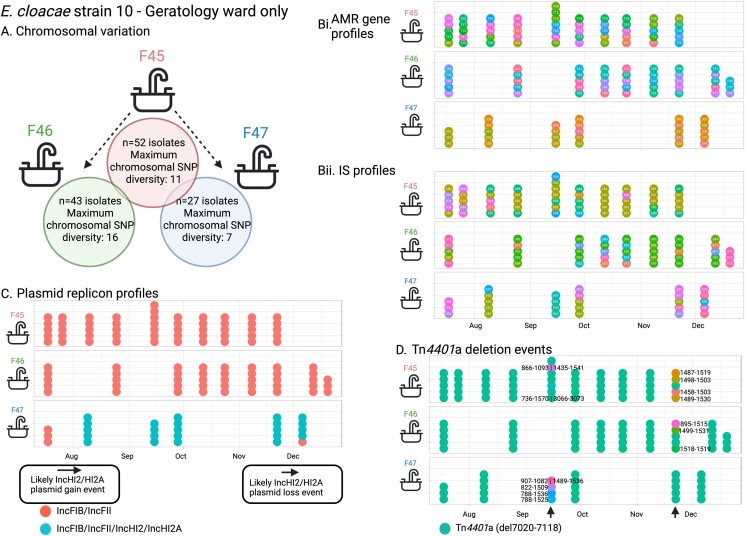
We systematically sampled wastewater sites ( = 4488 samples; 349 sites) and patients ( = 1247) across six wards over 6-12 months to understand bla-associated CPE (KPC-E) diversity within these reservoirs and transmission in a healthcare setting. Up to five KPC-E-positive isolates per sample were sequenced (Illumina). Recombination-adjusted phylogenies were used to define genetically related strains; assembly and mapping-based approaches were used to characterize antimicrobial resistance genes, insertion sequences (ISs) and Tn types/target site sequences. The accessory genome was evaluated in some of the largest clusters, and those crossing reservoirs.
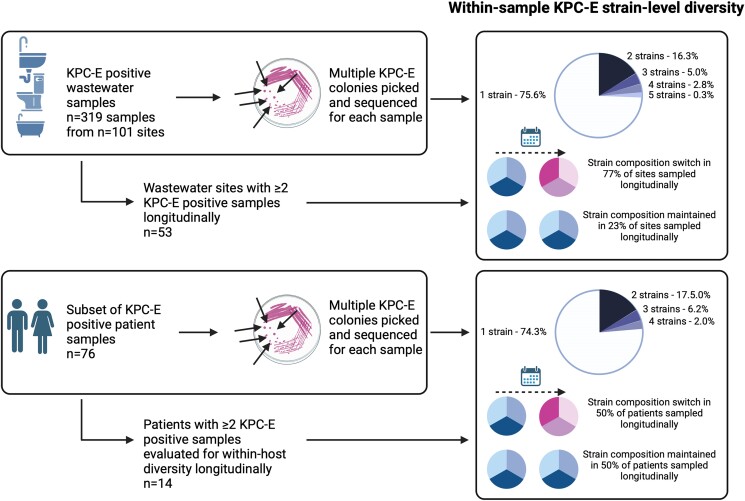
Wastewater site KPC-E-positivity was substantial [101/349 sites (28.9%); 228/5601 (4.1%) patients cultured]. Thirteen KPC-E species and 109 strains were identified using genomics, and 24% of wastewater and 26% of patient KPC-E-positive samples harboured one or more strains. Most diversity was explained by the individual niche, suggesting localized factors are important in selection and spread. Tn + flanking target site sequence diversity was greater in wastewater sites ( < 0.001), which might favour Tn-associated transposition/evolution. Shower/bath- and sluice/mop-associated sites were more likely to be KPC-E-positive (adjusted OR = 2.69; 95% CI: 1.44-5.01; = 0.0019; and adjusted OR = 2.60; 95% CI: 1.04-6.52; = 0.0410, respectively). Different strains had different bla dissemination dynamics.
We identified substantial and diverse KPC-E colonization of wastewater sites and patients in this hospital setting. Reservoir and niche-specific factors (e.g. microbial interactions, selection pressures), and different strains and mobile genetic elements likely affect transmission dynamics. This should be considered in surveillance and control strategies.
产碳青霉烯酶肠杆菌科细菌(CPE)定植的医疗相关废水和无症状患者储存库是医院内CPE传播的原因,但对此的特征和动态尚不清楚。
我们在6至12个月内对六个病房的废水位点(4488个样本;349个位点)和患者(1247名)进行系统采样,以了解这些储存库中与bla相关的CPE(KPC-E)多样性以及在医疗机构中的传播情况。每个样本最多对五个KPC-E阳性分离株进行测序(Illumina)。使用经重组调整的系统发育树来定义遗传相关菌株;使用基于组装和映射的方法来表征抗菌药物耐药基因、插入序列(IS)和转座子类型/靶位点序列。在一些最大的聚类以及跨越储存库的聚类中评估辅助基因组。
废水位点的KPC-E阳性率很高[101/349个位点(28.9%);培养的患者中有228/5601(4.1%)]。使用基因组学鉴定出13种KPC-E菌种和109株菌株,24%的废水和26%的患者KPC-E阳性样本含有一种或多种菌株。大多数多样性由个体生态位解释,这表明局部因素在选择和传播中很重要。废水位点中Tn +侧翼靶位点序列的多样性更大(<0.001),这可能有利于与Tn相关的转座/进化。淋浴/浴室和水闸/拖把相关位点更有可能是KPC-E阳性(调整后的OR = 2.69;95% CI:1.44 - 5.01;P = 0.0019;以及调整后的OR = 2.60;95% CI:1.04 - 6.52;P = 0.0410)。不同菌株具有不同的bla传播动态。
我们在这家医院环境中发现废水位点和患者中存在大量且多样的KPC-E定植。储存库和特定生态位因素(如微生物相互作用、选择压力)以及不同菌株和可移动遗传元件可能会影响传播动态。在监测和控制策略中应考虑到这一点。