Rhode Island Hospital, Providence.
Warren Alpert Medical School of Brown University, Providence, Rhode Island.
JAMA Netw Open. 2024 Sep 3;7(9):e2431612. doi: 10.1001/jamanetworkopen.2024.31612.
With the implementation of Measure 110 (M110) in 2021, Oregon became the first US state to decriminalize small amounts of any drug for personal use. To date, no analysis of the association of this law with overdose mortality has fully accounted for the introduction of fentanyl-a substance that is known to drive fatal overdose-to Oregon's unregulated drug market.
To evaluate whether the decriminalization of drug possession in Oregon was associated with changes in fatal drug overdose rates after accounting for the rapid spread of fentanyl in Oregon's unregulated drug market.
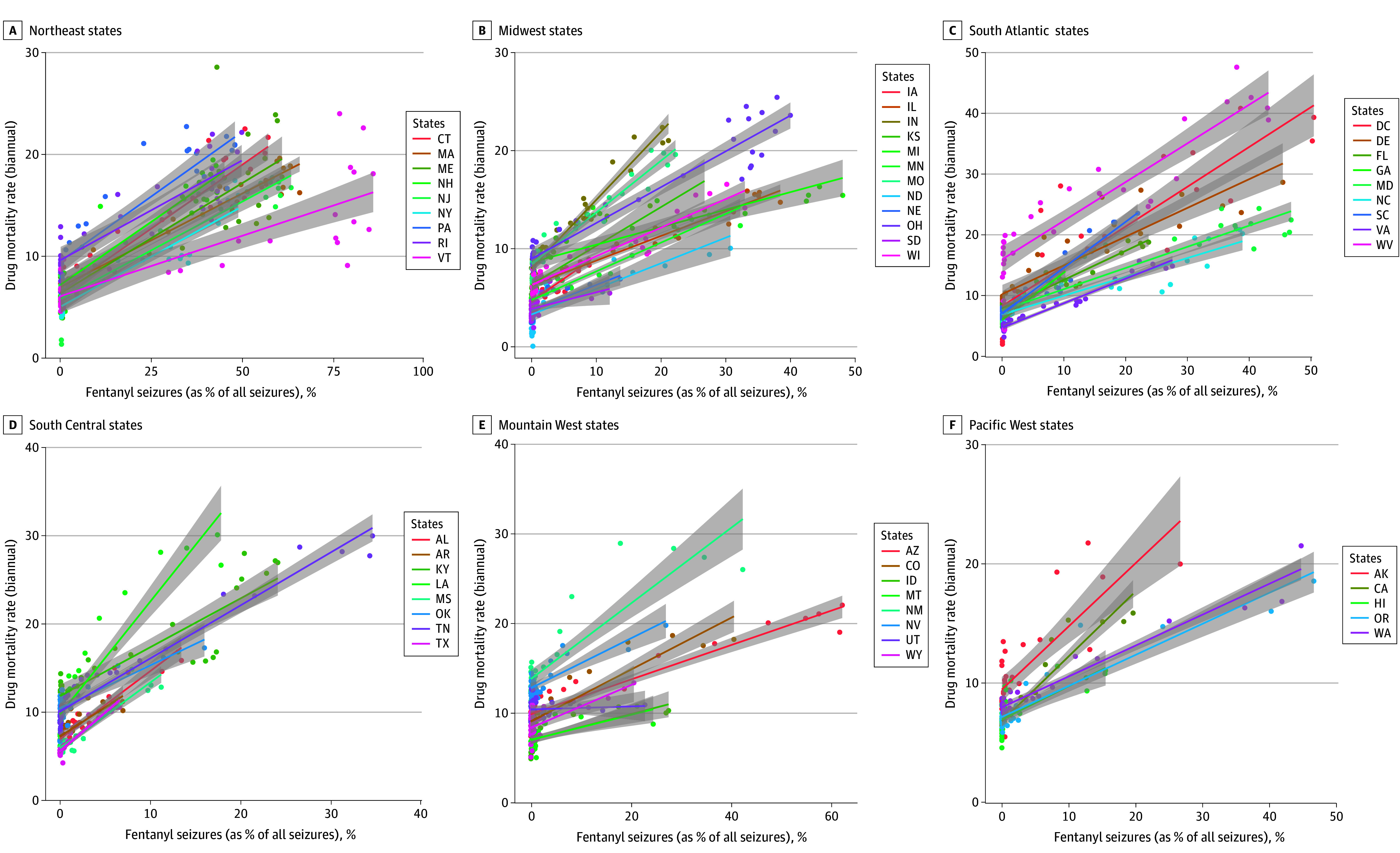
DESIGN, SETTING, AND PARTICIPANTS: In this cohort study, the association between fatal overdose and enactment of M110 was analyzed using a matrix completion synthetic control method. The control group consisted of the 48 US states and Washington, DC, all of which did not decriminalize drugs. The rapid spread of fentanyl in unregulated drug markets was determined using the state-level percentage of all samples reported to the National Forensic Laboratory Information System that were identified as fentanyl or its analogues. Mortality data were obtained from the Centers for Disease Control and Prevention for January 1, 2008, to December 31, 2022. Data analysis was performed from fall 2023 through spring 2024.
Measure 110 took effect in Oregon on February 1, 2021.
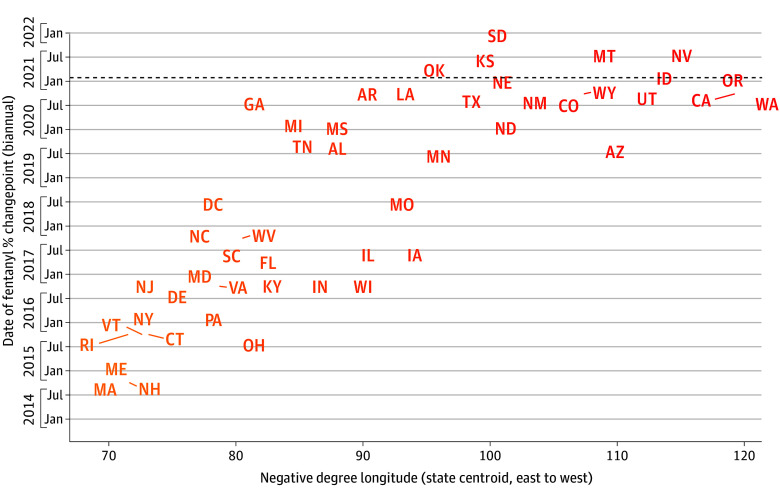
The primary outcome assessed was fatal drug overdose rates per half-year. A changepoint analysis also determined when each state experienced a rapid escalation of fentanyl in its unregulated drug market.
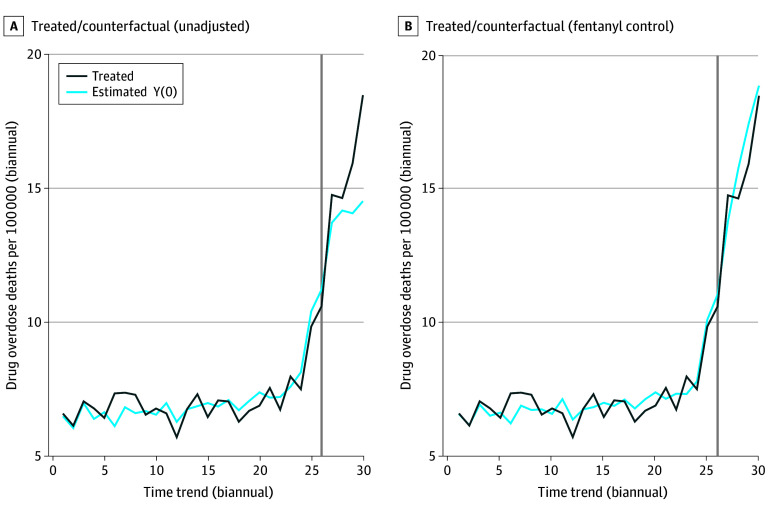
In this analysis, rapid spread of fentanyl in Oregon's unregulated drug supply occurred in the first half of 2021, contemporaneous with enactment of M110. A positive crude association was found between drug decriminalization and fatal overdose rate per 100 000 per half year (estimate [SE], 1.83 [0.47]; P < .001). After adjusting for the spread of fentanyl as a confounder, the effect size changed signs (estimate [SE], -0.51 [0.61]; P = .41) and there was no longer an association between decriminalization and overdose mortality in Oregon. Sensitivity analyses were consistent with this result.
In this cohort study of fatal drug overdose and the spread of fentanyl through Oregon's unregulated drug market, no association between M110 and fatal overdose rates was observed. Future evaluations of the health effects of drug policies should account for changes in the composition of unregulated drug markets.
随着 2021 年第 110 号措施(M110)的实施,俄勒冈州成为美国第一个将个人使用的任何毒品的少量毒品合法化的州。迄今为止,尚无分析表明这项法律与过量死亡率之间存在关联,也没有充分说明芬太尼的引入——一种已知会导致致命过量的物质——与俄勒冈州不受监管的毒品市场之间的关联。
评估在俄勒冈州将持有毒品合法化后,是否与在考虑到芬太尼在俄勒冈州不受监管的毒品市场迅速传播的情况下,与致命药物过量率的变化有关。
设计、地点和参与者:在这项队列研究中,使用矩阵补全合成控制法分析了致命药物过量与 M110 颁布之间的关联。对照组由美国 48 个州和华盛顿特区组成,这些州都没有将毒品合法化。通过国家法医实验室信息系统报告的所有样本中被确定为芬太尼或其类似物的比例来确定不受监管的毒品市场中芬太尼的快速传播。死亡率数据来自疾病控制与预防中心,时间为 2008 年 1 月 1 日至 2022 年 12 月 31 日。数据分析于 2023 年秋季至 2024 年春季进行。
第 110 号措施于 2021 年 2 月 1 日在俄勒冈州生效。
评估的主要结果是每半年的致命药物过量率。一个转折点分析还确定了每个州的不受监管的毒品市场中芬太尼迅速增加的时间。
在这项分析中,俄勒冈州不受监管的毒品供应中的芬太尼迅速传播发生在 2021 年上半年,与 M110 的颁布同时发生。药物合法化与每 10 万分之每半年致命药物过量率之间存在正的粗关联(估计值 [SE],1.83 [0.47];P<0.001)。在调整了芬太尼传播作为混杂因素后,效应大小发生了变化(估计值 [SE],-0.51 [0.61];P=0.41),俄勒冈州的药物合法化与过量死亡率之间不再存在关联。敏感性分析结果与此一致。
在这项关于致命药物过量和芬太尼通过俄勒冈州不受监管的毒品市场传播的队列研究中,没有发现 M110 与致命药物过量率之间的关联。未来对毒品政策健康影响的评估应考虑不受监管的毒品市场成分的变化。