Division of Computing, Analytics and Mathematics, Department of Mathematics and Statistics, School of Science and Engineering, University of Missouri, Kansas City, MO, United States of America.
Department of Statistics, Comilla University, Cumilla, Bangladesh.
PLoS One. 2024 Sep 5;19(9):e0309869. doi: 10.1371/journal.pone.0309869. eCollection 2024.
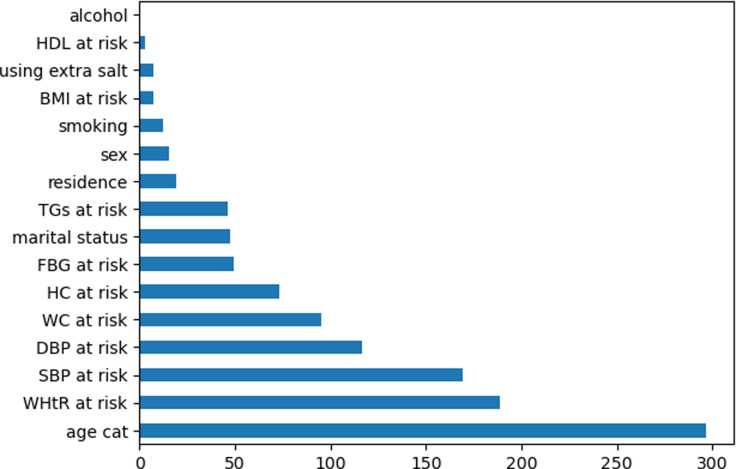
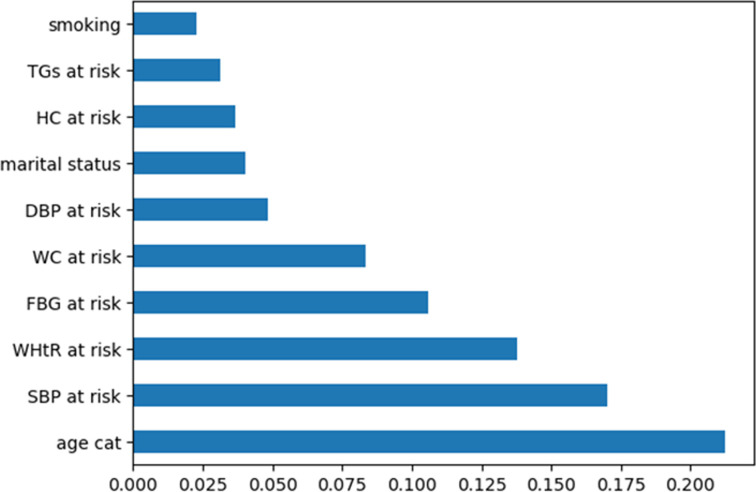
Metabolic syndrome (MetS) is a cluster of interconnected metabolic risk factors, including abdominal obesity, high blood pressure, and elevated fasting blood glucose levels, that result in an increased risk of heart disease and stroke. In this research, we aim to identify the risk factors that have an impact on MetS in the Bangladeshi population. Subsequently, we intend to construct predictive machine learning (ML) models and ultimately, assess the accuracy and reliability of these models. In this particular study, we utilized the ATP III criteria as the basis for evaluating various health parameters from a dataset comprising 8185 participants in Bangladesh. After employing multiple ML algorithms, we identified that 27.8% of the population exhibited a prevalence of MetS. The prevalence of MetS was higher among females, accounting for 58.3% of the cases, compared to males with a prevalence of 41.7%. Initially, we identified the crucial variables using Chi-Square and Random Forest techniques. Subsequently, the obtained optimal variables are employed to train various models including Decision Trees, Random Forests, Support Vector Machines, Extreme Gradient Boosting, K-nearest neighbors, and Logistic Regression. Particularly we employed the ATP III criteria, which utilizes the Waist-to-Height Ratio (WHtR) as an anthropometric index for diagnosing abdominal obesity. Our analysis indicated that Age, SBP, WHtR, FBG, WC, DBP, marital status, HC, TGs, and smoking emerged as the most significant factors when using Chi-Square and Random Forest analyses. However, further investigation is necessary to evaluate its precision as a classification tool and to improve the accuracy of all classifiers for MetS prediction.
代谢综合征(MetS)是一组相互关联的代谢危险因素,包括腹部肥胖、高血压和空腹血糖水平升高,这些因素会增加患心脏病和中风的风险。在这项研究中,我们旨在确定对孟加拉国人群代谢综合征有影响的风险因素。随后,我们打算构建预测机器学习(ML)模型,并最终评估这些模型的准确性和可靠性。在这项特定的研究中,我们使用 ATP III 标准作为评估来自孟加拉国 8185 名参与者的数据集的各种健康参数的基础。在使用多种 ML 算法后,我们确定有 27.8%的人口存在代谢综合征的患病率。代谢综合征的患病率在女性中较高,占 58.3%,而男性的患病率为 41.7%。最初,我们使用卡方检验和随机森林技术确定了关键变量。随后,使用获得的最佳变量来训练各种模型,包括决策树、随机森林、支持向量机、极端梯度提升、K-最近邻和逻辑回归。特别是,我们使用了 ATP III 标准,该标准使用腰高比(WHtR)作为诊断腹部肥胖的人体测量指标。我们的分析表明,年龄、SBP、WHtR、FBG、WC、DBP、婚姻状况、HC、TGs 和吸烟在使用卡方检验和随机森林分析时是最重要的因素。然而,需要进一步研究来评估其作为分类工具的精度,并提高所有用于代谢综合征预测的分类器的准确性。