Department of Public Health, Leuven Institute for Healthcare Policy, KU Leuven-University of Leuven, Leuven, Belgium.
Department of Neurosciences, Experimental Neurology, KU Leuven-University of Leuven, Leuven, Belgium.
Eur J Neurol. 2024 Dec;31(12):e16417. doi: 10.1111/ene.16417. Epub 2024 Sep 5.
Guidelines help physicians to provide optimal care for stroke patients, but implementation is challenging due to the quantity of recommendations. Therefore a practical overview related to applicability of recommendations can be of assistance.
A systematic review was performed on ischaemic stroke guidelines published in scientific journals, covering the whole acute care process for patients with ischaemic stroke. After data extraction, experts rated the recommendations on dimensions of applicability, that is, actionability, feasibility and validity, on a 9-point Likert scale. Agreement was defined as a score of ≥8 by ≥80% of the experts.
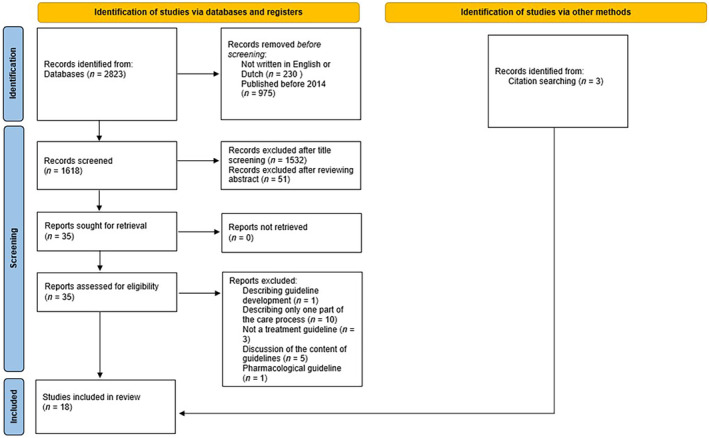
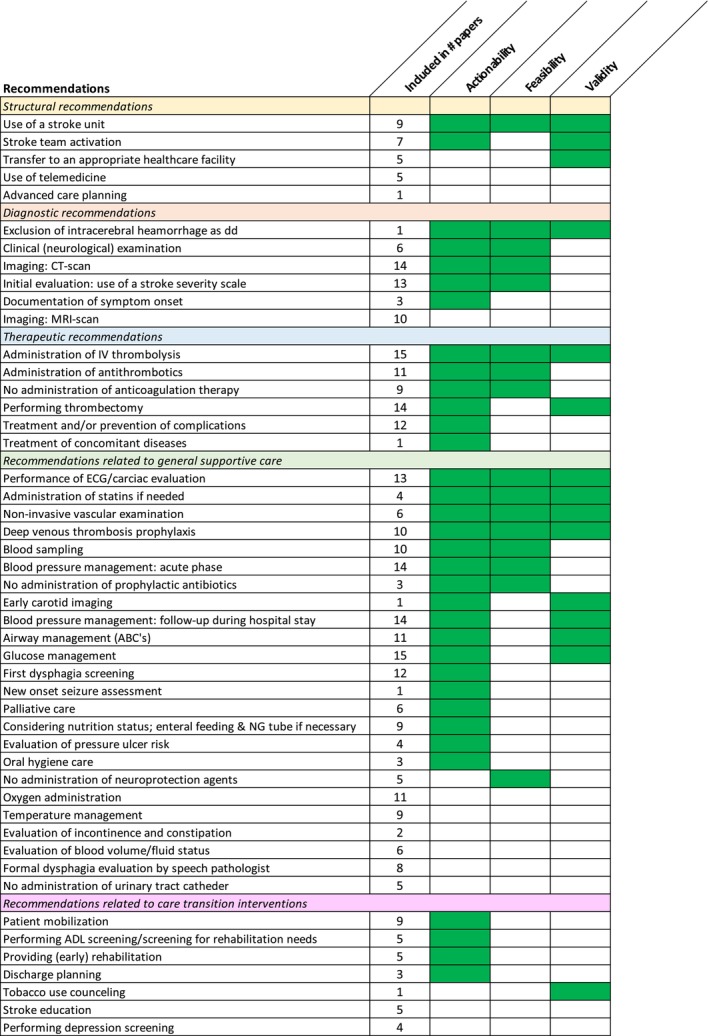
Eighteen articles were identified and 48 recommendations were ultimately extracted. Papers were included only if they described the whole acute care process for patients with ischaemic stroke. Data extraction and analysis revealed variation in terms of both content and comprehensiveness of this description. Experts reached agreement on 34 of 48 (70.8%) recommendations in the dimension actionability, for 16 (33.3%) in feasibility and for 15 (31.3%) in validity. Agreement on all three dimensions was reached for seven (14.6%) recommendations: use of a stroke unit, exclusion of intracerebral haemorrhage as differential diagnosis, administration of intravenous thrombolysis, performance of electrocardiography/cardiac evaluation, non-invasive vascular examination, deep venous thrombosis prophylaxis and administration of statins if needed.
Substantial variation in agreement was revealed on the three dimensions of the applicability of recommendations. This overview can guide stroke physicians in improving the care process and removing barriers where implementation may be hampered by validity and feasibility.
指南有助于医生为脑卒中患者提供最佳护理,但由于推荐意见数量众多,实施起来具有挑战性。因此,相关实用性概述可能有助于适用性建议。
对发表在科学期刊上的缺血性脑卒中指南进行了系统评价,涵盖了缺血性脑卒中患者整个急性护理过程。提取数据后,专家们根据可操作性、可行性和有效性等维度对推荐意见进行了 9 分李克特量表评分。专家评分≥8 且≥80%的为达成一致。
共确定了 18 篇文章,最终提取了 48 条建议。只有描述缺血性脑卒中患者整个急性护理过程的论文才被纳入。数据提取和分析显示,在描述内容和全面性方面存在差异。在可操作性维度上,专家们对 48 条建议中的 34 条(70.8%)达成一致,在可行性维度上达成一致的有 16 条(33.3%),在有效性维度上达成一致的有 15 条(31.3%)。在三个维度上均达成一致的有 7 条(14.6%):使用卒中单元、排除颅内出血作为鉴别诊断、静脉溶栓治疗、心电图/心脏评估、非侵入性血管检查、深静脉血栓形成预防以及需要时给予他汀类药物。
在推荐意见的可操作性、可行性和有效性三个维度上,专家的意见存在显著差异。本综述可指导脑卒中医生改善护理流程,并在有效性和可行性可能阻碍实施的地方消除障碍。