Department of Biostatistics, University of Washington, Seattle, WA, USA.
Janssen Vaccines & Prevention BV, Leiden, the Netherlands.
EBioMedicine. 2024 Oct;108:105320. doi: 10.1016/j.ebiom.2024.105320. Epub 2024 Sep 4.
The HVTN 705 Imbokodo trial of 2636 people without HIV and assigned female sex at birth, conducted in southern Africa, evaluated a heterologous HIV-1 vaccine regimen: mosaic adenovirus 26-based vaccine (Ad26.Mos4.HIV) at Months 0, 3, 6, 12 and alum-adjuvanted clade C gp140 at Months 6, 12. Per-protocol vaccine efficacy (VE) against HIV-1 diagnosis from seven to 24 months was 14.1% (95% CI: -22.0% to 39.5%). Immune correlates analysis was performed for markers selected based on prior evidence in efficacy trials and/or nonhuman primate models.
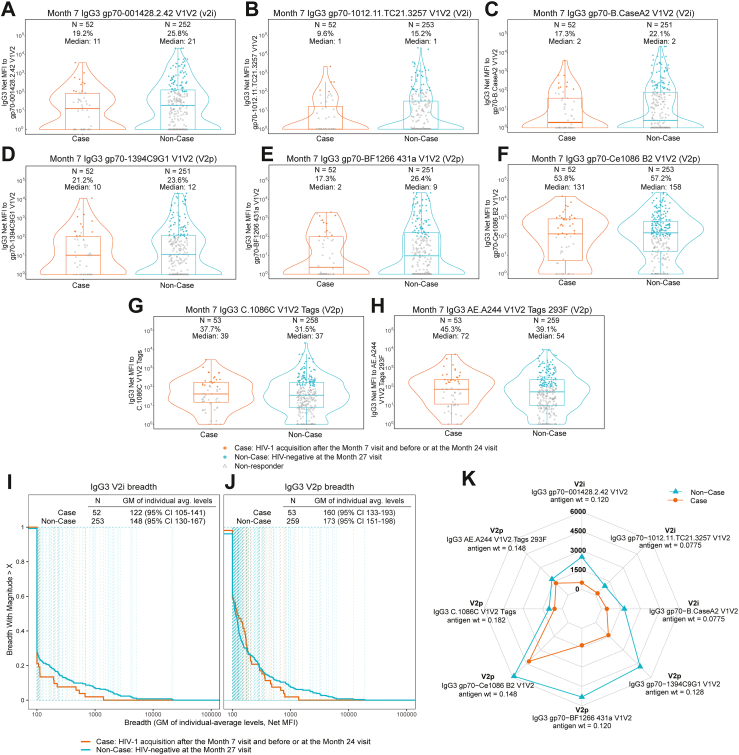
Humoral and cellular immune response markers at Month 7 were evaluated as immune correlates of risk and of protection in a breakthrough case-control cohort (n = 52 cases, 246 non-cases). Primary markers were IgG binding to vaccine-strain gp140, IgG3 binding to diverse Env antigens (IgG3 Env breadth), IgG3 binding to diverse V1V2 antigens (IgG3 V1V2 breadth), antibody-dependent phagocytosis against the vaccine-strain gp140, Env-specific CD4+ and CD8+ T-cell responses, and multi-epitope functions.
No immune markers were statistically significant correlates of risk. IgG3 V1V2 breadth trended toward an inverse association: hazard ratio 0.70 (95% CI: 0.36 to 1.35; p = 0.29) per 10-fold increase and 0.51 (95% CI: 0.21 to 1.24; p = 0.14) in a Cox model with all primary markers. The VE estimate was 11.8% (95% CI: -17.9% to 34.0%) at all IgG3 V1V2 breadth values below 667 weighted geometric mean net MFI; just above this value, the VE estimate sharply increased to 62.6% (95% CI: -17.9% to 89.6%), and further increased to 80.9% (95% CI: -17.9% to 99.5%) at 1471 MFI, the 95th percentile of the marker distribution. Mediation analysis yielded a VE of 35.7% (95% CI: 15.0% to 51.3%) attributable to the vaccine's impact on this marker.
The trend in association of greater IgG3 V1V2 antibody breadth with lower likelihood of HIV acquisition is consistent with the identification of antibodies against V1V2 as immune correlates in three other HIV vaccine efficacy trials and suggests that a greater emphasis should be placed on studying this region in the HIV-1 envelope as a vaccine immunogen.
National Institute of Allergy and Infectious Diseases and Janssen Vaccines & Prevention BV.
在南部非洲开展的 2636 名无 HIV 且出生时被指定为女性的 HVTN 705 Imbokodo 试验中,评估了一种异源 HIV-1 疫苗方案:基于腺病毒 26 的马赛克疫苗(Ad26.Mos4.HIV)在 0、3、6、12 个月,以及在 6、12 个月时用铝佐剂增强的 clade C gp140。7 至 24 个月时针对 HIV-1 诊断的按方案疫苗效力(VE)为 14.1%(95%CI:-22.0%至 39.5%)。基于先前在疗效试验和/或非人类灵长类动物模型中获得的证据,对标记物进行了免疫相关性分析。
在一个突破病例对照队列(n=52 例病例,246 例非病例)中,评估了第 7 个月的体液和细胞免疫反应标记物,作为风险和保护的免疫相关性。主要标记物是针对疫苗株 gp140 的 IgG 结合、针对多种Env 抗原的 IgG3 结合(IgG3Env 广度)、针对多种 V1V2 抗原的 IgG3 结合(IgG3V1V2 广度)、针对疫苗株 gp140 的抗体依赖性吞噬作用、Env 特异性 CD4+和 CD8+T 细胞反应以及多种表位功能。
没有免疫标记物是风险的统计学显著相关性。IgG3V1V2 广度呈负相关趋势:每增加 10 倍,危险比为 0.70(95%CI:0.36 至 1.35;p=0.29),在 Cox 模型中,所有主要标记物的危险比为 0.51(95%CI:0.21 至 1.24;p=0.14)。在所有 IgG3V1V2 广度值低于 667 加权几何平均净 MFI 时,VE 估计值为 11.8%(95%CI:-17.9%至 34.0%);就在这个值之上,VE 估计值急剧增加至 62.6%(95%CI:-17.9%至 89.6%),进一步增加至 80.9%(95%CI:-17.9%至 99.5%),在标记物分布的第 95 个百分位数为 1471 MFI。中介分析得出的 VE 为 35.7%(95%CI:15.0%至 51.3%),归因于疫苗对该标记物的影响。
与其他三项 HIV 疫苗疗效试验中鉴定出针对 V1V2 的抗体作为免疫相关性的趋势一致,IgG3 V1V2 抗体广度与 HIV 获得性降低的关联呈负相关,这表明应该更加重视研究 HIV-1 包膜中的这一区域作为疫苗免疫原。
国家过敏和传染病研究所和杨森疫苗和预防公司。