Nursing Administration Department, College of Nursing, University of Hail, Hail, Saudi Arabia.
Medical Surgical Nursing Department, College of Nursing, University of Hail, Hail, Saudi Arabia
BMJ Open. 2024 Sep 5;14(9):e084741. doi: 10.1136/bmjopen-2024-084741.
This study aimed to assess nurses' perceptions of patient safety culture (PSC) and its relationship with adverse events in Hail City, Saudi Arabia.
A cross-sectional study was conducted between 1 August 2023 and the end of November 2023 at 4 governmental hospitals and 28 primary healthcare centres.
Hail City, Saudi Arabia.
Data were collected from 336 nurses using 3 instruments: demographic and work-related questions, PSC and adverse events.
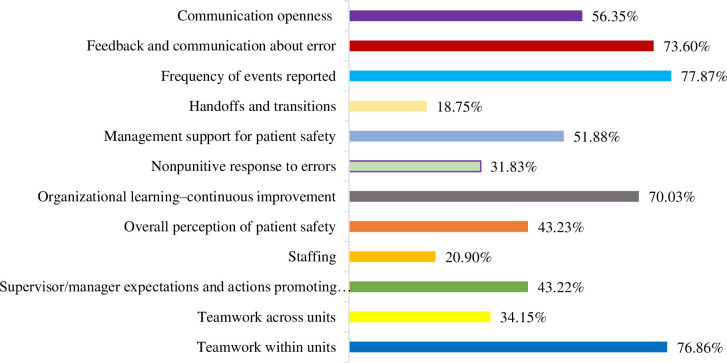
Nurses had positive responses in the dimensions of 'teamwork within units' (76.86%) and 'frequency of events reported' (77.87%) but negative responses in the dimensions of 'handoffs and transitions' (18.75%), 'staffing' (20.90%), 'non-punitive response to errors' (31.83%), 'teamwork across units' (34.15%), 'supervisor/manager expectations' (43.22%) and 'overall perception of patient safety' (43.23%). Significant associations were found between nationality, experience, current position and total safety culture, with p values of 0.015, 0.046 and 0.027, respectively. Nurses with high-ranking perceptions of PSC in 'handoffs and transitions,' 'staffing' and 'teamwork across hospital units' reported a lower incidence of adverse events than those with low-ranking perceptions, particularly in reporting pressure ulcers (OR 0.86, 95% CI 0.78 to 0.94, OR 0.82, 95% CI 0.71 to 0.94 and OR 0.83, 95% CI 0.70 to 0.99, respectively) (p<0.05). Nurses with high-ranking perceptions of PSC in UK 'handoffs and transitions' reported a lower incidence of patient falls. Similarly, those with high-ranking perceptions in both 'handoffs and transitions' and 'overall perception of patient safety reported a lower incidence of adverse events compared with those with low-ranking perceptions, especially in reporting adverse drug events (OR 0.83, 95% CI 0.76 to 0.91 and OR 0.75, 95% CI 0.61 to 0.92, respectively) (p<0.05).
From a nursing perspective, hospital PSCs have both strengths and weaknesses. Examples include low trust in leadership, staffing, error-reporting and handoffs. Therefore, to improve staffing, communication, handoffs, teamwork, and leadership, interventions should focus on weak areas of low confidence and high rates of adverse events.
本研究旨在评估沙特海尔市护士对患者安全文化(PSC)的认知及其与不良事件的关系。
2023 年 8 月 1 日至 11 月 30 日期间,在 4 家政府医院和 28 家初级保健中心进行了横断面研究。
沙特海尔市。
使用 3 种工具收集了 336 名护士的数据:人口统计学和工作相关问题、PSC 和不良事件。
护士在“单位内团队合作”(76.86%)和“报告事件的频率”(77.87%)维度上有积极的反应,但在“交接和过渡”(18.75%)、“人员配置”(20.90%)、“对错误的非惩罚性反应”(31.83%)、“单位间团队合作”(34.15%)、“主管/经理期望”(43.22%)和“整体患者安全感知”(43.23%)维度上有消极的反应。国籍、经验、现职与总体安全文化之间存在显著相关性,p 值分别为 0.015、0.046 和 0.027。在“交接和过渡”、“人员配备”和“医院间团队合作”方面对 PSC 有较高认知的护士报告的不良事件发生率低于认知较低的护士,特别是在报告压疮方面(OR 0.86,95%CI 0.78 至 0.94,OR 0.82,95%CI 0.71 至 0.94 和 OR 0.83,95%CI 0.70 至 0.99,分别)(p<0.05)。在 UK“交接和过渡”方面对 PSC 有较高认知的护士报告的患者跌倒发生率较低。同样,在“交接和过渡”和“整体患者安全感知”方面认知较高的护士报告的不良事件发生率低于认知较低的护士,尤其是在报告药物不良事件方面(OR 0.83,95%CI 0.76 至 0.91 和 OR 0.75,95%CI 0.61 至 0.92,分别)(p<0.05)。
从护理角度来看,医院 PSC 既有优势也有劣势。例如,对领导、人员配置、错误报告和交接的信任度较低。因此,为了改善人员配置、沟通、交接、团队合作和领导力,干预措施应侧重于信心较低和不良事件发生率较高的薄弱领域。