Cole Megan F, Barnes Paige, Monroe Isabelle G, Rukundo Joshua, Emery Thompson Melissa, Rosati Alexandra G
Department of Anthropology, University of New Mexico, Albuquerque, NM, USA.
Department of Psychology, University of Michigan, Ann Arbor, MI, USA.
Evol Med Public Health. 2024 Jun 19;12(1):129-142. doi: 10.1093/emph/eoae010. eCollection 2024.
Lifestyle has widespread effects on human health and aging. Prior results from chimpanzees (), one of humans' closest evolutionary relatives, indicate that these lifestyle effects may also be shared with other species, as semi-free-ranging chimpanzees fed a naturalistic diet show healthier values in several specific health biomarkers, compared with their sedentary, captive counterparts. Here, we examined how lifestyle factors associated with different environments affect rates of physiological aging in closely related chimpanzees.
We compared physiological dysregulation, an index of biological aging, in semi-free-ranging chimpanzees in an African sanctuary versus captive chimpanzees in US laboratories. If the rate of aging is accelerated by high-calorie diet and sedentism, we predicted greater age-related dysregulation in the laboratory populations. Conversely, if costs of a wild lifestyle accelerate aging, then semi-free-ranging chimpanzees at the sanctuary, whose environment better approximates the wild, should show greater age-related dysregulation. We further tested whether dysregulation differed based on sex or body system, as in humans.
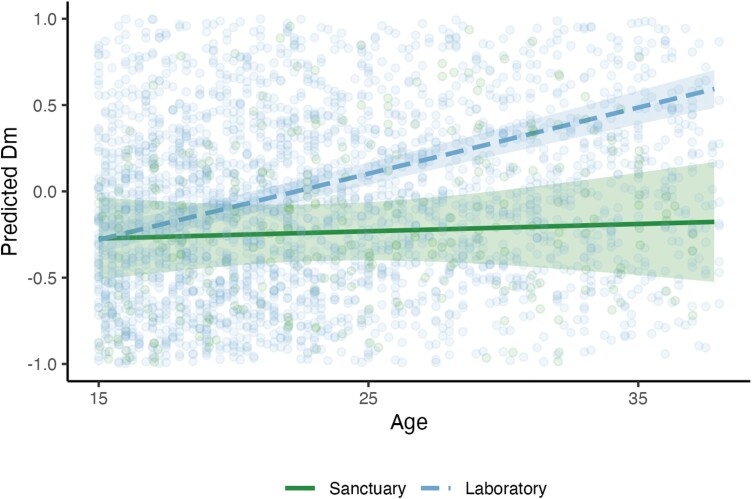
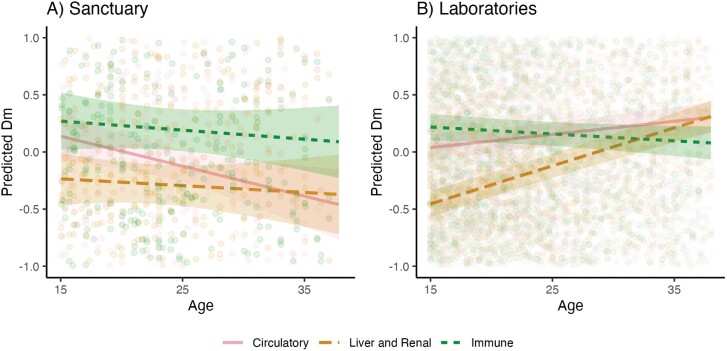
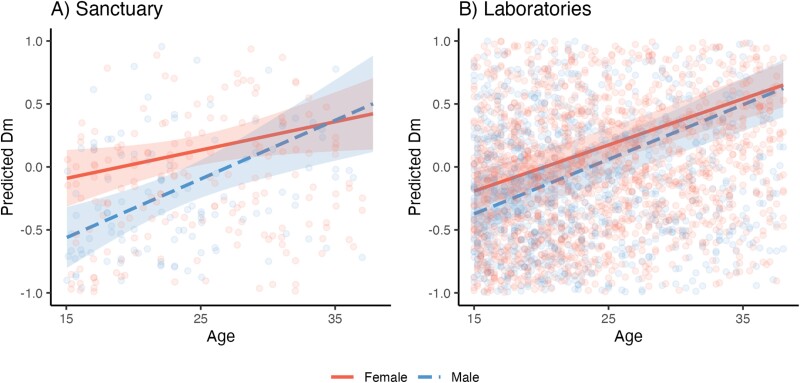
We found that semi-free-ranging chimpanzees showed lower overall dysregulation, as well as lower age-related change in dysregulation, than laboratory chimpanzees. Males experienced lower dysregulation than females in both contexts, and the two populations exhibited distinct aging patterns based on body system.
Our results support the conclusion that naturalistic living conditions result in healthier aging in chimpanzees. These data provide support for the proposal that lifestyle effects on human health and aging are conserved from deeper into our evolutionary history.
生活方式对人类健康和衰老有着广泛影响。人类最亲近的进化近亲之一黑猩猩先前的研究结果表明,这些生活方式的影响可能也适用于其他物种,因为与久坐圈养的黑猩猩相比,以自然饮食喂养的半散养黑猩猩在几种特定的健康生物标志物方面显示出更健康的值。在此,我们研究了与不同环境相关的生活方式因素如何影响亲缘关系密切的黑猩猩的生理衰老速率。
我们比较了非洲保护区内半散养黑猩猩与美国实验室中圈养黑猩猩的生理失调情况,生理失调是生物衰老的一个指标。如果高热量饮食和久坐不动会加速衰老,我们预测实验室群体中与年龄相关的失调会更严重。相反,如果野生生活方式的代价会加速衰老,那么保护区内环境更接近野生的半散养黑猩猩应该会表现出更严重的与年龄相关的失调。我们还像在人类研究中那样,进一步测试了失调是否因性别或身体系统而异。
我们发现,与实验室黑猩猩相比,半散养黑猩猩的总体失调程度较低,且与年龄相关的失调变化也较小。在两种情况下,雄性的失调程度都低于雌性,并且这两个群体基于身体系统表现出不同的衰老模式。
我们的结果支持这样的结论,即自然的生活条件会使黑猩猩更健康地衰老。这些数据为以下观点提供了支持,即生活方式对人类健康和衰老的影响在我们进化历史的更深处就已存在。