Nikishev Nikita, Medvedev Nikita
Institute of Physics, Czech Academy of Sciences, Na Slovance 1999/2, Prague 8 182 00, Czech Republic.
Faculty of Nuclear Sciences and Physical Engineering, Czech Technical University in Prague, Břehová 7, Prague 1 115 19, Czech Republic.
J Phys Chem B. 2024 Sep 19;128(37):9036-9042. doi: 10.1021/acs.jpcb.4c04126. Epub 2024 Sep 6.
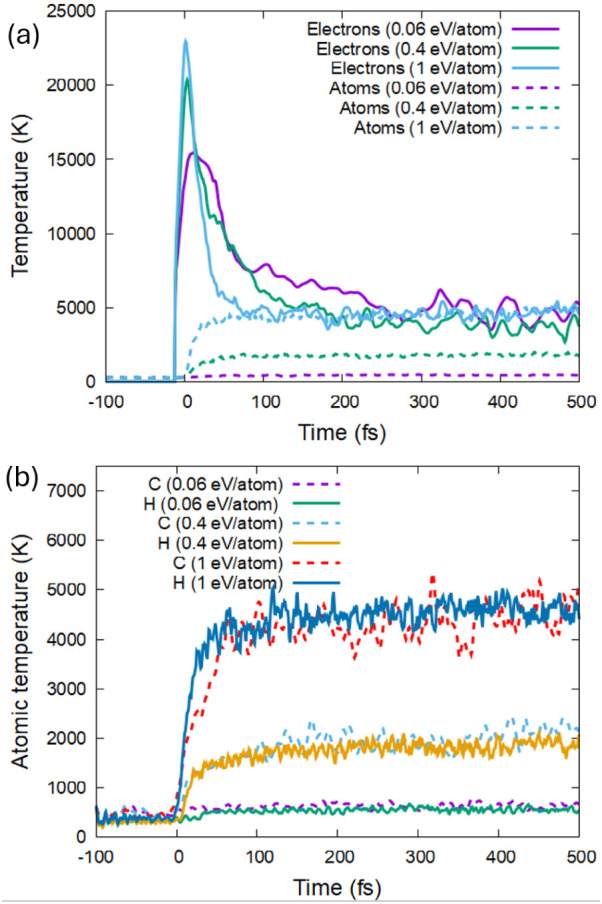
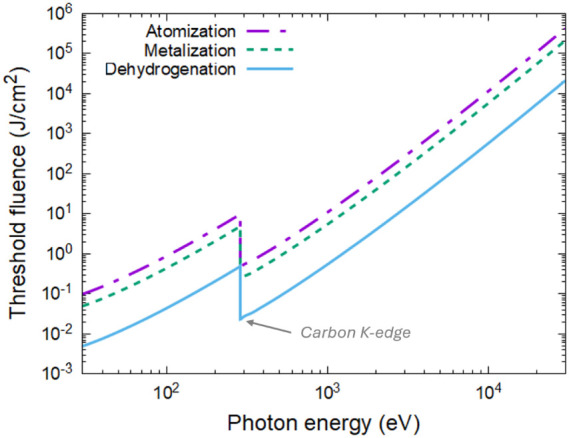
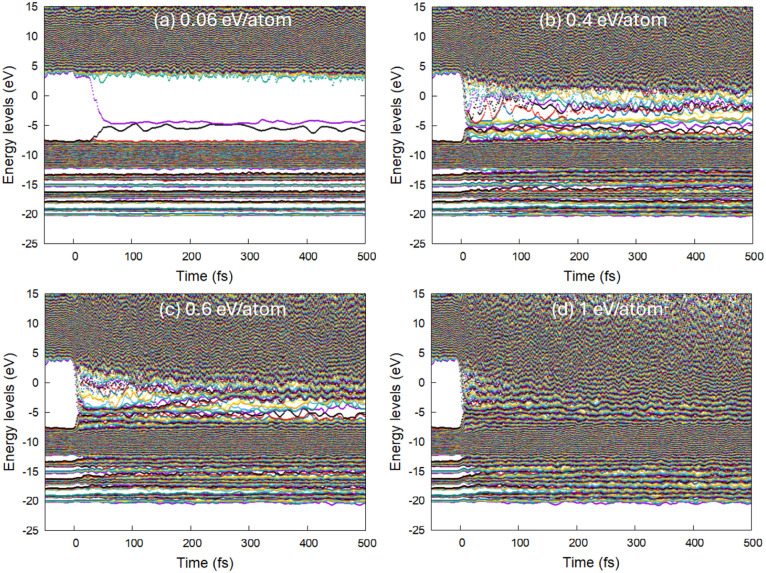
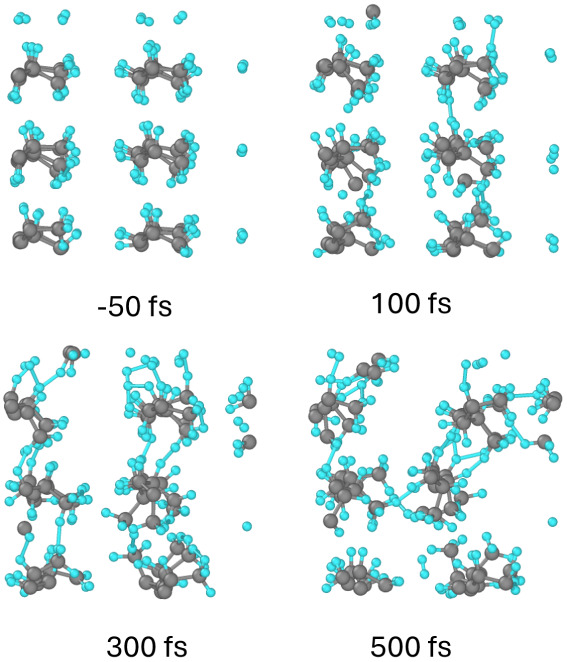
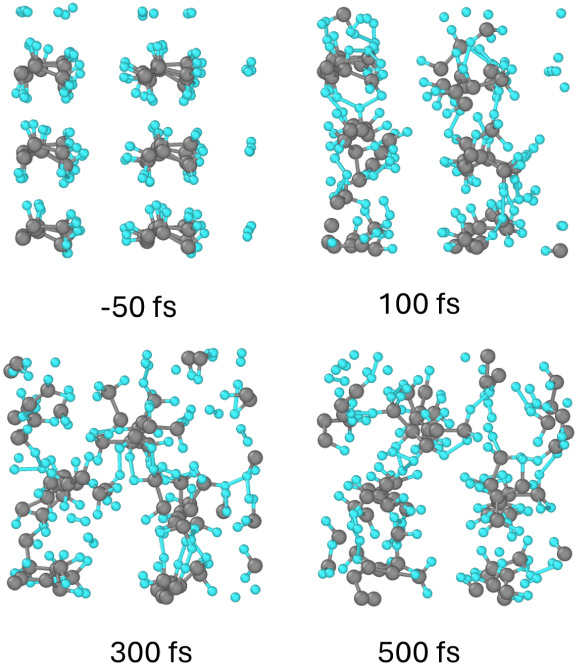
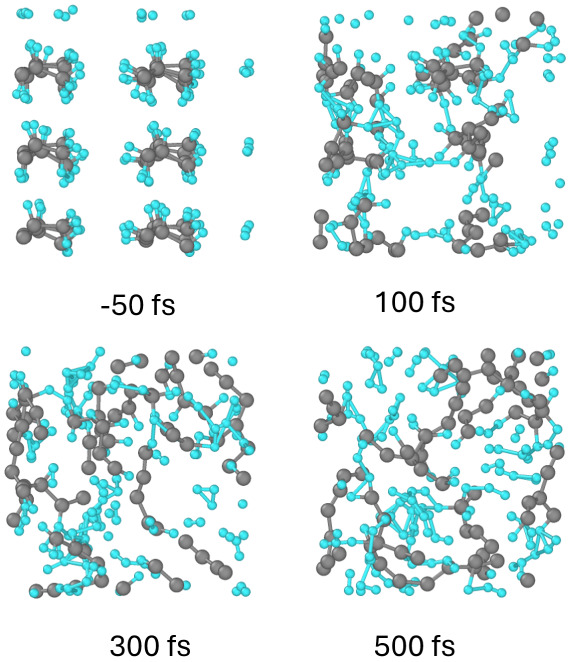
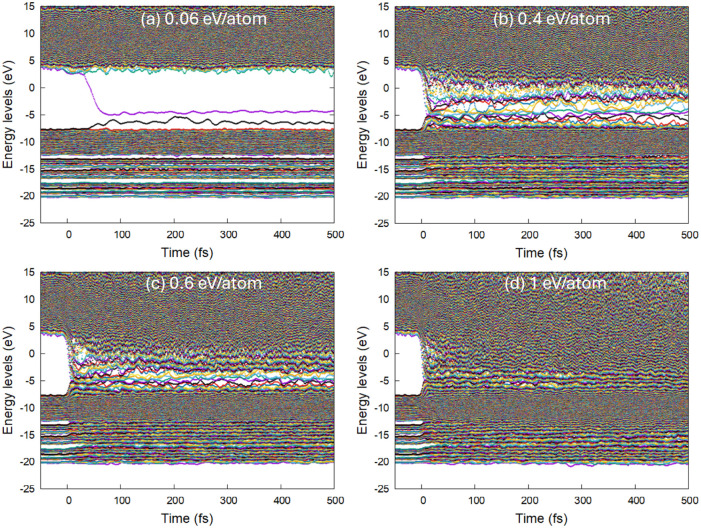
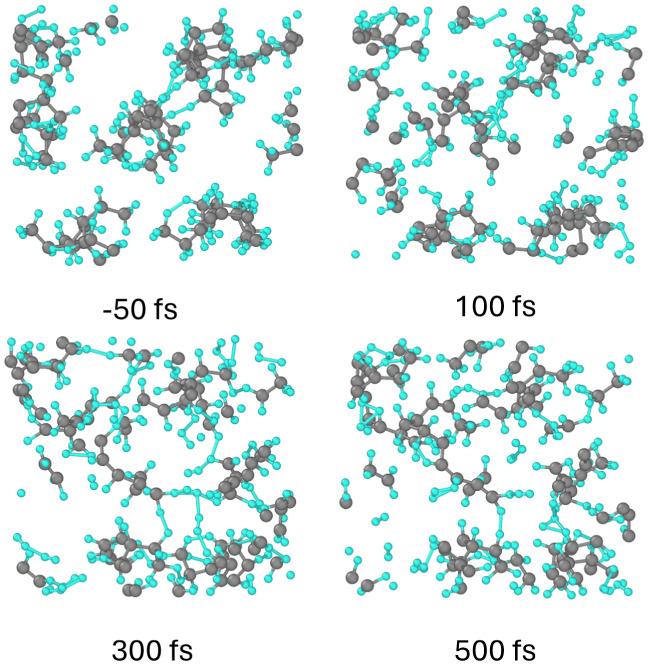
Although polymers are widely used in laser-irradiation research, their microscopic response to high-intensity ultrafast XUV and X-ray irradiation is still largely unknown. Here, we comparatively study a homologous series of alkenes. The XTANT-3 hybrid simulation toolkit is used to determine their damage kinetics and irradiation threshold doses. The code simultaneously models the nonequilibrium electron kinetics, the energy transfer between electrons and atoms via nonadiabatic electron-ion (electron-phonon) coupling, nonthermal modification of the interatomic potential due to electronic excitation, and the ensuing atomic response and damage formation. It is shown that the lowest damage threshold is associated with local defect creation, such as dehydrogenation, various group detachments from the backbone, or polymer strand cross-linking. At higher doses, the disintegration of the molecules leads to a transient metallic liquid state: a nonequilibrium superionic state outside of the material phase diagram. We identify nonthermal effects as the leading mechanism of damage, whereas the thermal (nonadiabatic electron-ion coupling) channel influences the kinetics only slightly in the case of femtosecond-pulse irradiation. Despite the notably different properties of the studied alkene polymers, the ultrafast-X-ray damage threshold doses are found to be very close to ∼0.05 eV/atom in all three materials: polyethylene, polypropylene, and polybutylene.
尽管聚合物在激光辐照研究中被广泛使用,但其对高强度超快极紫外光和X射线辐照的微观响应仍很大程度上未知。在此,我们对一系列同系烯烃进行了比较研究。使用XTANT-3混合模拟工具包来确定它们的损伤动力学和辐照阈值剂量。该代码同时对非平衡电子动力学、通过非绝热电子-离子(电子-声子)耦合实现的电子与原子间的能量转移、由于电子激发导致的原子间势的非热改性以及随之而来的原子响应和损伤形成进行建模。结果表明,最低损伤阈值与局部缺陷的产生有关,如脱氢、主链上各种基团的脱离或聚合物链的交联。在更高剂量下,分子的分解导致一种瞬态金属液态:一种处于材料相图之外的非平衡超离子态。我们确定非热效应是损伤的主要机制,而在飞秒脉冲辐照情况下,热(非绝热电子-离子耦合)通道对动力学的影响仅略微。尽管所研究的烯烃聚合物性质明显不同,但在聚乙烯、聚丙烯和聚丁烯这三种材料中,超快X射线损伤阈值剂量均非常接近约0.05 eV/原子。